Feminism and the Tunisian Revolution · CHAPTER 11 ·
Terrorism in Tunisia
Chapter 11 of Protest and Change: Second-Wave Feminism and Tunisia, 1945–2015: “Terrorism and Fragility”
After 2011 the jihadist group Ansar al-Sharia recruited in poor suburbs and interior towns; its supporters attacked the US embassy in September 2012 and members were linked to the 2013 murders of two left-wing politicians. Libya’s collapse supplied weapons and camps, and attacks in 2015 brought back emergency rule.
Chapter 11 is part of membership. WW2 is free — every chapter. Try chapters 1–2 of any 2 other atlases (3 with a free account). Opening a new atlas uses one of them. Membership opens all 21 — Join.
Free printable Feminism and the Tunisian Revolution study guide, sent by email ↓
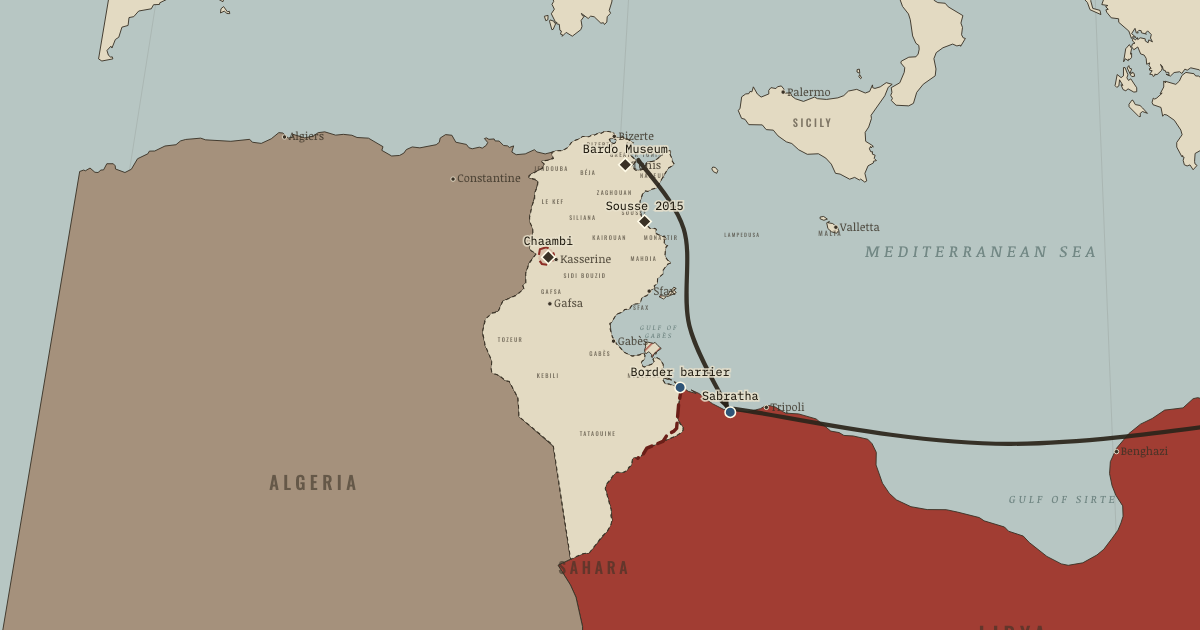
The map above is the world of Tunisia, July 2015 — After Sousse: the state of emergency.
Part of IB History: Second-wave feminism and Tunisia →
BRIEF EXPLANATION — THE ESSENTIAL ARGUMENT
The freedoms won in 2011 also opened space for jihadism, an armed movement that seeks to impose its own version of Islamic rule by violence, such as al-Qaeda and the Islamic State. After decades of repression, Salafist groups, which call for a return to the practices of the earliest Muslims, preached openly, and the most militant, Ansar al-Sharia (“Supporters of Islamic Law”), recruited in poor suburbs and interior towns. Its supporters attacked the US embassy in September 2012, and its members were linked to the murders in 2013 of two left-wing politicians, Chokri Belaïd and Mohamed Brahmi. They were also linked to an insurgency, a guerrilla campaign against the state, in the Mount Chaambi range, where eight soldiers were killed in an ambush in July 2013; a memorial marks the place on the map. Next door, Libya’s collapse provided weapons and training camps. By 2015 the United Nations estimated that about 5,500 Tunisians had joined jihadist groups in Syria, Iraq and Libya, one of the largest contingents from any country, so the most successful democracy of the Arab uprisings was also one of jihadism’s largest recruiting grounds.
Jihadists then struck at the economy on which the democratic transition depended, and in 2015 they hit its most exposed part, tourism. On 18 March two gunmen killed 21 foreign visitors and a Tunisian police officer at the Bardo Museum, and on 26 June a gunman killed 38 people, 30 of them British, on a beach near Sousse. The attackers had trained in Libya, and both attacks are memorials on the map. Tourism receipts fell by about a third, and the government began building a barrier along the Libyan border, drawn on the map as a dashed red line. On 4 July it declared the state of emergency that hatches the map, a legal regime that lets the government ban gatherings and strikes and confine people without trial, like the emergency powers some democracies use after a disaster. Three months later the Nobel Peace Prize went to the Quartet, the four civil-society organisations led by the UGTT union federation that had brokered the 2013 compromise. In November, seven weeks after the emergency was lifted, a bomb killed twelve presidential guards and the emergency returned. Democracy survived, but the methods used to defend it revived some of the powers the revolution had fought against.
The full story
Jihadism grew after 2011 because the revolution removed the police state faster than it built a new state. Three words need separating: Islamists, such as Ennahda, the party that led the 2011 government, seek to shape law through elections; Salafists want a return to the practice of the earliest Muslims; and jihadists, a small minority, use violence to impose their version of Islamic rule. A general amnesty in early 2011 freed hundreds of imprisoned Islamists, including veterans of foreign jihads. Ansar al-Sharia, founded by a veteran jihadist known as Abu Iyadh who had been freed in the amnesty, ran charities and preached in mosques whose imams had fled, recruiting unemployed young men in poor suburbs and interior towns. On 14 September 2012 its supporters stormed the US embassy compound during protests against a film insulting the Prophet, and four people were killed. Ennahda’s government designated it a terrorist organisation only in August 2013. A transition that is busy writing rules can leave gaps that armed groups fill.
Libya turned a domestic problem into a regional one, which the two arrows trace from Tunisia to the camps and onward to Syria. After Gaddafi’s fall in 2011, Libya’s weapons depots were looted and its border was barely policed, and by 2014 rival governments and militias divided the country, which is why it is red on the map. The Islamic State set up camps near Sabratha, less than 100 kilometres from the border, where Tunisian recruits trained. The UN estimated in July 2015 that about 5,500 Tunisians were fighting with jihadist groups, most of them in Syria, although estimates range from about 3,000, the government’s figure, to 6,000. Analysts disagree on why so many came from the only Arab Spring country to become a democracy, citing the frustrations of educated young men and the sudden freedom of recruiters after 2011. The open border meant that Tunisia’s security now depended on a neighbour with no functioning state.
The attacks of 2015 were designed to destroy the economy on which the transition depended, and the government’s response showed how fragile the new order was. After the Bardo Museum attack of 18 March and the killing of 38 people at Port El Kantaoui on 26 June, the state of emergency returned on 4 July, with powers to ban strikes and gatherings and to place people under house arrest. Tourism receipts fell by about 35 per cent in 2015 and about 70 hotels closed. A counter-terrorism law of July 2015 extended the death penalty to terrorist crimes and allowed detention without a lawyer for fifteen days, and work began on a barrier along the Libyan border. In October the Nobel Peace Prize was awarded to the National Dialogue Quartet, the four civil-society organisations led by the UGTT union federation that had brokered the compromise of 2013, a reminder that the transition’s greatest strength lay in negotiation. After a bombing killed twelve presidential guards on 24 November the emergency, lifted on 2 October, returned, so a democracy that had ended the revolution-era emergency in 2014 was again governing under a decree written for Bourguiba in 1978.
DEEP EXPLANATION — EVIDENCE & INTERPRETATION
Why so many Tunisians joined jihadist groups
The paradox that the only Arab Spring country to become a democracy sent one of the largest contingents of foreign fighters to Syria and Iraq has produced several explanations, and the evidence supports parts of each. Socio-economic accounts point to the profile of many recruits: young men from poor suburbs of Tunis, Bizerte and interior towns such as Kasserine and Ben Guerdane, often educated and unemployed, for whom jihad promised purpose, income and status. Political accounts stress the release of prisoners and the freedom of preachers after 2011, together with the bitterness left by Ben Ali’s repression of public religion, which enforced a ban on the headscarf in public offices and policed mosque attendance. Ideological accounts describe Salafism filling a vacuum left by the discredited official religious establishment, and network accounts emphasise recruitment through friends, prisons and particular mosques, which explains why fighters clustered in certain neighbourhoods. The numbers themselves are uncertain: the UN’s figure of about 5,500 in 2015, the 6,000 of the Soufan Group, a private security-research firm, and government estimates near 3,000 measure different things, since some count everyone who reached a conflict zone and others only fighters confirmed by intelligence services. The safest conclusion is that grievance, opportunity and networks combined, and that no single factor explains the pattern.
Defending democracy with emergency powers
The return of the state of emergency in 2015 raised a dilemma familiar to many democracies facing terrorism: measures that protect citizens can also erode the rights for which the revolution was fought. The emergency decree, inherited from a measure of 1978 issued on “Black Thursday”, the day the army crushed a general strike called by the UGTT, allowed governors to ban strikes and meetings, impose curfews, censor publications and place people under house arrest without judicial approval. The counter-terrorism law of July 2015 extended the death penalty to terrorist crimes, although Tunisia had observed a moratorium, a pause in carrying out executions, since 1991, and allowed suspects to be held for up to fifteen days without a lawyer. Human Rights Watch and Amnesty International documented arbitrary arrests, travel bans and torture in the months that followed, and police unions formed after 2011 lobbied for further powers and for immunity. Supporters of the measures argued that a state that could not protect tourists, soldiers and citizens would lose the public’s support for democracy itself. After November 2015 the emergency was renewed again and again for years, which suggests that emergency rule, once normalised, is hard to end. The episode shows that the threats to a transition can come from the response to violence as well as from violence itself.
Key places on the map
Why it happened
Freedom for preachers and recruiters. The revolution ended the surveillance of mosques and released political prisoners, including jihadist veterans, and the new government was reluctant to repress religious activists after Ennahda’s own members had suffered for decades. Salafist groups gained a freedom to preach, organise and recruit that they had never had, which they used among young men with few prospects. Some preachers banned under Ben Ali returned to their pulpits, and Salafist groups took over other mosques by force.
A security state in transition. The police, who had been the backbone of Ben Ali’s rule, were distrusted by the public and partly purged, while the army was small and inexperienced in counter-insurgency. Intelligence networks built to watch dissidents were poorly suited to tracking armed groups. A state that dismantles its repressive apparatus without building effective democratic policing in its place leaves a security gap. Officers who feared prosecution for their conduct under Ben Ali were often reluctant to take risks.
Libya’s collapse next door. The fall of Gaddafi in 2011 and Libya’s slide into civil war by 2014 created an ungoverned space within a day’s drive of Tunisian towns. Weapons were plentiful, the Islamic State held territory around Sirte and ran camps near Sabratha, and smuggling routes across the border, long tolerated because border towns depended on them, carried fighters as easily as fuel. A Tunisian recruit could reach the Libyan camps in a few hours and return almost as easily.
Grievances the revolution had not met. Unemployment, especially among young graduates and in the interior, was higher in 2015 than in 2010, and the economic gains promised by the revolution had not arrived. Jihadist recruiters offered young men without work a sense of purpose, belonging and pay. The same blocked hopes that drove the protests of 2010 could drive a minority toward violence. Many recruits came from the same towns and suburbs that had protested in 2010–11.
THE TURNING POINT
Port El Kantaoui, 26 June 2015. The attack near Sousse is the hinge of this chapter because of what followed it. Coming three months after the Bardo Museum attack, it convinced foreign governments to advise against travel to Tunisia and tour operators to cancel their programmes, so tourism, which employed hundreds of thousands of people, collapsed for the next two years. It also led the government to declare the state of emergency and pass the counter-terrorism law, returning the country to powers that had been lifted only sixteen months earlier. From this point the transition faced a choice between security and liberty that it never fully resolved.
What it changed
Emergency rule returns. The state of emergency declared on 4 July 2015, lifted on 2 October and reimposed on 24 November, was renewed continuously for years afterwards. It gave the executive powers over gatherings, strikes and movement that later leaders could use against political opponents as well as against armed groups, so a measure adopted to protect democracy became one of the tools that would later undermine it.
An economy without visitors. Tourism receipts fell by about 35 per cent in 2015, growth almost stopped and unemployment stayed around 15 per cent. Coastal resorts emptied, and the interior, which had seen few of the revolution’s economic benefits, saw even fewer. Some resort towns lost most of their visitors for two years. Economic disappointment became the most common reason Tunisians later gave for losing faith in democratic politics.
A prize for compromise. The award of the 2015 Nobel Peace Prize to the National Dialogue Quartet, announced on 9 October between the two declarations of emergency, recognised Tunisia’s achievement while it was under attack. The prize brought international attention and aid, and it confirmed the idea of Tunisia as the Arab Spring’s one success story, an image that both helped and burdened the governments that followed.
DISCUSSION QUESTION — Did the terrorist attacks of 2012–2015 threaten Tunisia’s democracy more than the government’s response to them?
The attacks were a direct threat: they killed soldiers, police, politicians and tourists, aimed to destroy the economy the transition depended on, and sought to provoke a conflict between secular and religious Tunisians. Their economic effect was severe, with tourism receipts falling by about a third in 2015. Yet the government’s response carried its own danger. The state of emergency, renewed for years, and the 2015 counter-terrorism law restored powers over gatherings, movement and detention that resembled the old regime’s, and human-rights groups documented abuses under them. In the short term the response helped democracy survive, since elections continued and the Nobel Prize rewarded the 2013 compromise. In the long term the emergency normalised exceptional powers that a later president would use to dismantle the democratic institutions themselves after 2021. The most persuasive judgement is that terrorism weakened democracy by damaging the economy and the public’s trust, while the response weakened it by eroding the habits of liberty, and that the second threat proved more lasting. The transferable lesson is that how a democracy defends itself can matter as much as the attack it faces.
An interesting fact
The National Dialogue Quartet that won the 2015 Nobel Peace Prize was led by four people from very different worlds: Houcine Abassi of the UGTT trade-union federation, Wided Bouchamaoui of the employers’ union UTICA, Abdessattar Ben Moussa of the Tunisian Human Rights League and Mohamed Fadhel Mahfoudh of the Order of Lawyers. Bouchamaoui, elected in 2011, was the first woman to lead Tunisia’s employers’ federation, so the prize honoured, among others, a woman heading the business lobby sitting beside the leader of the trade unions. It was the first Nobel Prize ever awarded to Tunisians.
Related
THE FREE PRINTABLE STUDY GUIDE
Join the Dispatch — a short welcome series, then a letter when a new atlas opens — and the printable study guide for Protest and Change is yours now, free.
NO TRACKING · YOUR ADDRESS IS USED FOR THE DISPATCH AND NOTHING ELSE · UNSUBSCRIBE ANYTIME