Feminism and the Tunisian Revolution · CHAPTER 10 ·
Tunisia’s transition to democracy
Chapter 10 of Protest and Change: Second-Wave Feminism and Tunisia, 1945–2015: “Building a Democracy”
After Ben Ali fled, sit-ins in the Kasbah forced the old ruling party out, and on 23 October 2011 Ennahda won 89 of 217 seats in the Constituent Assembly elections. It governed in coalition with two secular parties, and after a crisis at the Bardo from July 2013 Tunisia adopted a democratic constitution in January 2014.
Chapter 10 is part of membership. WW2 is free — every chapter. Try chapters 1–2 of any 2 other atlases (3 with a free account). Opening a new atlas uses one of them. Membership opens all 21 — Join.
Free printable Feminism and the Tunisian Revolution study guide, sent by email ↓
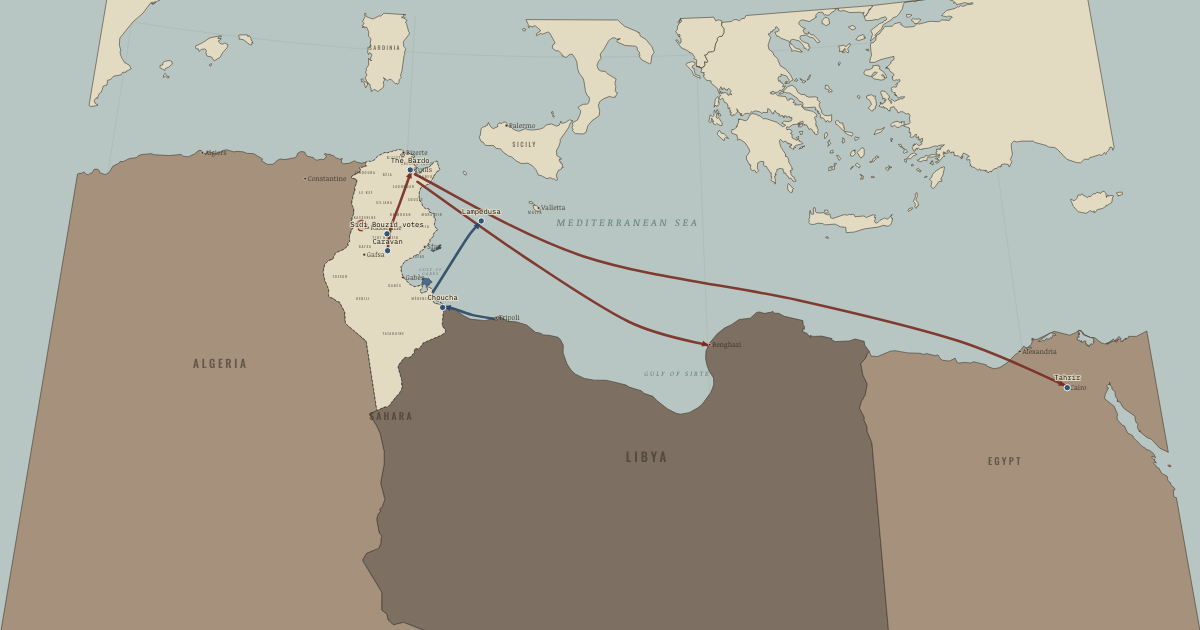
The map above is the world of Tunisia, March 2014 — A constitution in force; the emergency lifted.
Part of IB History: Second-wave feminism and Tunisia →
BRIEF EXPLANATION — THE ESSENTIAL ARGUMENT
Ben Ali’s flight left open the question of who would inherit the revolution. Tunisia’s transition, the passage from dictatorship to democracy, was much like replacing a building’s foundations while people still live inside it, and it survived where its neighbours’ transitions failed for three reasons. The first was continued pressure from the street. The interim government was full of the old ruling party’s ministers, so in January young people from the interior travelled to Tunis in the “Caravan of Liberation” and camped outside the prime minister’s office in the Kasbah. Two sit-ins forced the old guard out and won elections for a Constituent Assembly, a body elected to write a new constitution, much like the convention that wrote the American Constitution in 1787. On 23 October 2011 Ennahda, an Islamist party that seeks to shape law by Islamic values through elections, won 89 of its 217 seats and governed with two secular parties. A new rule requiring every party list to alternate women and men brought women about a quarter of the seats. The first free election thus revealed both the revolution’s democratic promise and the new strength of political Islam.
The second and third reasons were bargaining and mediation. In 2013 jihadist gunmen, militants who use violence to impose their version of Islamic rule, assassinated two left-wing opposition leaders, Chokri Belaïd and Mohamed Brahmi. Opposition crowds camped outside the Assembly at the Bardo, and in Egypt the army removed the elected Islamist president, so Tunisia faced the same choice between compromise and confrontation. Four organisations, the UGTT trade-union federation, the employers’ union, the Human Rights League and the Order of Lawyers, formed a “Quartet” that brokered a National Dialogue, a set of negotiations among the parties with fixed deadlines, much as a mediator settles a labour dispute. Under its roadmap Ennahda handed power to a non-party government, and on 26 January 2014 the Assembly adopted a constitution guaranteeing equality between women and men. The map shows March 2014: Tunisia blue for a constitution in force and the state of emergency lifted, Egypt tan again under military rule, and Libya grey-tan, its transition already fragmenting. The arrows trace the revolution’s example travelling to Cairo and Benghazi in 2011, the caravan from the interior to the capital, refugees from Libya’s war crossing into Tunisia, and young Tunisians sailing to Lampedusa. Compromise among rival camps, brokered from outside the parties, saved the Tunisian revolution.
The full story
The street kept forcing the transition further than the old elites intended. The first interim government, led by Ben Ali’s prime minister Mohamed Ghannouchi, kept ministers from the ruling party, the RCD. On 22 January 2011 young people from Menzel Bouzaiane and other interior towns set out for the capital, as the arrow shows, and camped in the Kasbah square outside the prime minister’s offices until 28 January, which forced a reshuffle. A second, larger sit-in, with more than 100,000 people in Tunis on 25 February, forced Ghannouchi to resign. On 3 March the interim president promised elections for a constituent assembly, an elected body whose only task was to write a new constitution. Under this pressure a court dissolved the RCD on 9 March, and an appointed commission wrote the electoral law, including a decree of May 2011 requiring every list to alternate women and men. The capacity to keep mobilising was the revolution’s main asset.
The election of October 2011 produced a democratic government and a deeply polarised country. Ennahda, the Islamist party that seeks to shape law by Islamic values through elections, won 89 of 217 seats with about 37 per cent of the vote. It governed in a “troika”, a coalition with two secular parties. Sidi Bouzid, where the revolution began, voted mainly for a populist list led by a London-based businessman and rioted when some of its seats were annulled, a sign that the interior felt the new politics passing it by. Secular Tunisians feared that Ennahda would roll back women’s rights, and in August 2012 a draft article describing women as “complementary” to men brought 7,000 to 9,000 protesters into the streets; the clause was dropped. Polarisation turned deadly in 2013, when jihadists, militants who use violence to impose their version of Islamic rule, shot the secular leaders Chokri Belaïd on 6 February and Mohamed Brahmi on 25 July with the same gun. Because the opposition blamed Ennahda for tolerating extremists, the killings became a crisis of the whole transition.
The crisis of 2013 was resolved by organisations outside the parties, which is why Tunisia’s path diverged from Egypt’s. After Brahmi’s death, opposition deputies walked out and tens of thousands camped outside the Assembly at the Bardo, while Egypt’s military coup of 3 July showed both sides the cost of a contest of force. The National Dialogue, negotiations convened by a Quartet of civil-society organisations, independent of the state and the parties (the UGTT union federation, the employers’ union, the Human Rights League and the Order of Lawyers), produced a roadmap. Ennahda agreed to hand over to a government of non-party experts in January 2014, and the Assembly completed the constitution. Adopted on 26 January 2014 by 200 votes to 12, it kept the 1959 formula that Tunisia’s religion is Islam and guaranteed freedom of conscience. Article 21 declared men and women equal in rights and duties, and Article 46 committed the state to parity in elected assemblies. In October 2014 Ennahda lost the election to the secular Nidaa Tounes and accepted the result. A democracy is established when the losers accept losing.
DEEP EXPLANATION — EVIDENCE & INTERPRETATION
“Twin tolerations” or a bargain of the weak?
Alfred Stepan argued in 2012 that Tunisia was building the “twin tolerations” that democracies need between religion and the state: religious parties accept the authority of elected institutions, and the state lets religious citizens organise and compete. He pointed to the long dialogue between Ennahda and secular opposition leaders in exile, including joint declarations of the opposition’s “18 October” coalition in the mid-2000s that accepted the Personal Status Code, Tunisia’s 1956 family law that banned polygamy and made divorce a matter for the courts. Rory McCarthy’s study of Ennahda shows a party divided between preachers and politicians, whose leaders chose compromise partly from conviction and partly from memory of the 1990s, when they had been imprisoned and tortured. Other scholars, such as Amel Boubekeur, describe the outcome as a “bargained competition” among Islamists, secularists and the old regime’s elites, who protected each other’s core interests. This bargain explains why few officials of the Ben Ali era faced trial and why Nidaa Tounes, a party built around the old elite, returned to power in 2014. Fear also mattered: Ennahda’s concessions came after Egypt’s coup of July 2013. The two readings agree on the result and differ on the motive, and the difference matters for judging how durable the settlement would prove.
Why Tunisia’s transition survived
Of the countries that rose in 2011, only Tunisia became a lasting democracy, at least for a decade, and historians compare it with Egypt, Libya and Syria to explain why. Safwan Masri’s Tunisia: An Arab Anomaly stresses long-term factors: a reformist tradition reaching back to the 1861 constitution, mass education, the Personal Status Code and a relatively homogeneous population without the sectarian divisions of Syria or the tribal regions of Libya. Other scholars stress the institutions Tunisia had in 2011. Tunisia’s army was small and politically marginal, unlike Egypt’s, which controlled a vast business empire and took power in 2013. Its trade-union federation, the UGTT, had hundreds of thousands of members in every region and enough legitimacy to mediate between parties. Tunisia also had little oil, so foreign powers had less reason to intervene. Contingency counted too, since leaders such as Rached Ghannouchi of Ennahda and Béji Caïd Essebsi of Nidaa Tounes chose to negotiate at moments when they could have escalated. The comparison suggests that structure made compromise possible and that individual choices made it happen, and explaining a revolution’s outcome usually requires weighing both.
Women and the new constitution
The transition turned women’s rights from a gift of the state into a cause defended from below, the reverse of 1956. The parity rule of May 2011 required lists to alternate women and men. Because about 93 per cent of lists were headed by men and many parties won only one seat in a constituency, women won about a quarter of the Assembly’s seats, a reminder that rules on paper interact with the way votes are counted. The fight over the draft Article 28 in 2012 showed the stakes: an Ennahda majority on the rights committee proposed protecting women “under the principle of complementarity with man within the family”, and women’s associations, newly free to organise, led the protests that removed it. Mounira Charrad and Amina Zarrugh describe the final constitution as a negotiated victory, since Article 21 declared equality and Article 46 committed the state to parity and to eliminating violence against women. In the same months the government withdrew its specific reservations to CEDAW, the UN women’s-rights treaty, effective in April 2014, while keeping a general declaration subordinating the treaty to the constitution’s first chapter. Many Ennahda women deputies supported the final text, which shows that the line between religious and secular feminism was less sharp than the protests suggested.
Key places on the map
Why it happened
Pressure from the streets did not stop. Unlike many revolutions, Tunisia’s did not end when the dictator left. The Kasbah sit-ins were led by young people from the same interior towns that had begun the revolt, and with trade unionists and students they kept occupying squares until the old ruling party’s ministers resigned and a constituent assembly was promised. Continued mobilisation prevented the old elite from managing a cosmetic change, which is what happened in several other Arab countries in 2011.
A union with national reach. The UGTT had survived Bourguiba and Ben Ali as the only mass organisation not wholly controlled by the regime, with branches in every governorate and members in every profession. Its leadership, compromised under Ben Ali, had rebuilt its credibility by siding with the protesters in January 2011. It therefore had the legitimacy and the organisation to call strikes, threaten the government and sit at the negotiating table, which made it the natural convener of the National Dialogue.
An Islamist party that chose compromise. Ennahda had been persecuted for twenty years and knew that it could be crushed again. Its leaders accepted the Personal Status Code, dropped demands to cite Islamic law as a source of legislation, and in 2014 handed power to technocrats and accepted electoral defeat. Their choices were shaped by conviction, by divisions inside the party and by fear of Egypt’s example, but without them no compromise would have been possible.
Fear of the Egyptian outcome. Egypt’s collapse taught both Tunisian camps what confrontation would cost: the army’s overthrow of the elected president Mohamed Morsi on 3 July 2013, followed by the killing of hundreds of his supporters in August, was watched closely in Tunis. Secular opponents of Ennahda saw how a military solution could destroy democracy, and Ennahda saw what could happen to an Islamist party that refused to bend. A neighbour’s disaster can be a powerful teacher.
THE TURNING POINT
The Bardo: from crisis to constitution, July 2013 – January 2014. The months between Brahmi’s assassination and the vote on the constitution are the hinge of the transition, because the country stood exactly where Egypt had stood weeks earlier: an elected Islamist government, a mass movement demanding its departure, and politicians on both sides tempted to escalate. The National Dialogue converted that confrontation into a negotiation with deadlines, and the vote of 26 January 2014, taken in the Assembly at the Bardo, produced a constitution that both sides could accept. From that point Tunisia had rules that the losers of later elections could appeal to, which is the practical meaning of a democratic transition.
What it changed
A democratic constitution. The 2014 constitution created a parliamentary system with a directly elected president, guaranteed civil liberties, equality between women and men and parity in elected assemblies, and promised to favour the poorer regions. Free legislative and presidential elections in late 2014 made Tunisia the only Arab country rated “free” by Freedom House for most of the following decade. Its chief weakness was that the constitutional court it required was never created, which later allowed a president to interpret the constitution alone.
The old elite returns by election. The first parliamentary election under the new constitution returned figures of the old regime to power. Nidaa Tounes (“Call of Tunisia”), a secular party founded in 2012 by the 85-year-old Béji Caïd Essebsi, a minister under Bourguiba, won the election of October 2014 with 86 seats against Ennahda’s 69, and Essebsi became president in December. Many revolutionaries saw this as proof that the revolution had changed the rules of politics while leaving many of the same people in charge.
A region that went the other way. Tunisia’s success was surrounded by failure: Egypt returned to military rule in 2013, Libya fragmented into rival governments and militias by 2014, and Syria descended into civil war. The collapse of Libya in particular brought weapons, training camps and jihadist recruitment to Tunisia’s border, while foreign governments and donors invested heavily in Tunisia as proof that democracy was possible in the region.
Women’s rights defended from below. The campaign against the “complementarity” clause and for parity showed Tunisian women organising freely and on a mass scale for the first time. Women held about a third of the seats in the parliament elected in 2014, and their associations went on to win new laws, including a comprehensive law against violence against women in 2017. Rights first granted from above could be extended from below.
DISCUSSION QUESTION — How far was Tunisia’s democratic transition the achievement of civil society rather than of political parties?
Civil society, the unions, associations and professional bodies that sit between citizens and the state, made a decisive contribution at two moments. In early 2011 young protesters and trade unionists forced the old ruling party out of government and won a constituent assembly. In 2013 the Quartet of the UGTT, the employers, the Human Rights League and the lawyers turned a confrontation that resembled Egypt’s into a negotiation, which the Nobel Committee later recognised. Yet the parties made the choices that the Quartet could only encourage: Ennahda agreed to hand over power and to drop contested clauses, secular leaders such as Essebsi agreed to share the state with Islamists, and the Assembly’s deputies wrote and passed the constitution. Historians such as Stepan stress long negotiations between party leaders, while others emphasise the union’s unique weight. The fairest judgement is that civil society created the conditions and deadlines for compromise and the parties supplied the compromises, so neither could have succeeded alone. The transferable insight is that democratic transitions usually depend on organisations that sit between the state and the parties, because they can apply pressure without seeking power for themselves.
An interesting fact
Tunisians living abroad elected eighteen of the 217 members of the 2011 Constituent Assembly, from six overseas constituencies, with ten seats for the large community in France and others for Italy, Germany, the Americas and the rest of Europe, and the Arab world. Tunisian polling stations opened in cities from Paris to Montreal days before the vote at home. Emigrants who had left to escape unemployment or repression therefore helped to write the constitution of the country they had left, and some of the deputies they elected had themselves spent decades in exile, sentenced in absentia by the regime that had just fallen.
Related
THE FREE PRINTABLE STUDY GUIDE
Join the Dispatch — a short welcome series, then a letter when a new atlas opens — and the printable study guide for Protest and Change is yours now, free.
NO TRACKING · YOUR ADDRESS IS USED FOR THE DISPATCH AND NOTHING ELSE · UNSUBSCRIBE ANYTIME