Feminism and the Tunisian Revolution · CHAPTER 4 ·
Black and Chicana feminism
Chapter 4 of Protest and Change: Second-Wave Feminism and Tunisia, 1945–2015: “Who Was Left Out?”
The largest feminist organisations reflected the priorities of mostly white, middle-class leaders. Black women, Chicanas, women on welfare and lesbians built their own groups, among them the National Black Feminist Organization (1973) and Boston’s Combahee River Collective, whose April 1977 statement linked race, sex and class.
Chapter 4 is part of membership. WW2 is free — every chapter. Try chapters 1–2 of any 2 other atlases (3 with a free account). Opening a new atlas uses one of them. Membership opens all 21 — Join.
Free printable Feminism and the Tunisian Revolution study guide, sent by email ↓
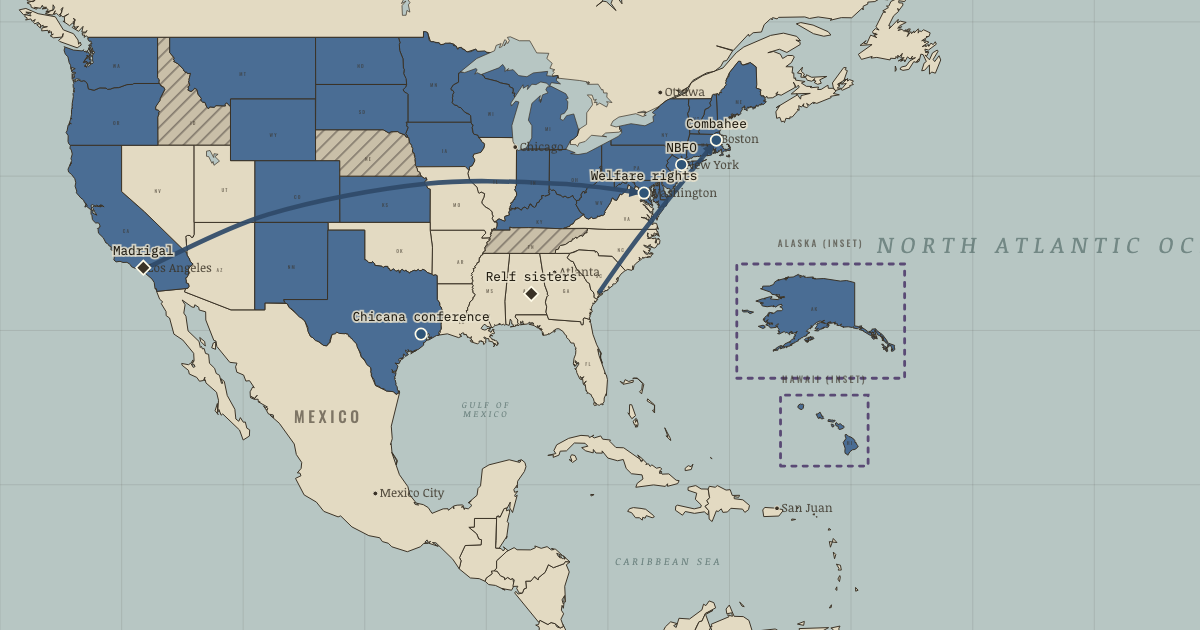
The map above is the world of Women’s rights, November 1977 — The ERA: 35 states, three short; three rescissions.
Part of IB History: Second-wave feminism and Tunisia →
BRIEF EXPLANATION — THE ESSENTIAL ARGUMENT
The third part of this atlas’s governing question, whom change leaves out, is answered most sharply from inside the women’s movement itself. The organisations that dominated the news, such as the National Organization for Women (NOW), the largest feminist lobby, fought for priorities that reflected the lives of their mostly white, middle-class leaders. Those priorities were entry to the professions, the Equal Rights Amendment (a proposed constitutional guarantee of equal rights for women) and abortion as a woman’s “choice”. Black women, Chicanas (Mexican-American women), working-class women on welfare and lesbians found that this agenda missed the problems that shaped their own lives, so they built organisations of their own, among them the National Black Feminist Organization (1973) and the Combahee River Collective in Boston (1974–80). They argued that oppressions of race, sex, class and sexuality were “interlocking”, so that a movement fighting only one of them could not free the women who faced several at once. Today this idea is called intersectionality, a term coined in 1989, which shows that the women the mainstream overlooked produced one of feminism’s most influential ideas.
The mainstream and its critics were fighting two different kinds of injustice, and the map shows both. Its colours record the mainstream’s great cause in November 1977, with the Equal Rights Amendment ratified by 35 states and already withdrawn by three. The two diamonds mark something no legal colour can show: the coerced sterilisation of poor women of colour, meaning operations that permanently prevented pregnancy, performed without real consent. Victims included two Black girls in Montgomery, Alabama, in 1973, and Mexican-American mothers in Los Angeles, so for many women the threat was being prevented from having children at all. These critics changed feminism’s ideas more than its laws. Federal rules on sterilisation consent came in 1978, and the federally funded National Women’s Conference in Houston in 1977 adopted a section of its programme, a “plank” like one item in a party manifesto, written by women of colour. Yet most of their organisations were small, poor and short-lived, and their agenda entered the mainstream only decades later.
The full story
The mainstream spoke of a universal sisterhood, but its priorities followed the experiences of the women who led it. Frances Beal, a veteran of the student civil-rights group SNCC, argued in her 1969 essay “Double Jeopardy” that Black women faced racism and sexism together, and that treating housework as women’s prison ignored Black women who had always cleaned other people’s houses for wages. When her Third World Women’s Alliance, named for the formerly colonised peoples, marched in August 1970 with placards defending the Black activist Angela Davis, an organiser told them her case had nothing to do with women’s liberation. In May 1971 more than 600 Chicanas, Mexican-American women, met in Houston at La Conferencia de Mujeres por la Raza (“the Conference of Women for the People”), where the meeting divided over whether feminism weakened the Mexican-American civil-rights movement. In May 1970 lesbians calling themselves the “Lavender Menace” seized a feminist congress to protest being kept out of sight. In each case the women most affected found that “universal” sisterhood had an unspoken membership list, which is why they began to organise apart.
Poor women’s feminism was organised around welfare, the government payments for mothers raising children alone, and it inverted the mainstream’s demands. The National Welfare Rights Organization (NWRO), mostly Black mothers on welfare, claimed some 25,000 members by 1969 under its chair Johnnie Tillmon, whose arrow on the map runs from a Los Angeles housing project to Washington. They demanded an adequate guaranteed income, like today’s proposals for a universal basic income, and an end to “midnight raids”, in which caseworkers searched homes for evidence of a man. For women told by Friedan to escape the home, freedom meant a job; for welfare mothers told to take any job, freedom meant the right to raise their own children with dignity. In 1972 Tillmon wrote that “welfare is a women’s issue”, yet the mainstream gave the cause little support, and the NWRO went bankrupt in 1975, which shows that the feminism of the poorest women was the easiest to ignore.
Reproductive rights showed the deepest divide, because “choice” meant something different to women who faced coercion in the opposite direction. In June 1973 a federally funded clinic in Montgomery sterilised the Relf sisters, Mary Alice and Minnie Lee, neither yet fifteen, with operations that permanently prevent pregnancy, after their mother, who could not read, marked an X on a consent form. In Los Angeles, Mexican-American mothers were sterilised in labour after signing English forms, and although they lost their lawsuit, Madrigal v. Quilligan, in 1978, their testimony helped win federal rules that year requiring consent in the patient’s language and a 30-day wait. In April 1977 the Boston-based Combahee River Collective, named after a South Carolina river and linked to it by an arrow, argued that racism, sexism, class exploitation and homophobia had to be fought together, and it listed sterilisation abuse beside abortion rights among its causes. Reproductive freedom, these critics argued, meant the right to bear children as well as the right not to, the demand later activists called reproductive justice.
DEEP EXPLANATION — EVIDENCE & INTERPRETATION
Left out, or on separate roads?
For years the history of second-wave feminism was written as the story of NOW and the radical collectives, with women of colour appearing late, as critics. Becky Thompson’s 2002 essay “Multiracial Feminism” challenged this chronology, arguing that Black, Latina, Asian American and Native American women were building feminist politics from the late 1960s onward, often inside civil-rights, labour and nationalist movements, so the standard “wave” story erases them by definition. Benita Roth’s Separate Roads to Feminism (2004) explains why they organised apart. White feminists frequently ignored their concerns, and Black and Chicana women also faced an “organisational mandate” from their own communities, where Black and Chicano nationalists, who put the unity of their community first, called feminism a white distraction from the struggle against racism. Kimberly Springer’s study of Black feminist organisations shows how small and fragile these groups were: the NBFO dissolved within about four years, and Combahee had only a few dozen members. The fairest reading is that exclusion and autonomy worked together. Women of colour were pushed out of the mainstream and also chose to build their own institutions, because neither the women’s movement nor the movements of their communities could hold all of who they were.
The evidence of coerced sterilisation
Sterilisation abuse is hard to measure because the same operation could be a free choice, a pressured choice or an act of force, and the surviving records rarely say which. Court cases provide the clearest evidence. In Relf v. Weinberger (1974) Judge Gerhard Gesell accepted as credible the plaintiffs’ estimate that 100,000 to 150,000 low-income people were sterilised each year under federal programmes, and found that some had been told they would lose welfare payments if they refused. A 1976 report by the General Accounting Office counted 3,406 sterilisations of Native American women in four of the Indian Health Service’s twelve areas between 1973 and 1976, with many consent forms that broke the rules. Activists’ estimates of the proportion of Native women affected run far higher and remain disputed. In Puerto Rico a 1965 survey found that about a third of ever-married women aged 20 to 49 had been sterilised, a practice so common it was called simply la operación, “the operation”. Historians such as Iris López warn against treating these women only as victims, since many chose sterilisation within narrow options. Elena Gutiérrez shows that even when Madrigal was lost in 1978, the women’s testimony changed the law. The evidence is uneven, but its direction is consistent: the burden fell on poor women of colour.
Welfare rights as feminism
Premilla Nadasen argues that the women of the National Welfare Rights Organization were feminists on their own terms, even though most never used the word and the mainstream rarely recognised them. Their demands went to the heart of how the state treated women: they wanted motherhood counted as work deserving an income, privacy from caseworkers who policed their sex lives, and the right to refuse low-paid jobs that took them away from their children. Some of these demands won in court. In King v. Smith (1968) the Supreme Court struck down Alabama’s “substitute father” rule, which cut off payments to any mother suspected of a relationship with a man. Yet the movement had the fewest resources of any branch of feminism, depended on a few male-led foundations and allies, and collapsed when funding dried up and the political climate turned against welfare in the 1970s. Its history matters for the governing question, because the women most directly harmed by poverty built the movement with the least power to protect itself. A movement’s influence often tracks the resources of its members, however just its cause.
Key places on the map
On this day
Why it happened
A movement built in the image of its founders. The first texts and organisations of the second wave were created by educated white women, and they naturally began from their own experience of suburban isolation, professional exclusion and unwanted pregnancy. Women whose main problems were racism, poverty or coerced sterilisation found those concerns missing from the agenda. Friedan’s book, for example, said almost nothing about the millions of women who already worked for wages. No movement can see experiences that its members do not share unless someone forces them on to it.
The pull of other loyalties. Black and Chicana women were often active in civil-rights, Black Power and Chicano movements, whose leaders, male and female, frequently argued that feminism was a white middle-class luxury that would divide their communities. This pressure discouraged women of colour from joining white-led organisations and also made organising as feminists within their own movements difficult, which is why they so often created separate groups. Many also feared that criticising Black or Chicano men in public would hand ammunition to racists who already portrayed their communities as disordered.
The same issue meant different things. Mainstream feminists saw abortion as the central reproductive right because unwanted pregnancy was their main risk. Poor women of colour also faced pressure in the opposite direction, from doctors and welfare officials who wanted them to have fewer children. Similarly, paid work meant liberation for the suburban housewife and hardship for the domestic worker. A movement that takes one group’s experience as universal will misread the needs of every other group.
Exclusion inside the organisations. Lesbians were pushed to the margins of NOW in 1969 and 1970, and women of colour reported being treated as tokens or ignored at meetings and marches. These experiences convinced many that reform from within was impossible and that only autonomous organisations, led by the women most affected, could represent them. Exclusion pushed people out, but it also pushed them to build. Even NOW’s first Black president, Aileen Hernandez, elected in 1970, later left the organisation, criticising its failure to take up the concerns of minority women.
THE TURNING POINT
The Combahee River Collective Statement, April 1977. The statement is the hinge of this chapter because it turned a set of grievances into a theory that outlived every organisation of the decade. Its authors, Barbara Smith, Beverly Smith and Demita Frazier, argued that oppressions of race, sex, class and sexuality were interlocking and had to be fought together. They described their politics as rooted in their own identity as Black women, the first known use of the phrase “identity politics”. Their claim that the freedom of the most oppressed would require the freedom of everyone reversed the mainstream’s logic of starting with the most privileged. The collective itself was tiny and ended in 1980, yet its ideas became the basis of intersectional feminism. Movements are sometimes changed most by the people with the least power inside them.
What it changed
From reproductive rights to reproductive justice. Campaigns by groups such as the Committee to End Sterilization Abuse won federal rules in 1978 requiring a 30-day waiting period, consent in the patient’s language and a ban on sterilising people under 21. In 1994 Black women activists coined the term “reproductive justice” to describe the right to have children, not to have them, and to raise them safely, a direct descendant of the arguments of the 1970s.
Houston, 1977: inclusion in the official agenda. At the federally funded National Women’s Conference in Houston in November 1977, delegates adopted a “minority women” plank drafted by Black, Latina, Asian American and Native American women, which Coretta Scott King was among those to champion. It was the most diverse gathering in the movement’s history, and also the moment conservative women organised the counter-rally that defined the backlash of the next chapter.
A literature that changed feminist theory. Writers including Audre Lorde, bell hooks, and Cherríe Moraga and Gloria Anzaldúa, whose anthology This Bridge Called My Back appeared in 1981, made the critique of white feminism central to feminist thought. Kimberlé Crenshaw’s concept of “intersectionality” (1989) gave it a name that spread worldwide, which shows that ideas formed at the margins can eventually reshape the centre. Their essays are now among the most widely taught texts of the whole movement.
Fragile institutions. The organisations of this chapter were small and poorly funded: the NWRO went bankrupt in 1975, the NBFO dissolved by the late 1970s and Combahee ended in 1980. Their ideas spread through books and later movements, while their practical demands, such as an adequate income for mothers, were largely defeated, culminating in the welfare cuts of the 1990s. Ideas can outlive the defeat of the organisations that produced them, which is one reason the history of a movement should be judged over decades.
DISCUSSION QUESTION — Were Black, Chicana and working-class women “left out” of second-wave feminism, or did they build a different feminism of their own?
The evidence supports both readings, and the answer depends on what “the movement” is taken to mean. If it means the national organisations and the legal campaigns that dominated the press, then these women were largely left out: NOW and the mainstream gave welfare rights little support, ignored coerced sterilisation until activists forced the issue, and treated lesbians and women of colour as embarrassments or tokens. Yet the record of the Third World Women’s Alliance, the Chicana conference of 1971, the NWRO and the Combahee River Collective shows women who did not wait to be included; they built organisations, wrote theory and won concrete changes such as the 1978 sterilisation rules. Historians such as Thompson and Roth therefore argue that second-wave feminism was always plural, and that the image of a single movement is itself a product of who wrote its history. The most persuasive judgement is that these women were excluded from power in the movement while being central to its ideas. The transferable insight is that the question “who was left out?” should always be followed by “what did they do about it?”, because exclusion is a starting point for agency as well as a loss.
An interesting fact
The Combahee River Collective took its name from a military operation. On the night of 1–2 June 1863, during the American Civil War, Harriet Tubman, who had escaped slavery and was working as a scout for the Union army, guided Union steamboats up the Combahee River in South Carolina. The raid destroyed plantations and freed more than 700 enslaved people, who ran to the boats as the steam whistles sounded. Tubman is widely credited as the first woman to lead an armed military operation in American history. More than a century later, a group of Black feminists in Boston chose the name to signal that their politics came from a long tradition of Black women’s collective action.
Related
THE FREE PRINTABLE STUDY GUIDE
Join the Dispatch — a short welcome series, then a letter when a new atlas opens — and the printable study guide for Protest and Change is yours now, free.
NO TRACKING · YOUR ADDRESS IS USED FOR THE DISPATCH AND NOTHING ELSE · UNSUBSCRIBE ANYTIME