ONE LAND · 7 ATLASES
History of Haiti in maps
Haiti as it appears in 7 interactive history atlases, from 1750 to 2015: Saint-Domingue, then Haiti, Saint-Domingue / Haiti, Haiti. Each era below lists who ruled the land and when control changed, linked to the dated map that shows it.
WW2 is free — every chapter. Try chapters 1–2 of any 2 other atlases (3 with a free account). Opening a new atlas uses one of them. Membership opens all 21 — Join.
Free printable Haiti and Kenya independence study guide, sent by email ↓
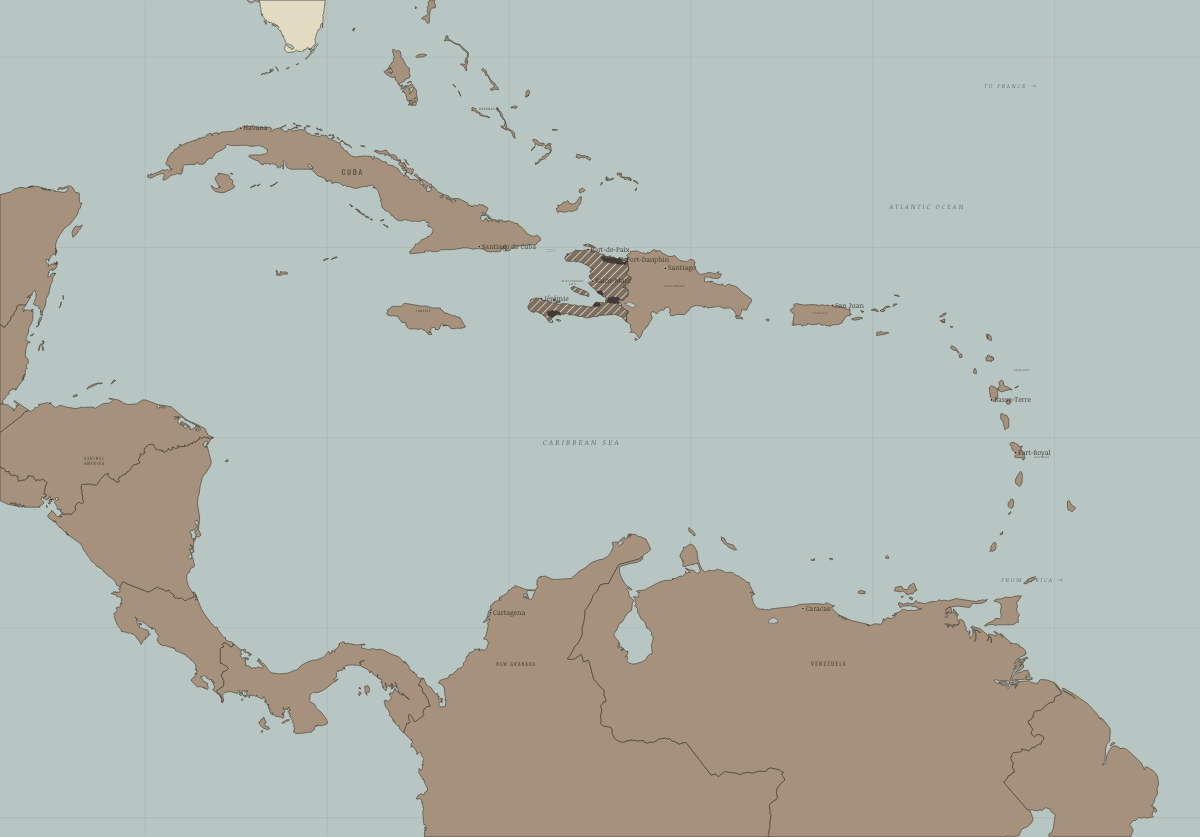
What was Haiti before it was Haiti? Below, every era of this land in the Maps of History atlases — who ruled it, what it was called, and when control changed — each line linked to the dated map that shows it. Modern borders stand in as an honest approximation; every atlas says so on the map itself.
Saint-Domingue, then Haiti (1804) · Industrial Revolution
In 1791 enslaved people in Saint-Domingue, the most profitable sugar and coffee colony in the world, rose against their masters, and in 1804 they founded Haiti, the first nation to abolish slavery for good. France later forced it to pay a huge indemnity for its independence. Haiti’s revolution removed the largest sugar producer from the market and showed the Atlantic world that slavery could be overthrown.
| Colony or dependency — the opening position | |
| Agrarian economy |
INDUSTRIAL REVOLUTION: EVERY CHAPTER AND MAP →
Saint-Domingue / Haiti · Age of Revolutions
The age’s absolute revolution: the enslaved of Saint-Domingue freed themselves (1791–1804), defeated Spain, Britain and Napoleon’s largest expedition, and founded the first Black republic — then paid for recognition with a century of extorted indemnity (150 million francs, 1825) and embargo. It armed Bolívar on condition he abolish slavery. Every power on this map owed it a debt; almost none acknowledged it.
| Colonial possessions — the opening position | |
| Republics & revolutionary states |
AGE OF REVOLUTIONS: EVERY CHAPTER AND MAP →
Saint-Domingue / Haiti · Haiti and Kenya independence
Saint-Domingue, the western third of Hispaniola, was France’s richest colony in 1789: some 800 sugar estates, thousands of coffee farms and about half a million enslaved people. Between 1791 and 1803 they rose, won emancipation and defeated Napoleon’s army, and on 1 January 1804 their generals named the country Haiti. Its founders defined every citizen as free and Black; its rulers then argued for decades over plantations against family land, and France made it pay 150 million francs, later 90 million, for recognition.
| Under colonial rule — the opening position | |
| Self-rule in all but name | |
| Under colonial rule | |
| Held by insurgents | |
| Independence won |
HAITI AND KENYA INDEPENDENCE: EVERY CHAPTER AND MAP →
Haiti · American Civil War
The hemisphere’s first Black republic, born of its own slave revolution in 1804 — which is precisely why Washington had refused to recognize it for six decades. Lincoln’s government extended recognition in 1862, the war having removed the Southern veto. Frederick Douglass later served as US minister here. Haiti’s existence had haunted the slaveholding South for sixty years as proof of what enslaved people could do; its recognition was one of emancipation’s quiet diplomatic corollaries.
| Neighbors & the outside world — the opening position |
AMERICAN CIVIL WAR: EVERY CHAPTER AND MAP →
Haiti · WWI
| The Entente & Allies — the opening position | |
| The Entente & Allies |
Haiti · Cold War
| US-aligned states — the opening position |
COLD WAR: EVERY CHAPTER AND MAP →
Haiti · Feminism and the Tunisian Revolution
| Refused: women excluded; ERA never ratified — the opening position | |
| Right won in law | |
| No reform yet / outside this story | |
| Right won in law |
FEMINISM AND THE TUNISIAN REVOLUTION: EVERY CHAPTER AND MAP →
Related
THE FREE PRINTABLE STUDY GUIDE
Join the Dispatch — a short welcome series, then a letter when a new atlas opens — and a printable atlas study guide of your choice is yours now, free.
NO TRACKING · YOUR ADDRESS IS USED FOR THE DISPATCH AND NOTHING ELSE · UNSUBSCRIBE ANYTIME