Industrial Revolution · 1750
Why did Britain industrialise first: resources or people?
The seminar question: “Did Britain industrialise first because of what it had, such as coal and colonies, or because of what its people did with them?”
In 1750 China made about a third of the world’s manufactured goods and the Indian subcontinent about a quarter, while Britain made under two per cent. Britain industrialised first partly because it combined dear labour with cheap coal: London labourers earned roughly twice the real wages of workers in Vienna.
WW2 is free — every chapter. Try chapters 1–2 of any 2 other atlases (3 with a free account). Opening a new atlas uses one of them. Membership opens all 21 — Join.
Free printable Industrial Revolution study guide, sent by email ↓
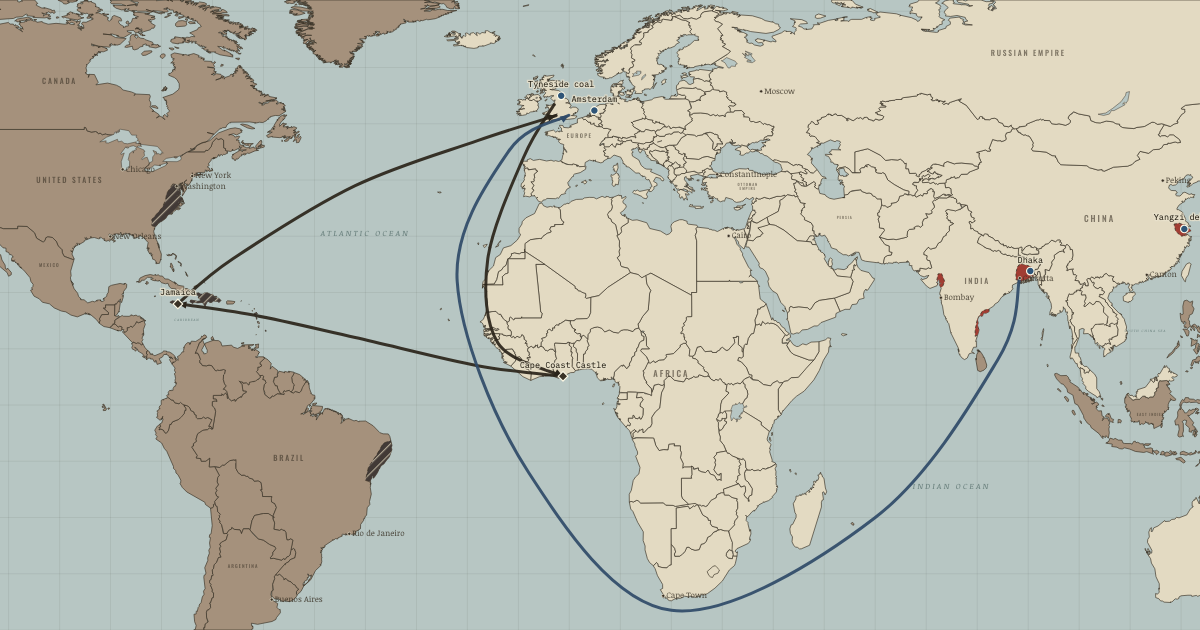
Any explanation of the Industrial Revolution, the shift from hand production to machines driven first by water and then by coal, has to start from how ordinary the world of 1750 still looked. The richest manufacturing regions lay in Asia. Around Suzhou in the Yangzi delta millions of rural households spun and wove cotton and silk for markets across China, and Bengal supplied about two-thirds of the textiles bought in Asia around 1750 by the English East India Company, a private firm holding a royal monopoly of Britain’s trade with Asia, much like a corporation with its own army. All of these economies, Britain’s included, were what the historian E. A. Wrigley calls organic economies, in which nearly all heat, light and motion came from the land, as wood for fuel, food for workers and fodder for horses. Such an economy can grow only until it runs short of land, much as a town heated by local firewood can grow only until its woods are gone. What made the Industrial Revolution new was the escape from that ceiling.
The short answer
- Dear labour and cheap coal. British wages were high by world standards because a century of trading growth had raised the price of labour, while coal from Tyneside and the Midlands was the cheapest energy anywhere. That pair of prices meant that a machine replacing workers with fuel repaid its cost in Britain far sooner than in France, India or China. Inventors and investors follow such returns, so Britain attracted the experiments, and the experiments were then improved until they paid elsewhere too.
- An Atlantic economy built on enslaved labour. Britain’s Atlantic empire rested on enslaved labour: by 1750 it ruled colonies in North America and the Caribbean whose plantations were worked by enslaved Africans. About 12.5 million people were embarked on slave ships across the Atlantic between the sixteenth and nineteenth centuries, and in the late 1700s British ships carried more of them than any other nation’s. Slavery thus enriched Britain twice, through the sugar and cotton the plantations sold and the cloth and iron they bought, and through the ports, merchants and banks their trade built, whose capital and skills later served industry.
- A culture of useful knowledge. Britain was unusually good at moving knowledge from the study to the workshop, and that habit mattered as much as discovery itself. The Royal Society, London’s leading scientific academy, and provincial philosophical societies, as science clubs were then called, joined with cheap print and travelling lecturers to connect gentlemen scientists with instrument makers, millwrights, who built mill machinery, and clockmakers. A patent system, slow and expensive as it was, let inventors sell their ideas. The historian Joel Mokyr argues that this culture, which he calls the Industrial Enlightenment, turned one-off ingenuity into a steady flow of improvements, which is the condition for growth that lasts.
- Farms, markets and a strong state. English farming fed a large population with a shrinking share of the workforce, so many people already worked in crafts and trade: by 1700 over 40 per cent of men worked in manufacturing, mining or building. Coastal shipping, rivers and turnpike roads, private toll roads kept in repair by their users’ fees, joined a national market with no customs barriers between its regions. After the Glorious Revolution of 1688, which made Parliament supreme over the monarch, a Parliament of property owners taxed heavily but predictably, borrowed cheaply and paid for the navy that guarded Britain’s trade, conditions that the economist Douglass North linked to secure investment.
THE TURNING POINT
Tyneside’s coal, c. 1750. The hinge of this first chapter is a resource Britain had burned for centuries before anyone thought of it as revolutionary. By the 1750s colliers, the ships of the coal trade, sailed from the River Tyne at Newcastle to London, and steam engines already pumped water from the deepest pits. Coal mattered because it broke the land ceiling of the organic economy, whose energy came almost entirely from the land, since a ton of coal gave off about as much heat as the wood an acre of forest grows in a year. Every later chapter, from the steam engine to the railway to the steel mill, depends on that fuel. Without cheap coal, Britain’s high wages would have produced a rich commercial economy like that of the Dutch Republic, today’s Netherlands; with it, they produced machines.
What it changed
Indian cloth becomes the target. The first industry to take the new path was the one in which Britain was most clearly behind. Indian calicoes, light cotton fabrics, set the standard for cheap, washable, printed cloth, and Parliament’s bans of 1700 and 1721 left British producers a protected home market in which to imitate them. The machines invented to spin cotton as fine as Bengal’s, the subject of chapter 2, would let Europe out-produce Asia in Asia’s own speciality for the first time.
Coal meets the steam engine. The engines that pumped water from Britain’s coal mines were so wasteful that they made sense only beside a pithead, the top of a mine shaft, where coal cost almost nothing. Making them efficient enough to work anywhere became the task of the Scottish engineer James Watt, and his engine, together with iron made with coke, a fuel baked from coal, and the canals dug to move coal, is the subject of chapter 3. The fuel came first, and the machines that burned it followed.
Slavery expands with the machines. Industrial demand enlarged the Atlantic slave economy. As British mills consumed ever more cotton, plantation slavery spread across the American South, from about 700,000 enslaved people in 1790 to almost four million in 1860. Chapter 2 traces this chain to Lancashire, and chapter 11 follows it to its breaking point in the American Civil War. Cheap cotton for the mills meant more land and more forced labour on the plantations.
A divergence begins. The industrial age turned a modest gap between the world’s richest and poorest regions into a chasm. Within a century and a half, industrial Europe and North America made most of the world’s manufactured goods, and the textile districts of Bengal and the Yangzi delta had lost their export markets. Chapter 11 examines this Great Divergence, as historians call the widening gap, and the epilogue asks who paid for it. The question still shapes how nations judge one another, because the rich world’s lead and the poor world’s grievances both date from these decades.
The full answer, argued
The case for what Britain had is strong. The economic historian Robert Allen’s prices show that only British conditions made the first machines profitable, and the historian Kenneth Pomeranz’s comparison suggests that a region as advanced as China’s Yangzi delta lacked chiefly coal near its towns and land overseas. Yet resources do nothing by themselves. China had coal too, and Britain had mined coal for centuries before anyone built a steam engine; turning resources into an industrial economy required inventors, mechanics, investors and institutions that rewarded them, the culture the historian Joel Mokyr calls the Industrial Enlightenment. The colonial advantage cuts both ways, since Britain held the Caribbean only because its navy, merchants and planters seized it and worked it with enslaved labour, which was itself a choice with victims. Most historians now combine the two answers: endowments, the advantages a country starts with, set the incentives, and people and institutions decided whether anyone responded to them. The transferable lesson is that geography and prices make an outcome possible, while human choices decide when and where it actually happens.
An interesting fact
Some of the men who did most to join science to industry in eighteenth-century Britain met by moonlight. The Lunar Society of Birmingham, active from the mid-1760s to about 1813, gathered once a month on a Sunday or Monday near the full moon, so that members could ride home safely after dinner along unlit roads. Its circle included the manufacturer Matthew Boulton, the engineer James Watt, the potter Josiah Wedgwood, the chemist Joseph Priestley and the physician Erasmus Darwin, grandfather of Charles. They called themselves the Lunarticks, and their dinners, where chemical experiments shared the table with business plans, show how closely British science and industry already worked together.
This is the study layer of Why Britain industrialised first, chapter 1 of The Industrial Revolution, 1750–1914; the full index of the atlas is here.
Related questions
THE FREE PRINTABLE STUDY GUIDE
Join the Dispatch — a short welcome series, then a letter when a new atlas opens — and the printable study guide for The Industrial Revolution is yours now, free.
NO TRACKING · YOUR ADDRESS IS USED FOR THE DISPATCH AND NOTHING ELSE · UNSUBSCRIBE ANYTIME