Industrial Revolution · 1851
Did workers gain or lose from the Industrial Revolution?
The seminar question: “Did the first industrial generations gain or lose from industrialisation?”
By 1851 just over half the population of England and Wales lived in towns, and Manchester grew from about 70,000 people in 1801 to over 300,000. Crowded housing without clean water or sewers spread disease, cholera killed about 32,000 people in 1831–32, and from the Factory Act of 1833 the state began to act.
Chapter 5 is part of membership. WW2 is free — every chapter. Try chapters 1–2 of any 2 other atlases (3 with a free account). Opening a new atlas uses one of them. Membership opens all 21 — Join.
Free printable Industrial Revolution study guide, sent by email ↓
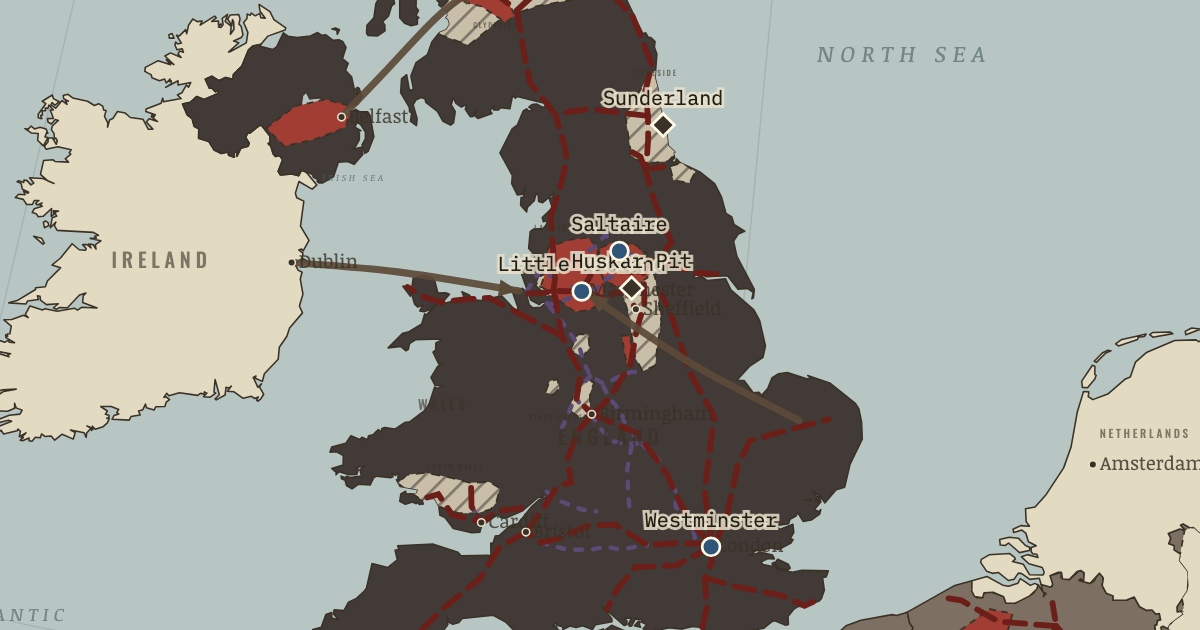
The industrial town was the new environment of the age, and the speed of its growth explains most of its problems. Factories needed workers close by, and workers poured in from the countryside, from Scotland and from Ireland, especially after the Great Famine of 1845–52, when the potato crop failed, killed about a million people and drove many more abroad; the map’s arrows trace them into Liverpool, Manchester and Glasgow. Builders put up the cheapest housing they could: back-to-back terraces sharing a rear wall and therefore without through-draughts, courts of houses crowded around small yards and reached by narrow passages, and cellars that flooded. In Little Ireland, a slum beside the River Medlock in Manchester, Friedrich Engels, a young German working for his family’s cotton firm, found families living in cellars, a single outdoor toilet shared by dozens of people and a river black with dye and sewage. Towns had no authority responsible for drains, water or rubbish, so disease filled the gap.
The short answer
- Factories pulled workers into towns. Steam power let mills and works gather where coal, canals and railways met, and the jobs they offered drew people from a countryside where enclosure, the fencing of common land into private farms, falling demand for hand spinning and a growing population left many underemployed. The population of England and Wales roughly doubled between 1801 and 1851, from about 8.9 to 17.9 million, and most of the growth went to the towns. Wages there were higher than in farming, which is why people came despite the conditions.
- No one was in charge of the towns. Most industrial towns had no elected council with power over building, drains or water until the Municipal Corporations Act of 1835, which gave the old boroughs elected councils, and many new towns had none even then. Builders and landlords faced almost no regulation, and private water companies supplied only those who could pay. This absence of authority, together with the sheer speed of growth, explains why towns grew for decades without sewers. Reform had to wait until disease made the cost of doing nothing impossible to ignore.
- Families needed children’s wages. Working-class families depended on several earners, because one adult wage rarely covered rent and food, especially when a father was sick, dead or out of work. The economic historian Jane Humphries’ study of working-class autobiographies shows that children from fatherless and large families started work earliest, often before the age of ten. Mill owners valued children for tasks such as piecing broken threads and for their low wages, so demand met supply. Poverty sent most children to work, and employers were glad to hire them.
- Evidence made the costs visible. Industrial Britain counted itself as no society had done before. Censuses from 1801, the civil registration of births and deaths from 1837, parliamentary inquiries and newly appointed inspectors produced numbers and testimony that campaigners could use. The civil servant Edwin Chadwick’s mortality tables and the evidence gathered after the Huskar Pit disaster, in which 26 children drowned in a flooded mine, turned private suffering into public facts that Parliament could not ignore. Statistics became a tool of reform. Numbers persuaded MPs who would never visit a mill or a mine.
THE TURNING POINT
The Factory Act, Westminster, 1833. The Factory Act of 1833 is the hinge because it was the first law to regulate industrial employers that a government actually enforced. Earlier acts of 1802 and 1819 had limited children’s work in cotton mills, but they had no inspectors and were widely ignored. The 1833 Act covered most textile mills, banned children under nine, limited the hours of older children, required two hours of schooling a day for those under thirteen and appointed four paid inspectors with power to enter mills and prosecute. It accepted that the market alone would not protect workers, and every later factory, mines and public health law built on that principle.
What it changed
Protest grows from hardship. Low wages, hunger and the loss of skilled trades fed the protest movements of the same decades, from machine-breaking to Chartism, a mass movement demanding the vote for all men. The crowded industrial towns described in this chapter were their recruiting grounds, and their meetings filled the moors and squares outside them. The towns that concentrated hardship also concentrated the people who suffered it, which made mass protest possible for the first time.
Living standards rise after 1850. Real wages, life expectancy and heights improved clearly only after about 1850, as food grew cheaper, sanitation spread and working hours were limited. The gains of industrialisation reached most workers a generation or two after its costs. Trade unions and the vote, won by many working men in 1867 and 1884, helped them claim a larger share, so what workers received depended on political power as well as productivity.
Regulation spreads abroad. Britain’s factory and public health laws became models elsewhere. Prussia, the largest German state, limited child labour in 1839 and France in 1841, and by the end of the century most industrial countries had factory inspectors and public health boards, as chapters 7 and 8 show. The idea that the state should regulate industry became one of the Industrial Revolution’s most lasting legacies. Each new industrial country rediscovered the problems that Britain had met first.
The full answer, argued
The answer depends on which evidence carries the most weight. Wage data show modest gains: the economic historian Charles Feinstein’s careful series suggests that working-class living standards rose by less than 15 per cent between the 1780s and the 1850s, while optimists such as the economists Peter Lindert and Jeffrey Williamson found much larger rises. Other evidence points the other way. Average heights fell for men born between the 1820s and 1850, a sign of poorer nutrition and more childhood disease, and life expectancy in the largest industrial towns fell far below the national average. Child labour, on the evidence of the economic historian Jane Humphries, grew more intense. Yet many migrants chose the towns because wages there were higher than on the land, and the factory laws, sanitation and cheaper goods of later decades rested on the wealth those years created. Most historians conclude that the first generations bore heavy costs for gains their grandchildren enjoyed. In judging any transformation, the useful questions are who paid and when, as well as whether average incomes rose.
An interesting fact
The most famous account of Manchester’s slums was written by a young clerk in his family’s cotton firm. Friedrich Engels, the son of a German textile manufacturer, came to Manchester in 1842 to work for his family’s firm, Ermen & Engels, and wrote The Condition of the Working Class in England (1845) from what he saw there. He returned in 1850 and stayed for almost twenty years, eventually as a partner, and much of the income he earned from cotton supported his friend Karl Marx, the revolutionary thinker, while Marx wrote Capital, his critique of capitalism. The two founders of modern communism were in part financed by a Lancashire cotton mill.
This is the study layer of Urbanisation and the Factory Acts, chapter 5 of The Industrial Revolution, 1750–1914; the full index of the atlas is here.
Related questions
THE FREE PRINTABLE STUDY GUIDE
Join the Dispatch — a short welcome series, then a letter when a new atlas opens — and the printable study guide for The Industrial Revolution is yours now, free.
NO TRACKING · YOUR ADDRESS IS USED FOR THE DISPATCH AND NOTHING ELSE · UNSUBSCRIBE ANYTIME