Industrial Revolution · 1850
Did railways create Britain’s industrial economy?
The seminar question: “Did railways create Britain’s industrial economy, or did an industrial economy create the railways?”
Railways grew out of the coalfields: the Stockton & Darlington line opened in 1825 to carry coal. After the Stephensons’ Rocket won the Rainhill trials in October 1829, the Liverpool & Manchester Railway opened in 1830 as the first line between two cities worked entirely by steam to a timetable.
Chapter 4 is part of membership. WW2 is free — every chapter. Try chapters 1–2 of any 2 other atlases (3 with a free account). Opening a new atlas uses one of them. Membership opens all 21 — Join.
Free printable Industrial Revolution study guide, sent by email ↓
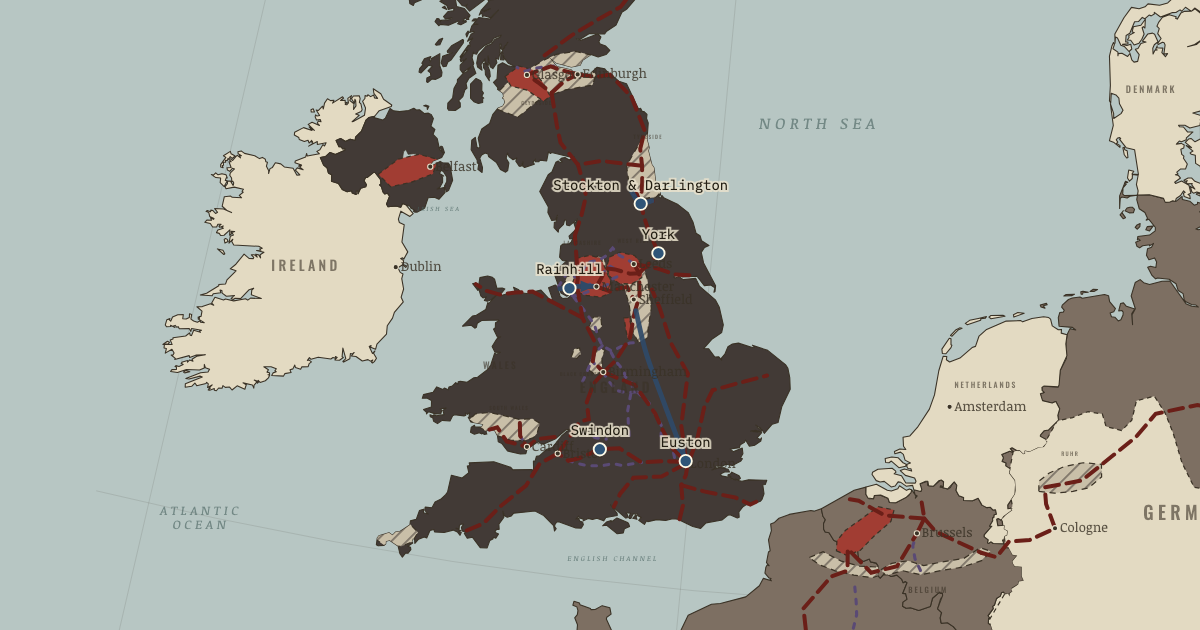
Railways began as an answer to the oldest problem of the coal industry, which was the cost of moving a heavy, cheap fuel. Wagonways with wooden rails had carried coal from Tyneside pits to the river since the seventeenth century, so iron rails and steam locomotives improved a familiar system. The Cornish engineer Richard Trevithick ran a high-pressure locomotive at Penydarren in South Wales in 1804, and coal-mine engineers such as George Stephenson built locomotives at Killingworth near Newcastle in the 1810s. The Stockton & Darlington Railway opened on 27 September 1825 to carry coal from the Durham pits to the River Tees, using steam locomotives for freight and horses for most passengers. Its success showed that a public railway, open to anyone who paid, could earn money, and merchants in Liverpool and Manchester, frustrated by slow and costly canal carriage, set out to build a better one.
The short answer
- Coal needed cheaper carriage. Coal was bulky and cheap, so the cost of moving it often exceeded the cost of mining it. Collieries, as coal mines were called, had used horse-drawn wagons on rails for two centuries, and the steam engines that already pumped their pits offered a way to haul the wagons as well. The Stockton & Darlington Railway, opened in 1825 to carry Durham coal to the sea, was promoted by local Quakers, members of a small Christian movement, led by the Darlington wool merchant Edward Pease. Its purpose shows that the first railways were the coal industry’s answer to the cost of carriage.
- High-pressure steam made engines mobile. The engineer James Watt’s low-pressure engines were too large and heavy to move themselves. The Cornish engineer Richard Trevithick’s high-pressure engines of around 1800 delivered more power from a smaller boiler, and later refinements, such as the many fire-tubes that carried hot gas through the boiler and the blast pipe that fanned the fire with spent steam, both used in the locomotive Rocket, raised steam fast enough to haul trains at speed. Robert Stephenson & Co., founded in Newcastle in 1823, was the first works built to make locomotives, turning these improvements into a reliable product.
- Merchants frustrated by the canals. Canal carriers had grown complacent without competition, and by the 1820s the waterways between Liverpool and Manchester were busy, slow and, in the merchants’ view, overpriced. Cotton merchants and manufacturers, who needed raw cotton and finished cloth to move quickly between port and mill, backed the Liverpool & Manchester Railway as a rival. The scale of the cotton trade meant that any saving in carriage was multiplied many times over. The first great railway began as a merchants’ revolt against a transport monopoly.
- Savings looking for a home. Britain’s middle classes had built up savings, and in 1825 Parliament repealed the Bubble Act, a law of 1720 that had restricted share-selling firms, so joint-stock companies, which sold shares to the public, became easier to form. Government bonds, which are loans to the state, paid modest interest, so railway shares promising high returns drew in clergymen, widows, merchants and manufacturers alike. Cheap credit in the mid-1840s turned that interest into a mania, a frenzy of share-buying, which financed a network far faster than any government plan could have done.
THE TURNING POINT
Rainhill, October 1829. The Rainhill trials, a contest to find the best locomotive for the new Liverpool & Manchester Railway, are the hinge because they settled what kind of railway Britain would build. The Liverpool & Manchester’s directors had seriously considered hauling trains with fixed engines and cables, and the performance of Rocket, the locomotive built by George Stephenson and his son Robert, reaching about 30 miles an hour and running reliably, persuaded them to rely on locomotives. When the line opened in 1830 it proved that steam railways could carry passengers as well as freight, at speed and to a timetable, between two great cities. Every main line built afterwards, in Britain and abroad, followed the pattern set by the engine that won at Rainhill.
What it changed
A national market and national time. Railways carried coal, cloth, fish, milk and newspapers across the country overnight, so prices converged and local monopolies collapsed. Railway companies adopted Greenwich time, set by the Royal Observatory at Greenwich, from the 1840s and towns followed, giving Britain a single clock decades before the law confirmed it in 1880. Cheap transport let the industrial cities keep growing after 1850, because railways could bring in food and fuel from far beyond the reach of canals and carts.
The continent builds its own lines. Railways became the leading industry of continental industrialisation, because they created demand for coal, iron and machines all at once. Belgium opened the continent’s first state-built steam railway in 1835, and the German states and France followed within a few years, often with British locomotives and engineers. Because continental governments often planned the routes themselves, their networks served national strategy as well as private profit.
Railways across the world. British capital and engineers built railways from India to Argentina, and the transcontinental lines of the United States, Canada and Russia opened continents to settlement and trade. Chapters 9 and 11 follow the lines that carried grain, cotton and migrants into a single world economy, and the costs they brought to the people who lived in their path. Wherever they went, railways turned distant land into suppliers for industrial markets.
The full answer, argued
The chronology of events favours the second view. Railways appeared after cotton, coal, iron and steam were already transforming Britain, they grew out of the coal industry’s needs, and they were paid for with savings that an industrial and commercial economy had produced. Measured by social savings, the extra cost of moving the same traffic without them, as the economic historian G. R. Hawke did, they made Britain richer by several per cent of national income, a large gain but one the economy could partly have made up with canals and roads. Yet the railway also changed the industrial economy’s character. It created a mass market for coal and iron, made engineering a leading industry, built towns, standardised time and drew ordinary investors into a national market for shares, so the system that emerged after 1850 differed in kind from the one before it. The best judgement is that an industrial economy created the railways, and the railways then created a fully industrial society. For any innovation it helps to separate the change that starts a process from the change that completes it.
An interesting fact
Before the railways, every British town kept its own time by the sun, so the clocks of Bristol, about 170 kilometres west of London, ran roughly ten minutes behind the capital’s. When the Great Western Railway began running its trains on London time in 1840, Bristol’s citizens found themselves living by two clocks. The compromise is still visible: the clock on the Corn Exchange, Bristol’s eighteenth-century trading hall, in Corn Street has two minute hands, one showing London time and one showing Bristol time, ten minutes apart. Greenwich Mean Time, the time kept by the Royal Observatory at Greenwich, became the legal time of Great Britain only in 1880, long after the railway timetable had made it the clock most Britons actually lived by.
This is the study layer of Early railways and Railway Mania, chapter 4 of The Industrial Revolution, 1750–1914; the full index of the atlas is here.
Related questions
THE FREE PRINTABLE STUDY GUIDE
Join the Dispatch — a short welcome series, then a letter when a new atlas opens — and the printable study guide for The Industrial Revolution is yours now, free.
NO TRACKING · YOUR ADDRESS IS USED FOR THE DISPATCH AND NOTHING ELSE · UNSUBSCRIBE ANYTIME