Indian independence · DEC 1885
Did British policy cause the famines of 1876–1900?
The seminar question: “Did British policy cause the famines of 1876–78 and 1896–1900, or only fail to prevent them?”
After 1858 the Raj governed India through a Viceroy, about a thousand Indian Civil Service officers and allied princes, and by 1900 railways built with Indian taxes ran to about 25,000 miles. Famines struck in 1876–78 and 1896–1900, and the Indian National Congress was founded at Bombay in December 1885.
WW2 is free — every chapter. Try chapters 1–2 of any 2 other atlases (3 with a free account). Opening a new atlas uses one of them. Membership opens all 21 — Join.
Free printable Indian independence study guide, sent by email ↓
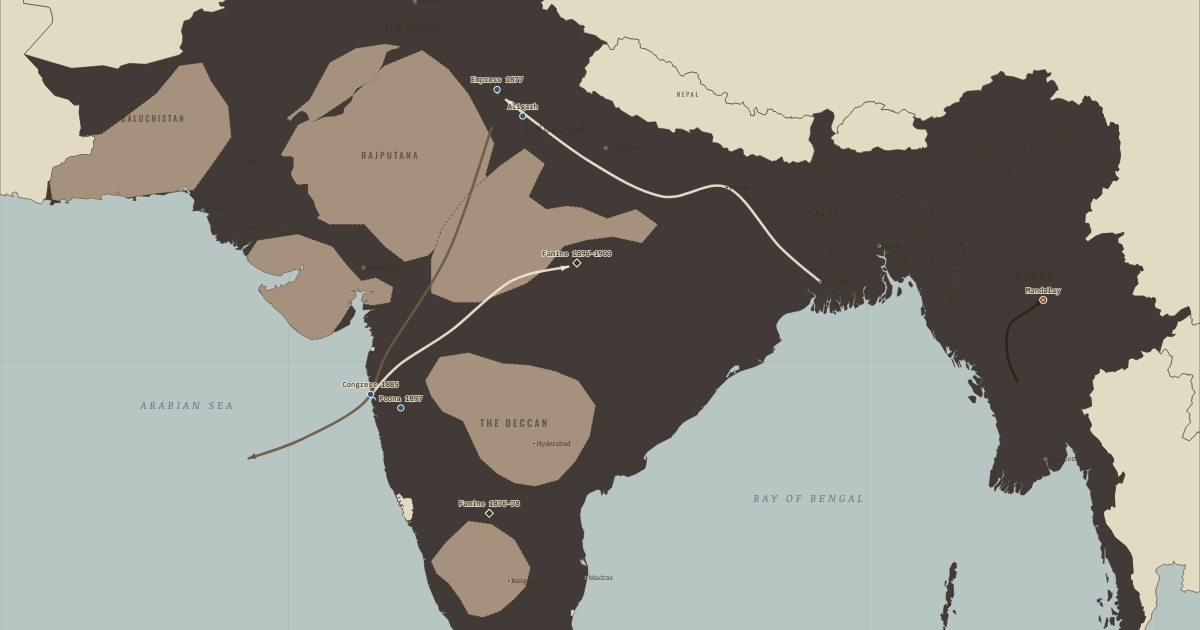
The Raj, as Crown rule over India was called, governed cheaply by relying on three pillars, and each of them shaped the map. The first was the Indian Civil Service, about a thousand British officers who ran every district, collected the land tax and sat as judges, much as a small corps of senior managers might run a vast company’s branches. Victoria had promised that her subjects would be admitted to office impartially, yet the examination was held only in London and its age limit was cut to nineteen in 1876, so only a handful of Indians entered. The second pillar was the princes, rulers of the semi-independent princely states, who were guaranteed their thrones and their right to adopt heirs; Mysore, run by British commissioners since 1831, was even returned to its dynasty in 1881. The third was an army rebuilt with more British troops and recruited in the Punjab and Nepal. Each pillar kept power in reliable hands, and each showed educated Indians where equality stopped.
The short answer
- The Crown’s promise and its limits. Queen Victoria’s proclamation of 1858 promised that Indians would be “freely and impartially admitted” to office, and educated Indians took the promise literally, while the Raj did not. The ICS examination was held only in London, and in 1876 the Secretary of State, Lord Salisbury, cut its upper age limit to nineteen (from the examination of 1878), which made it nearly impossible for Indian graduates to compete, so only a handful entered the service before the end of the century. A generation of lawyers and teachers learned that the Raj’s liberal language and its practice were different things, and they organised to close the gap.
- The Ilbert Bill and the lesson of agitation. The Ilbert Bill taught educated Indians how organised pressure worked, because they watched British residents use it against them. In 1883 the Viceroy, Lord Ripon, backed a bill drafted by his law member, Courtenay Ilbert, to let senior Indian magistrates try Europeans in rural courts. British planters, merchants and officials in Calcutta answered with an openly racial campaign, and in 1884 the government retreated to a compromise that let a European accused demand a jury at least half European. Indians drew two conclusions: that the Raj would bend to organised pressure, and that they had no comparable organisation of their own. Two years later they built one of their own, the Indian National Congress.
- Railways, print and English made an all-India public. The Raj unified India physically and intellectually in ways it did not intend. Railways let delegates from Madras, Lahore and Calcutta meet in a single city; the telegraph and cheap newspapers carried debates across provinces; and English, the language of the universities founded at Calcutta, Bombay and Madras in 1857, gave Bengalis, Marathas and Tamils a shared political language. Congress met in a different city each December, which only the railway made possible. The infrastructure of empire supplied nationalism with its delegates, its readers and its vocabulary.
- Famine and the economic case against the Raj. The famines gave nationalist economists their strongest evidence. Dadabhai Naoroji, whose estimates of income per head from the 1870s were collected in Poverty and Un-British Rule in India (1901), argued that a “drain” of tribute to Britain, through pensions, army costs and interest, kept India poor and therefore defenceless against drought. Romesh Chunder Dutt’s Economic History of India (1902–04) blamed heavy land revenue for the famines directly. The argument mattered because it turned British rule from a question of dignity into a question of livelihood, which any peasant could understand.
THE TURNING POINT
Bombay, 28 December 1885. The first session of Congress is the hinge of this chapter because it turned scattered local associations into a body that claimed to speak for India as a whole. Its 72 delegates came from every province, met under an Indian president, W. C. Bonnerjee, and passed resolutions addressed to the government of India and to Parliament. Its demands were modest: more elected Indians on the legislative councils, ICS examinations held in India as well as London, and lower military spending. What changed was the frame, because from 1885 the Raj faced a standing national opposition that met every year, and every later movement in this atlas, from Swadeshi to Quit India, worked through it or against it.
What it changed
Moderates and extremists. Within twenty years Congress divided over method. Moderates such as Gokhale believed that reasoned petitions to British liberals would win reform step by step. Tilak, sentenced to eighteen months for sedition in 1897 over articles in his newspaper Kesari, which had also attacked the plague searches in Poona, argued that only pressure would move the Raj, and he used the Ganapati and Shivaji festivals to carry nationalism into the street. The split became open at Surat in 1907, two chapters on, and its question, whether petition or pressure moved the Raj, ran through every later phase of the movement.
Muslim politics takes its own road. Sayyid Ahmad Khan believed that Muslims, about a fifth of the population and behind Hindus in English education, would be outvoted under any elected system, and in 1887–88 he urged them to keep out of Congress. His college at Aligarh trained the generation that founded the All-India Muslim League in 1906. The argument over whether India’s Muslims were a minority to be protected or a nation in their own right began here, half a century before anyone spoke of Pakistan.
Curzon inherits a confident empire. Lord Curzon inherited an empire that looked unshakeable, and he governed as if it were. When he became Viceroy in 1899 the Raj had absorbed Upper Burma, survived two great famines and kept Congress to annual petitions. He read that record as proof of permanence, staging the Delhi durbar, an imperial pageant, in 1903 and partitioning Bengal in 1905 with little regard for Indian opinion. That confidence is the starting point of the next chapter and its overreach the subject of the one after, because a ruler sure of permanence stops asking what his subjects will accept.
The drain becomes a nationalist creed. The economic critique built by Naoroji and Dutt gave Congress a programme that outlived its petitions. Swadeshi, the campaign begun in 1905 to buy goods made in India and boycott British ones, was the drain theory turned into action, and Gandhi later drew on the same arguments when he made homespun cloth the symbol of independence. The famines of 1876–1900 were the evidence the critique pointed to, which is why Indian economic nationalism began as a theory of hunger.
The full answer, argued
Drought caused the harvest failures and policy decided how many people died, so the strongest answer separates the trigger from the toll. The trigger was climatic, since the El Niño droughts of 1876–77 and 1896–97 were among the worst of the century across the tropics. The toll, however, depended on human choices. The government let grain be exported and moved by private traders to the highest bidder, set relief rations below what its own medical officers advised, and demanded hard labour before giving food, in the belief that generous relief would create dependency. Death rates were far lower where relief came early, and the Famine Codes after 1883 did save lives. Davis’s estimate of 12 to 29 million dead and Maharatna’s lower reconstructions differ on scale, yet both describe a catastrophe of many millions. A fair judgement is that drought was the trigger and British policy made the famine deadlier than it needed to be, because it put the market and the budget first. Amartya Sen later showed that people starve when they lose the means to buy food, even where food exists, and these famines are early evidence for his point.
An interesting fact
The first Congress was meant to meet in Poona, whose Sarvajanik Sabha was to host it, but an outbreak of cholera there forced a last-minute move to Bombay, where the Gokuldas Tejpal Sanskrit College lent its hall. Its leading economist later carried the argument into Parliament itself. In 1892 Dadabhai Naoroji won the London seat of Finsbury Central for the Liberals by just five votes, and he used his three years in the House of Commons to press the drain argument on the government that ruled India, a colonial subject lobbying the empire from inside its own legislature.
This is the study layer of British Raj and the early Congress, chapter 2 of Indian Independence & Partition, 1857–1964; the full index of the atlas is here.
Related questions
THE FREE PRINTABLE STUDY GUIDE
Join the Dispatch — a short welcome series, then a letter when a new atlas opens — and the printable study guide for Indian Independence & Partition is yours now, free.
NO TRACKING · YOUR ADDRESS IS USED FOR THE DISPATCH AND NOTHING ELSE · UNSUBSCRIBE ANYTIME