Haiti and Kenya independence · 1954
Did Mau Mau win Kenya’s independence?
Kenya’s Emergency began with Governor Evelyn Baring’s declaration of 20 October 1952, allowing detention without trial and collective punishment. The Kenya Land and Freedom Army fought from the Aberdare and Mount Kenya forests in what was also a Kikuyu civil war; in 1954 Operation Anvil sent some 16,000 to 24,000 men to camps.
Chapter 9 is part of membership. WW2 is free — every chapter. Try chapters 1–2 of any 2 other atlases (3 with a free account). Opening a new atlas uses one of them. Membership opens all 21 — Join.
Free printable Haiti and Kenya independence study guide, sent by email ↓
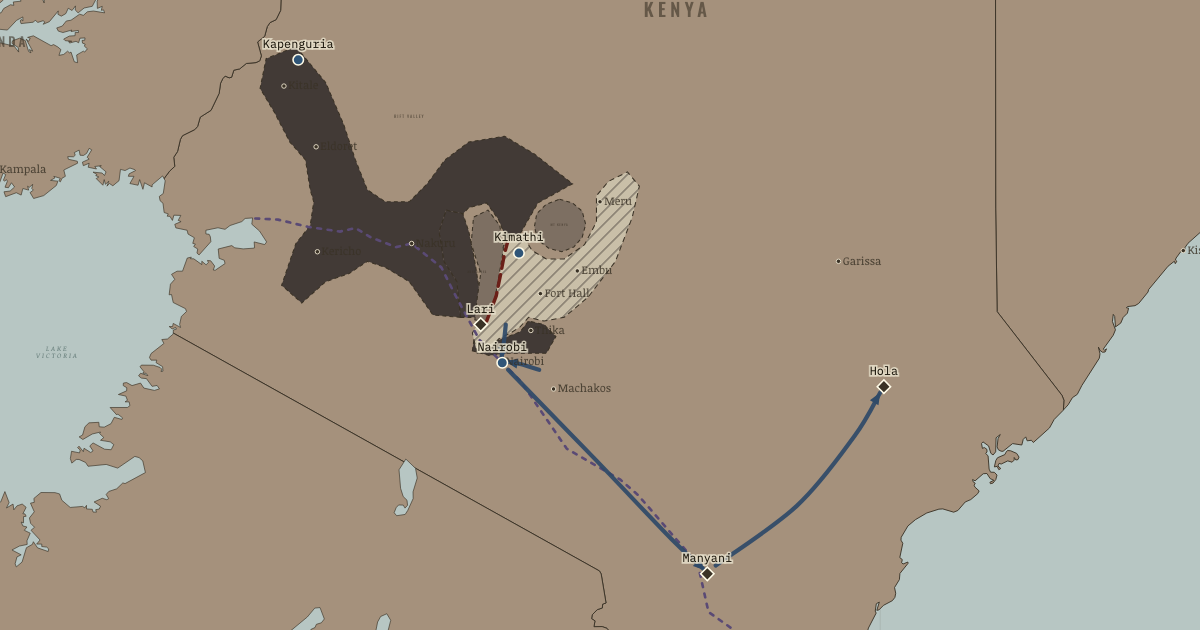
The rebellion was fought by poorly armed fighters with deep local support, and the first colonial response aimed at the leaders and the forests. Kenyatta and five KAU leaders were tried at Kapenguria, a remote schoolhouse chosen to keep crowds away, from December 1952 to April 1953, and sentenced to seven years’ hard labour on evidence that a key witness later swore he had been bribed to give. In the forests, fighters under Dedan Kimathi in the Aberdares and Waruhiu Itote on Mount Kenya, with women such as Muthoni wa Kirima among their commanders, ambushed patrols and drew food through networks of women in the reserves. On 26 March 1953 fighters killed 74 people at Lari, most of them families of loyalists, Kikuyu who sided with the colonial government, and security forces killed at least twice as many in reprisal. Lari drove thousands into the Home Guard, a loyalist militia of more than 25,000 men by 1954, and made the civil war inside the rebellion impossible to ignore.
The short answer
- An insurgency rooted in land. The forest armies drew their strength from the land crisis of the 1940s: squatters pushed off the farms, young men without plots in crowded reserves, and Nairobi’s unemployed. Their slogan, land and freedom, named the grievance plainly. Because the cause was so widely shared, the fighters could rely on food, shelter and intelligence carried by women and children in the reserves. That support made them hard to defeat by patrols alone, and it pushed the government toward measures aimed at whole communities.
- A civil war inside a colonial war. The oath divided Kikuyu society before October 1952, and the fighting deepened the split. Insurgents killed chiefs, headmen, Christians and their families; loyalists joined the Home Guard, which grew to more than 25,000 men by 1954. Lari in March 1953 hardened both sides. Because Kikuyu fought Kikuyu, the government could recruit local allies who knew the villages and the forest paths, and that knowledge mattered as much as British battalions in defeating the rebellion.
- Counter-insurgency against a whole people. The colonial state set out in 1954 to control an entire population, having concluded that hunting the fighters alone could not win. Operation Anvil emptied Nairobi of suspects, villagisation moved over a million people behind wire, and the detention pipeline held tens of thousands without trial. These methods cut the forest armies off from food and recruits within two years. They also produced the abuses, from forced labour to beatings in the camps, that later made the victory impossible to defend.
- A Britain reconsidering its empire. The Emergency was expensive, and after the Suez crisis of 1956 British leaders questioned whether colonies held by force were worth their cost. Harold Macmillan’s government reviewed the empire’s balance sheet in 1957, and the scandals of 1959, Hola in Kenya and the Devlin Report on Nyasaland, arrived in the same month of parliamentary debate. After the October 1959 election Macmillan appointed Iain Macleod as Colonial Secretary, and Macleod moved quickly toward majority rule.
THE TURNING POINT
Hola camp, 3 March 1959. Hola is the hinge because it turned the Emergency from a military success into a political liability. The eleven men killed that day were detainees classed as hard core who had refused to work; guards were following a plan, drawn up in the prisons department, to force them, and the first official story blamed contaminated water. When the cover-up failed, the killings were debated in the House of Commons on 27 July 1959, in the same weeks as the Devlin Report condemned British conduct in Nyasaland. Ministers concluded that the camps could no longer be defended at home. Within six months the Emergency had ended and the conference that would lead to African majority rule had begun in London.
What it changed
The Emergency ends and the talks begin. With the forest war over and the camps discredited, Britain lifted the Emergency on 12 January 1960, days before the first Lancaster House conference opened in London. Detainees were released in stages, and former prisoners such as Kenyatta, Kaggia and Kubai returned to a political world transformed by the elections of 1957, which had brought Tom Mboya and Oginga Odinga into the Legislative Council.
A loyalist landed class. The Swynnerton Plan’s consolidation and titling of land, carried out while thousands of suspected rebels were detained, left loyal families with secure farms and the right to grow coffee. That class of African smallholders and traders became a pillar of the independent state, and its gains help explain why independent Kenya never returned the land that detainees had lost. Many of the chiefs, civil servants and politicians of the 1960s came from these families, so the winners of the Emergency also wrote the rules of the new state.
A war remembered in silence. Independent Kenya kept Mau Mau at arm’s length: the movement stayed banned until 2003, and Kenyatta urged Kenyans to forgive and forget. The silence suited both former colonisers and the new elite. The memory returned through courts, archives and memorials only in the twenty-first century, when a statue of the forest leader Dedan Kimathi rose in central Nairobi in 2007 and ageing veterans sued the British government. The people the new state had asked to forget had forced both governments to remember.
The full answer, argued
Militarily it lost: by late 1956 the forest armies were broken, Kimathi was captured, and tens of thousands of suspected supporters were held in detention camps. The constitutional settlement of 1960–63 was negotiated by politicians, many of whom, like Mboya, had never fought, and the loyalist side of the civil war kept land and office. Yet the rebellion forced the pace: the Emergency was costly, it exposed the settlers’ dependence on British troops, and the methods used against it, culminating in the killing of eleven detainees by guards at Hola camp in March 1959, convinced London that colonial rule could not be defended. Historians divide on the weight of each point. Branch argues that defeating Mau Mau created Kenya’s ruling order, while Anderson and Elkins stress how the war’s violence discredited empire. A balanced answer concludes that the rebellion made independence urgent and others decided its shape. The transferable lesson is that losers on the battlefield can still change the political calculation of those who beat them.
An interesting fact
Muthoni wa Kirima was the only woman to reach the rank of field marshal in the forest armies, where women served as fighters, scouts and suppliers as well as cooks and carriers. After the war she kept the dreadlocks she had grown in the forest for almost seventy years, finally cutting them in April 2022 when she was about ninety. She died on 4 September 2023. Her uncut hair became a living reminder, in a country that kept the movement banned until 2003, that the fighters themselves had not forgotten.
This is the study layer of Mau Mau uprising and the Emergency, chapter 9 of Two Roads to Independence: Haiti 1789–1838 and Kenya 1895–1978; the full index of the atlas is here.
Related questions
THE FREE PRINTABLE STUDY GUIDE
Join the Dispatch — a short welcome series, then a letter when a new atlas opens — and the printable study guide for Two Roads to Independence is yours now, free.
NO TRACKING · YOUR ADDRESS IS USED FOR THE DISPATCH AND NOTHING ELSE · UNSUBSCRIBE ANYTIME