Feminism and the Tunisian Revolution · 1982
Why did the Equal Rights Amendment fail?
The seminar question: “Did the ERA fail because of Phyllis Schlafly, or because of the rules for amending the Constitution?”
Congress passed the Equal Rights Amendment on 22 March 1972, and 22 states ratified it that year, reaching 30 by March 1973, with 38 needed. In autumn 1972 Phyllis Schlafly founded STOP ERA, and a counter-movement organised largely by women stalled ratification until the amendment failed.
Chapter 5 is part of membership. WW2 is free — every chapter. Try chapters 1–2 of any 2 other atlases (3 with a free account). Opening a new atlas uses one of them. Membership opens all 21 — Join.
Free printable Feminism and the Tunisian Revolution study guide, sent by email ↓
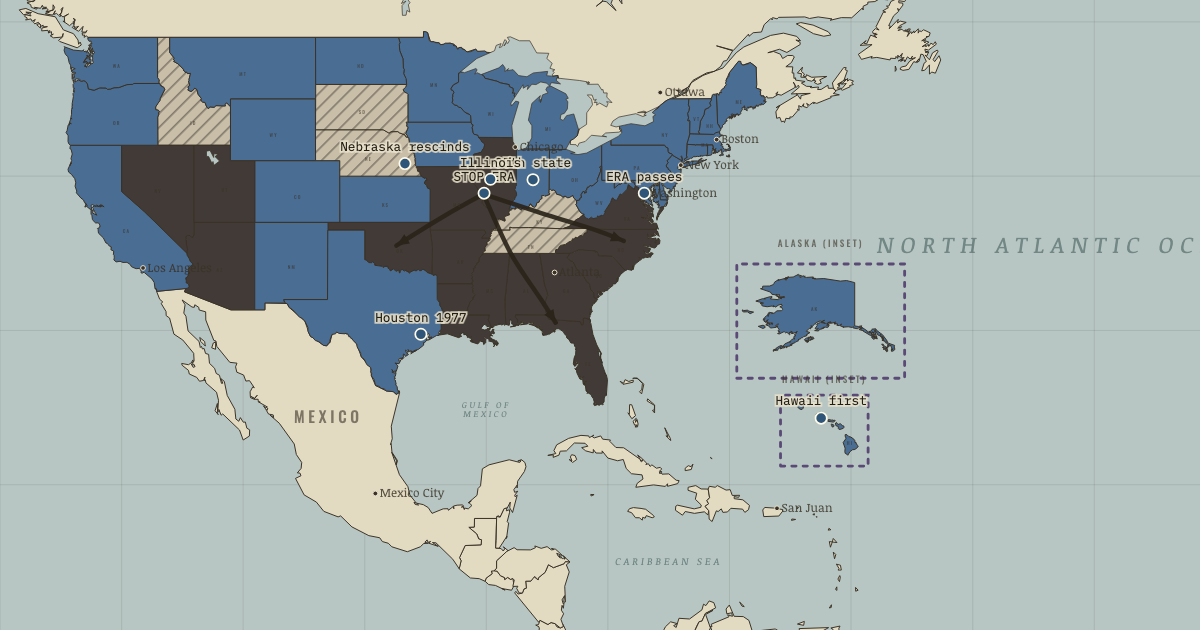
The ERA began with enormous momentum because almost everyone in power claimed to support it. Alice Paul of the National Woman’s Party had first drafted an amendment in 1923, both major parties had endorsed it in their platforms for decades, and by 1972 President Nixon, a growing number of trade unions and the new women’s organisations all backed it. The Senate passed it by 84 votes to 8. On the map the first snapshot shows 22 states ratifying within nine months, many with little debate: Hawaii on the same day, then New Hampshire, Delaware, Iowa, Idaho, Kansas, Nebraska and Texas within about a week. By March 1973 the total reached 30, and only eight more were needed. The speed of the early votes concealed a weakness, because legislators who ratify without debate have not been persuaded and can be unpersuaded.
The short answer
- A supermajority rule. Because 38 of 50 states had to ratify, opponents needed to hold only 13 states, and in each of them they needed to persuade only one chamber of the legislature. A movement that wins the national argument can still lose if its opponents are concentrated in enough places. The rule favoured the South and the Mormon West, where conservative churches were strongest and where the ERA was most easily presented as an attack on local values.
- A counter-movement of women. STOP ERA was effective because it was led by women who spoke as homemakers defending the respect and security they believed the law gave them. Legislators could not easily dismiss it as men defending privilege. Schlafly also offered her followers a positive identity, the full-time wife and mother, at a moment when many felt that feminism looked down on them, so the backlash drew its strength from the same politics of identity that had built the women’s movement.
- Abortion and the culture war. Abortion turned the ERA into a battle over the family: after Roe v. Wade in 1973, opponents argued that the ERA would also protect abortion and, later, gay rights, which drew Catholic, evangelical and Mormon churches into the campaign. By the late 1970s many of STOP ERA’s most active volunteers had been recruited through their congregations. The ERA ceased to be a narrow legal question and became a symbol in a wider conflict over the family. Each victory of one movement can hand its opponents a new reason to organise.
- The decision lay with legislators. Ratification was decided by a few thousand state legislators, most of them men, many in part-time assemblies where personal lobbying mattered enormously. Polls showed majority support for the ERA nationally, but legislators heard most from the most intensely committed citizens, and in the late 1970s the most intense were the ERA’s opponents. In Illinois, Florida and North Carolina the decisive votes were lost by only a handful of legislators. Intensity often beats breadth in politics.
THE TURNING POINT
STOP ERA, autumn 1972. The founding of STOP ERA is the hinge because the pace of ratification changed almost at once. Twenty-two states ratified in 1972, eight in 1973, three in 1974, one in 1975, none in 1976 and one in 1977, and the first rescission came in March 1973. Before Schlafly organised, the ERA was a consensus measure that legislators passed without thinking; after she organised, it was a controversy that cautious legislators avoided. She proved that a counter-movement can defeat a protest movement by changing what a question is about, in this case from equal rights to the future of the family.
What it changed
Equality by other routes. Much of what the ERA promised arrived through courts and statutes: the Supreme Court’s rulings in Reed v. Reed (1971) and Craig v. Boren (1976) subjected sex discrimination to stricter review, meaning that courts demanded a strong justification for any law that treated men and women differently. Congress also passed the Equal Credit Opportunity Act (1974) and the Pregnancy Discrimination Act (1978). The defeat of the symbol did not reverse the legal change already under way.
The rise of the New Right. The STOP ERA network became one of the foundations of a new conservative coalition of churches and grassroots activists. In 1980 the Republican Party dropped the support for the ERA it had held since 1940, and Ronald Reagan won the presidency. A “gender gap”, with women voting less Republican than men, appeared in that same election and has persisted since.
An amendment that never quite died. The ERA has been reintroduced in almost every Congress since 1982. Nevada, Illinois and Virginia ratified it between 2017 and 2020, taking the total to 38, but because the deadline had passed and five states had rescinded, its legal status remains disputed. The fight shows how a defeated cause can remain a symbol long after its practical purpose has been met elsewhere.
The full answer, argued
Schlafly’s role was real and measurable: ratifications slowed sharply after STOP ERA formed, and her movement supplied the arguments, volunteers and pressure that turned wavering legislators in Illinois, Florida, North Carolina and elsewhere. Yet the rules for amendment were what made her campaign decisive. A national poll majority was not enough when 13 states could block the change, when Illinois required a three-fifths vote, and when a deadline gave opponents a date by which they simply had to hold their ground. Some supporters also contributed to the defeat by overstating what the amendment would do, which gave Schlafly her best material, as Mansbridge argues. The most persuasive answer is that Schlafly turned a structural possibility into an actual defeat: without the supermajority rule her campaign could only have delayed the ERA, and without her campaign the rule would probably not have mattered. The transferable lesson is that the outcome of protest depends on the interaction between agency and institutions, because the same movement can win under one set of rules and lose under another.
An interesting fact
Phyllis Schlafly, the woman who did most to defeat an amendment designed to open careers to women, built a remarkable career of her own. She had run unsuccessfully for Congress in Illinois more than once, first in 1952, and her 1964 book A Choice Not an Echo sold about three million copies in support of Barry Goldwater’s presidential campaign. In the middle of the ERA struggle, in her fifties, she earned a law degree from Washington University in St. Louis, graduating in 1978. Her opponents pointed out the irony; her supporters saw a woman who had achieved everything she wanted without needing the amendment, which was precisely her argument.
This is the study layer of Equal Rights Amendment, chapter 5 of Protest and Change: Second-Wave Feminism and Tunisia, 1945–2015; the full index of the atlas is here.
Related questions
THE FREE PRINTABLE STUDY GUIDE
Join the Dispatch — a short welcome series, then a letter when a new atlas opens — and the printable study guide for Protest and Change is yours now, free.
NO TRACKING · YOUR ADDRESS IS USED FOR THE DISPATCH AND NOTHING ELSE · UNSUBSCRIBE ANYTIME