Feminism and the Tunisian Revolution · 1985
Did the UN Decade for Women unite or divide women?
The seminar question: “Did the UN Decade for Women unite women across the world, or reveal how divided they were?”
The UN declared 1975 International Women’s Year and 1976–1985 the Decade for Women, with world conferences in Mexico City, Copenhagen and Nairobi. Its most lasting result was CEDAW, the Convention on the Elimination of All Forms of Discrimination against Women, adopted by the General Assembly on 18 December 1979.
Chapter 6 is part of membership. WW2 is free — every chapter. Try chapters 1–2 of any 2 other atlases (3 with a free account). Opening a new atlas uses one of them. Membership opens all 21 — Join.
Free printable Feminism and the Tunisian Revolution study guide, sent by email ↓
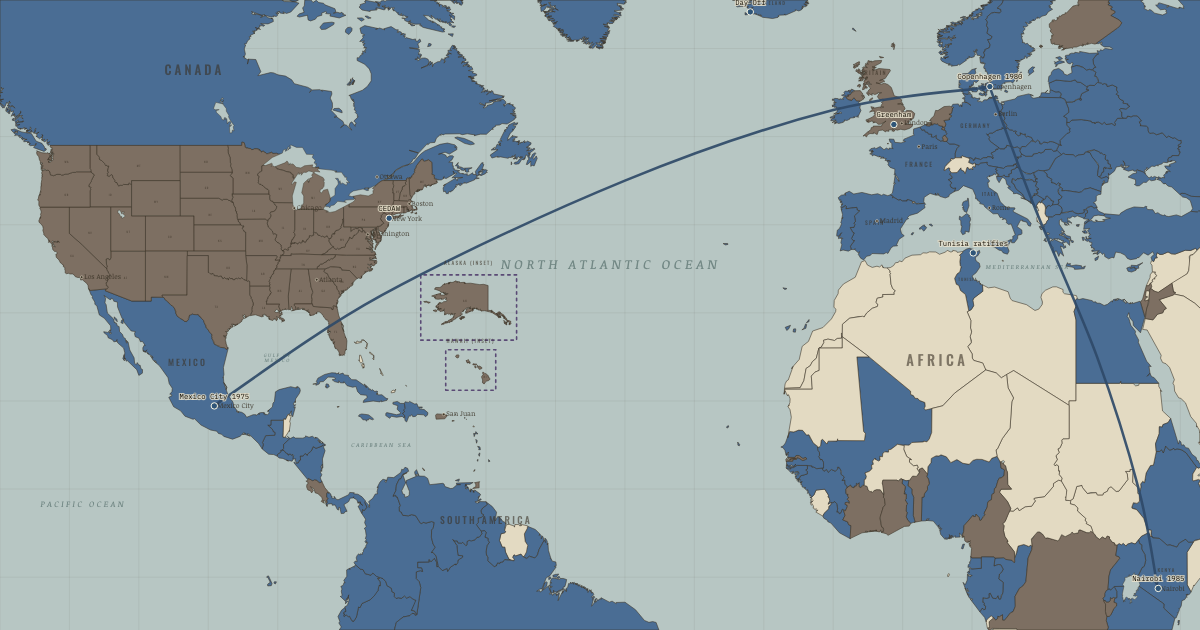
The UN became feminism’s global stage because it combined a forum, a staff and the authority to set standards. Its Commission on the Status of Women, a committee of government delegates, had monitored women’s rights since 1946. The proposal for an International Women’s Year came in 1972 from the Women’s International Democratic Federation, aligned with the Soviet bloc, which shows how Cold War competition to appear progressive helped put women on the agenda. The first World Conference on Women met in Mexico City in June and July 1975, with delegations from 133 governments. A parallel forum, the Tribune, gathered non-governmental organisations (NGOs), citizens’ groups much like today’s charities. There Domitila Barrios de Chungara, the wife of a Bolivian tin miner, challenged middle-class feminists from the North. Her community’s enemy, she argued, was poverty and the mine owners, and men and women had to fight it together. The quarrel announced the central tension of the Decade, between a feminism of legal equality and a feminism of survival.
The short answer
- The UN as an amplifier. An international institution can magnify a movement by making governments answer questions they would otherwise avoid, and the UN had the tools to do so: a Commission on the Status of Women from 1946 and the authority to declare years, convene conferences and draft treaties. Once International Women’s Year was approved, governments had to send delegations and write reports on women’s status, and these obligations turned ministries and statisticians into collectors of evidence about inequality. The same machinery lent weight to activists who had little leverage over their own governments.
- Decolonisation changed the room. Decolonisation changed who sat in the room: by 1975 the UN had 144 members, most of them from Africa, Asia and Latin America, many independent for less than twenty years, and African states alone held about a third of the seats. Their delegates brought priorities shaped by colonialism and poverty, and they could outvote the Western states. The Decade therefore had to address development and peace alongside legal equality, which broadened feminism and also produced its sharpest quarrels.
- A Western movement looking outward. After a decade of domestic campaigns, American and European feminists were eager to build international solidarity, and their organisations had money, publications and experience to export. Their confidence brought energy to the conferences and also provoked resentment when they assumed that their own agenda, such as abortion rights or workplace equality, was everyone’s. Many delegates from the Global South saw the men of their own communities as allies in struggles against poverty and imperialism, a view that Western radical feminists found hard to accept.
- Cold War competition. The Soviet Union and its allies presented themselves as pioneers of women’s equality, pointing to women’s high employment rates and state childcare, and the Women’s International Democratic Federation proposed International Women’s Year. The United States and its allies could not afford to appear less committed. Here superpower rivalry, an unlikely ally of women’s rights, raised the political price of ignoring them.
THE TURNING POINT
CEDAW adopted, 18 December 1979. The adoption of CEDAW is the hinge because it converted a decade of declarations and conferences into a binding legal standard that states could join, be measured against and be pressed to honour. Earlier documents, such as the 1967 Declaration on discrimination against women, had no reporting system or committee. By the end of 1985 more than seventy states had ratified it. The treaty also carried the movement’s ideas into family law and culture through Articles 5 and 16, areas many governments had treated as off limits. A protest movement achieves its most durable change when it writes its demands into rules that outlast the protest.
What it changed
A standard for movements everywhere. The CEDAW Committee of independent experts, which first met in October 1982 and reviewed its first national reports the next year, gave campaigners an international audience. Activists in dozens of countries used the treaty to challenge discriminatory laws on nationality, inheritance and family. In Tunisia, which ratified with reservations in 1985, women’s organisations campaigned for decades to lift them, and after the 2011 revolution the government withdrew its specific reservations while keeping a general declaration, which shows that a treaty works slowly and only when someone at home uses it.
Feminism of the Global South. Networks such as DAWN and the women who filled the Nairobi Forum made development, debt and poverty central to international feminism. The next world conference, in Beijing in 1995, adopted a Platform for Action that reflected this broader agenda, declaring that “women’s rights are human rights”. It also placed violence against women at the centre of the agenda, an issue largely missing from CEDAW’s original text.
The United States stays outside. The Senate never ratified CEDAW, despite hearings in later decades, which left the United States among a handful of UN members outside the treaty. Senators opposed to ratification argued that it would intrude on family law and national sovereignty. The movement’s most famous homeland had changed its own laws through courts and statutes, while declining international oversight of them, a gap that critics abroad have cited ever since.
The full answer, argued
The Decade certainly revealed how divided women were, along lines of class, region and politics. At Mexico City the Bolivian miner’s wife Domitila Barrios de Chungara’s challenge to Western feminists exposed a gulf between a feminism of legal equality and a feminism of survival. The conferences of 1975 and 1980 also split over Zionism, the movement for a Jewish state, over apartheid and over the world economy. Yet the same Decade produced CEDAW, adopted by the UN General Assembly without a single vote against, and built networks of women who had never met before, such as the 12,000 to 15,000 people at the Nairobi Forum. The divisions were themselves a sign of unity of a kind, because women who disagreed were for the first time arguing inside shared institutions. Olcott’s work suggests that the quarrels were the Decade’s real achievement, since they forced Western feminists to recognise that their agenda was one among many. The most persuasive judgement is that the Decade replaced the illusion of a single global sisterhood with a working coalition of different movements. The transferable lesson is that international protest succeeds, when it does, by giving people with different priorities a common framework in which to bargain.
An interesting fact
The first United Nations world conference on women was chaired by a man. When the delegates met in Mexico City in June 1975, the host government’s nominee, Mexico’s attorney general Pedro Ojeda Paullada, was elected president of the conference, a choice that delegates and journalists at the time noted with irony. The conference’s emblem, a stylised dove combined with the symbol for woman and an equals sign, was designed by the American graphic artist Valerie Pettis and became the symbol of the whole Decade for Women. The chair went to the host country by custom, a convention that made the irony possible.
This is the study layer of UN Decade for Women and CEDAW, chapter 6 of Protest and Change: Second-Wave Feminism and Tunisia, 1945–2015; the full index of the atlas is here.
Related questions
THE FREE PRINTABLE STUDY GUIDE
Join the Dispatch — a short welcome series, then a letter when a new atlas opens — and the printable study guide for Protest and Change is yours now, free.
NO TRACKING · YOUR ADDRESS IS USED FOR THE DISPATCH AND NOTHING ELSE · UNSUBSCRIBE ANYTIME