Feminism and the Tunisian Revolution · 1972
Was consciousness-raising politics or therapy?
The seminar question: “Was consciousness-raising a political method, or a form of therapy that distracted women from politics?”
Second-wave feminists argued that problems women experienced as private, in marriage, housework and pregnancy, were produced by social power. Consciousness-raising groups spread through the United States, Britain and France between 1968 and 1972, and the campaign to repeal abortion laws led to Roe v. Wade on 22 January 1973.
Chapter 3 is part of membership. WW2 is free — every chapter. Try chapters 1–2 of any 2 other atlases (3 with a free account). Opening a new atlas uses one of them. Membership opens all 21 — Join.
Free printable Feminism and the Tunisian Revolution study guide, sent by email ↓
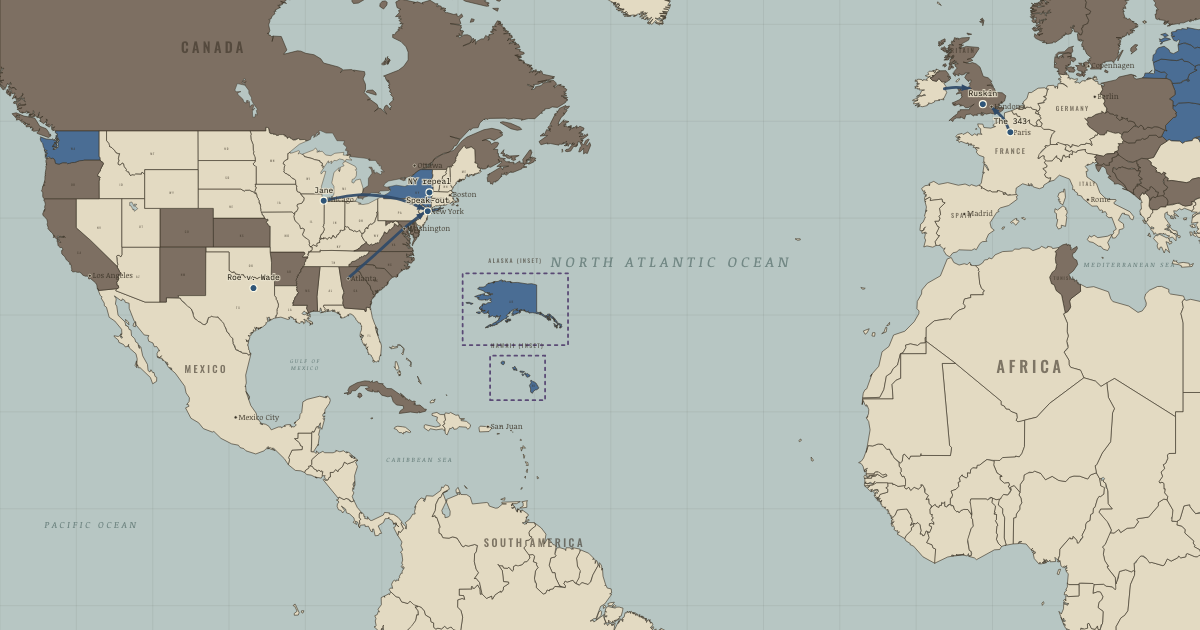
Consciousness-raising, in which small groups of women compared their lives much as a support group does, turned complaint into analysis because it treated each woman’s experience as evidence. In 1968 Kathie Sarachild of New York Radical Women described the method: members answered one question at a time, about their mothers, jobs or first sexual experiences, and looked for the pattern. Carol Hanisch defended the practice in a 1969 paper that her editors titled “The Personal Is Political”, arguing that these groups were political action because they traced women’s unhappiness to the power men held in marriage, work and law. By the early 1970s tens of thousands of women had joined such groups. In February 1970 between 500 and 600 women met at Ruskin College, Oxford, for Britain’s first national women’s liberation conference and demanded equal pay, equal education, 24-hour nurseries and free contraception and abortion on demand. A method invented in small rooms became the grammar of a mass movement.
The short answer
- A method that turned experience into evidence. Consciousness-raising groups gave women a way to see that their individual problems, from housework to sexual coercion, followed common patterns. Once a pattern is visible it can be blamed on institutions and law, which turns a private sorrow into a political grievance. The method was cheap, needed no leaders and could be copied anywhere, which is why it spread faster than any organisation could recruit. Its findings also gave women the confidence that they spoke for many others, which is the precondition of any public protest.
- An injustice that fell hardest on the poor. Illegal abortion was available to women who could pay a sympathetic doctor or travel abroad, and dangerous for those who could not. Wealthier women could travel abroad or persuade a hospital committee to approve a “therapeutic” abortion, options that were closed to most poor women. Hospital wards for septic abortion filled with poor women, and maternal deaths fell disproportionately on Black and Puerto Rican women. The visible inequality of the old system made repeal an argument about fairness, which broadened its appeal far beyond the women’s movement.
- Doctors, lawyers and clergy changed sides. Reform gained respectable allies when professionals changed sides: from the early 1960s the American Law Institute, an influential body of lawyers, proposed allowing abortion on limited medical grounds, and many doctors who saw the results of illegal procedures supported reform. In 1967 a network of Protestant and Jewish clergy in New York began referring women to safe providers. When professional elites shift, protest movements gain allies who can draft laws and testify with authority. Their support also made reform respectable to legislators who would never have listened to radical feminists.
- Public confession as a weapon. Speak-outs, manifestos and courtroom protests broke the secrecy on which the old laws depended. When famous women such as Beauvoir and Catherine Deneuve announced that they had broken the law, prosecutors faced a choice between enforcing it against the respectable and admitting that it was unenforceable. The same tactic ran through gay liberation’s contemporary call to “come out” and reappeared decades later in the online testimonies of #MeToo. Making a crime public and collective can make a law collapse, because laws depend on being obeyed quietly.
THE TURNING POINT
Roe v. Wade, 22 January 1973. Roe is the hinge because it converted a slow, uneven state-by-state campaign into a national right in a single day, erasing the patchwork on the map. The case had been filed in Dallas in 1970 by two young lawyers, Sarah Weddington and Linda Coffee, on behalf of Norma McCorvey, a pregnant woman who could not afford to travel to a state where abortion was legal. By ruling that the right to privacy covered a woman’s decision, the Court protected women in the parchment and grey-tan states who had no political route to change their own laws. Its framing of abortion as a private choice, which placed no duty on government to provide care, would shape almost fifty years of conflict, until the Supreme Court overturned the ruling in 2022.
What it changed
A national right and a national opposition. After 1973 abortion was legal in early pregnancy everywhere in the United States, and the movement to reverse it became a national political force. Catholic organisations and, from the late 1970s, evangelical Protestants made opposition to abortion central to a new conservative politics, which joined the campaign against the Equal Rights Amendment. Abortion became one of the most divisive issues in American politics and remained so for half a century.
Rights without access. The Hyde Amendment of 1976 stopped Medicaid, the public health insurance for people on low incomes, from paying for most abortions, so the right remained but poor women increasingly could not afford to use it. Feminists of colour argued that a movement centred on “choice” had ignored the material conditions and the abuses, such as forced sterilisation, that shaped their reproductive lives. The gap arose because the Court defined the right as freedom from state interference, which protected a woman’s choice without paying for it.
Europe follows a similar path. Western Europe followed the same path of confession, trial and reform. France’s Veil law of January 1975, carried through parliament by the health minister Simone Veil against fierce hostility in her own majority, legalised abortion in the first ten weeks, and Italy followed in 1978 after a long campaign of civil disobedience. Ireland and Northern Ireland held out for decades, which shows that public confession could change the law only where religious authority no longer dominated politics.
The full answer, argued
Critics at the time, including some socialist feminists and many men on the left, argued that talking about personal experience was self-absorbed and that real politics meant organising workers or opposing the war in Vietnam. The evidence of this chapter suggests otherwise. The groups produced a shared analysis that moved directly into action: the Redstockings speak-out grew out of consciousness-raising, and the same logic of making private experience public drove the Manifesto of the 343 and the Bobigny trial, both of which helped change national laws. The method also reached women who would never have joined a party or a union. Its limits were real, because groups were often homogeneous, mostly white and middle-class, so the patterns they found reflected the experiences of their members and missed those of others. The fairest judgement is that consciousness-raising was a genuinely political method whose findings were only as broad as the women in the room. The transferable lesson is that the way a movement gathers its evidence decides whose problems it will see.
An interesting fact
The Manifesto of the 343 is remembered in France by an insult. A week after it appeared, the satirical weekly Charlie Hebdo ran a cover headline asking “Who got the 343 sluts from the abortion manifesto pregnant?”, with a cartoon of the defence minister Michel Debré, a champion of a higher birth rate, replying “It was for France!” The phrase “the 343 sluts” (les 343 salopes) stuck; some signatories later wore it as a badge of defiance, while others rejected it. The signatories included the novelists Marguerite Duras and Françoise Sagan, the actresses Catherine Deneuve and Jeanne Moreau, the filmmaker Agnès Varda and the lawyer Gisèle Halimi, who defended the Bobigny accused the following year, so the insult was aimed at some of the most admired women in France.
This is the study layer of The personal is political, chapter 3 of Protest and Change: Second-Wave Feminism and Tunisia, 1945–2015; the full index of the atlas is here.
Related questions
THE FREE PRINTABLE STUDY GUIDE
Join the Dispatch — a short welcome series, then a letter when a new atlas opens — and the printable study guide for Protest and Change is yours now, free.
NO TRACKING · YOUR ADDRESS IS USED FOR THE DISPATCH AND NOTHING ELSE · UNSUBSCRIBE ANYTIME