Feminism and the Tunisian Revolution · 1956
Was the Personal Status Code a victory for Tunisian women?
The seminar question: “Was the Personal Status Code a victory for Tunisian women, or a tool of Bourguiba’s state?”
Tunisia became independent from France on 20 March 1956 under Habib Bourguiba, and on 13 August 1956 his government decreed the Personal Status Code, which banned polygamy, ended divorce by a husband’s declaration and required a bride’s consent. Women first voted in 1957, but rights came without the freedom to organise.
Chapter 7 is part of membership. WW2 is free — every chapter. Try chapters 1–2 of any 2 other atlases (3 with a free account). Opening a new atlas uses one of them. Membership opens all 21 — Join.
Free printable Feminism and the Tunisian Revolution study guide, sent by email ↓
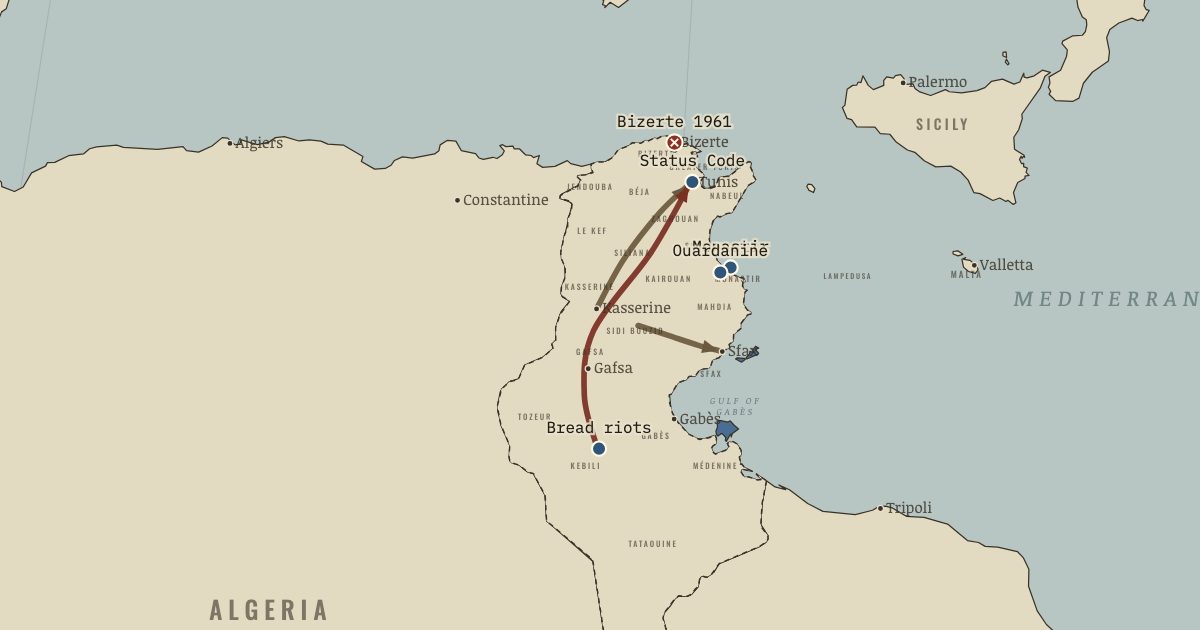
The Personal Status Code was possible because Bourguiba’s state depended less on traditional authorities than any of its neighbours. It was decreed on 13 August 1956 and took effect on 1 January 1957, before Tunisia even had a constitution. The sociologist Mounira Charrad explains why Tunisia went further than Morocco or Algeria. The Neo-Destour was a party of urban professionals and townsmen of the Sahel, the coastal plain around Sousse and Monastir, and it had defeated a rival nationalist faction backed by rural notables and conservative clergy. It therefore did not need the support of tribal kin groups, whose power rested on family law that kept property and marriages within the lineage. Bourguiba presented the Code as a modern reading of Islamic law, drawing on reformers such as Tahar Haddad, whose 1930 book on women in the Sharia had been condemned by the religious establishment. On the map Tunisia is blue while Algeria, then a French colony at war, and Libya remain parchment, because their family law still allowed polygamy, a contrast that came from the structure of each state more than from its religion.
The short answer
- A nationalist party that owed little to tradition. Tunisia’s family law was reformed quickly because the party that won independence had little attachment to religious tradition. The Neo-Destour (“New Constitution”) party, founded in 1934 at Ksar Hellal in the Sahel, Tunisia’s coastal heartland, was led by French-educated lawyers and teachers who wanted a modern nation-state. In 1955–56 Bourguiba defeated his rival Salah Ben Youssef, whose pan-Arab nationalism, the hope of uniting all Arabic-speaking peoples, attracted conservative clergy and rural notables. Victory left Bourguiba free of the groups most opposed to changing family law, which explains why reform came so fast. Ben Youssef himself was assassinated in Frankfurt in 1961, a reminder of how ruthlessly the victors guarded their position.
- A reformist tradition within Islam. Tunisian reformers had argued for decades that Islamic law could be reinterpreted for modern life, a practice known as ijtihad, the independent reasoning of a qualified scholar. Tahar Haddad’s 1930 book called for women’s education and an end to polygamy. The Code drew on this tradition and was presented as faithful to Islam, which made it harder for religious opponents to reject it outright. Haddad had died poor and isolated in 1935, and the Code turned a condemned dissident into a national prophet.
- Women as citizens of a new nation. Bourguiba saw the patriarchal extended family as an obstacle to national unity and economic development. Educated women workers and smaller families would, in his view, make Tunisia modern, so the Code was part of a wider programme of schooling, family planning and secular courts. Rapid population growth also made family planning an economic priority for the new state. Women’s rights were a means to the state’s ends as well as an end in themselves, which shaped their limits.
- A state without counterweights. Because the party controlled the Constituent Assembly, the press and, from 1963, all legal political life, the government could decree reforms without negotiating with parliament, clergy or the public. The UGTT, the one mass organisation with an independent base, was purged whenever its leaders defied the party, as in 1978. The same concentration of power that made rapid reform possible also prevented independent organisations, including women’s groups and unions, from acting freely, which left the interior with no voice when development passed it by.
THE TURNING POINT
The Personal Status Code, 13 August 1956. The Code is the hinge of this chapter because it defined the relationship between the Tunisian state and women for the next sixty years. By abolishing polygamy and repudiation and making divorce a matter for the courts, it gave Tunisian women legal rights that women in most of the Arab world would wait decades for, and 13 August became National Women’s Day. It also established the bargain at the centre of this case study: rights granted by an authoritarian state in exchange for political silence. Every later ruler, Ben Ali and the Islamist-led government of 2012 alike, had to define himself in relation to the Code, which shows how a reform from above can become a red line defended from below.
What it changed
The most liberal family law in the Arab world. The Code was extended under Bourguiba and Ben Ali, for example in 1993, when mothers gained new rights over their children. It became part of Tunisian national identity, so that when a draft constitution of 2012 described women as “complementary” to men, thousands marched to defend the rights the Code had created. Ben Ali presented himself as the Code’s guardian, which helped him win Western support while he repressed Islamists.
Rights without the freedom to organise. Because the only legal women’s organisation belonged to the ruling party, Tunisian women had rights on paper and little independent means to use or extend them. Independent feminist associations appeared only in the late 1980s and spent two decades under police surveillance, though many of the women who led protests in 2011 and 2012 came from them. Rights granted by a state can be defended only by citizens free to organise, which is why women’s groups emerged as organised actors only after 2011.
A country divided between coast and interior. Regional inequality became a lasting feature of the state Bourguiba built. Young people from the interior migrated to the coast or abroad, and those who stayed faced fewer jobs, schools and hospitals. In 2010 poverty in the Centre-West was four times that of the coastal Centre-East. Their resentment, voiced in the bread riots of 1984 and the mining-basin revolt of 2008, exploded in Sidi Bouzid in December 2010, so the development model that favoured the coast built the grievance that would bring down Bourguiba’s successor.
A succession crisis waiting to happen. By the mid-1980s Bourguiba was in his eighties and erratic, dismissing prime ministers and divorcing his influential wife in 1986. Islamist activists of the new Islamic Tendency Movement were tried in 1987, and Bourguiba demanded death sentences. His prime minister, Zine el-Abidine Ben Ali, used the crisis to have him declared medically unfit in November 1987, a bloodless coup that was at first widely welcomed. A president for life could be removed only by declaring him unfit, so the succession came through a medical coup dressed in constitutional form.
The full answer, argued
The case for victory is strong. The Code abolished polygamy and repudiation, made divorce a judicial right for both spouses and set the foundation for votes, schooling, contraception and legal abortion, giving Tunisian women rights that most women in the region would wait decades to win. Its durability shows that many Tunisian women came to treat it as their own. Yet the evidence also shows a tool of the state. It was decreed without public debate, used to weaken the religious establishment, and accompanied by a ban on independent women’s organisations, so women could not defend or extend their rights except through the party. Its benefits also reached urban, educated women faster than rural women of the interior. Charrad’s structural argument suggests that the question is partly false, since a state that needed no support from kin groups could afford to give women rights for its own reasons. The most persuasive judgement is that the Code was both, a real gain delivered as an instrument of power. The transferable insight is that rights granted from above are only secure once people below are free to defend them, which is exactly what Tunisian women became after 2011.
An interesting fact
Bourguiba’s own marriages follow the arc of his reforms. His first wife was a Frenchwoman, Mathilde Lorrain, whom he met while studying law in Paris in the 1920s and who later took the Arabic name Moufida. In 1962 he married Wassila Ben Ammar, who became one of the most powerful figures at his court for over two decades. When the ageing president ended that marriage in 1986, he did so through a court, because the Personal Status Code he had decreed thirty years earlier had made a judge’s ruling the only legal way for any Tunisian man to divorce his wife.
This is the study layer of Tunisia under Bourguiba, chapter 7 of Protest and Change: Second-Wave Feminism and Tunisia, 1945–2015; the full index of the atlas is here.
Related questions
THE FREE PRINTABLE STUDY GUIDE
Join the Dispatch — a short welcome series, then a letter when a new atlas opens — and the printable study guide for Protest and Change is yours now, free.
NO TRACKING · YOUR ADDRESS IS USED FOR THE DISPATCH AND NOTHING ELSE · UNSUBSCRIBE ANYTIME