Decolonization of Africa · APR 1994
Why did South Africa’s transition to democracy hold?
The seminar question: “The South African transition is celebrated as a peaceful miracle, yet it nearly collapsed in violence several times. What actually made it hold — and what does it teach about ending entrenched conflicts?”
Between 1990 and 1994 South Africa’s government and the ANC negotiated through the CODESA talks amid severe violence, including the Boipatong massacre of 1992 and Chris Hani’s assassination in April 1993. On 27 April 1994 about twenty million people voted, most for the first time, and a government of national unity followed.
Chapter 11 is part of membership. WW2 is free — every chapter. Try chapters 1–2 of any 2 other atlases (3 with a free account). Opening a new atlas uses one of them. Membership opens all 21 — Join.
Free printable Decolonization of Africa study guide, sent by email ↓
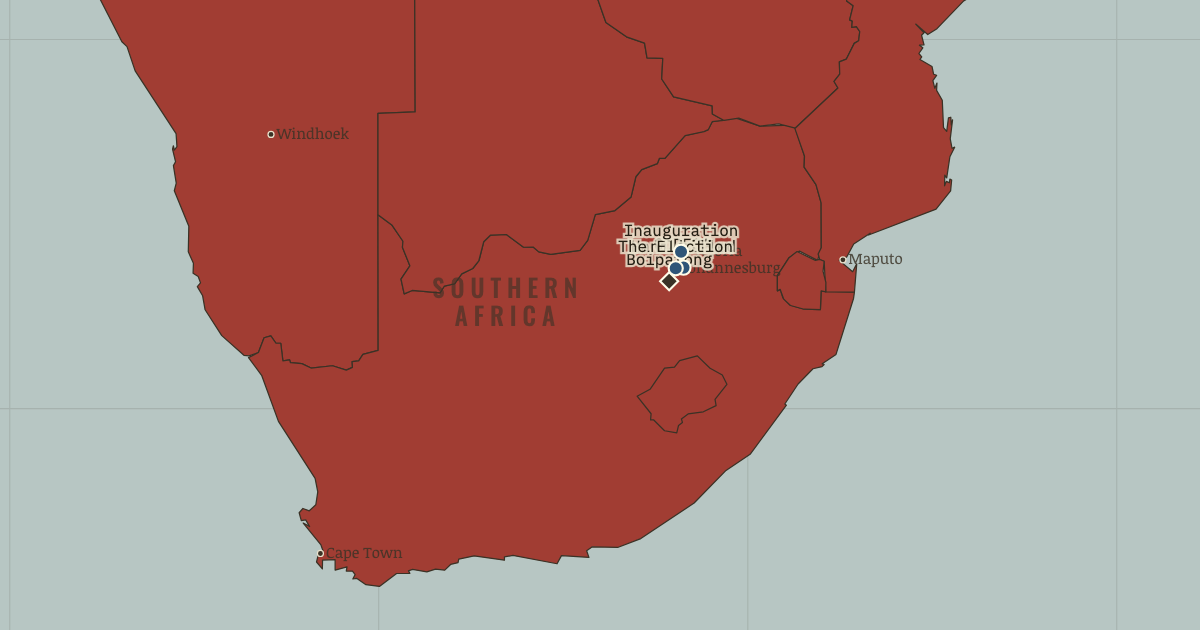
The CODESA negotiations turned on a single dispute, since the government sought protections that could preserve a white veto while the ANC demanded majority rule secured by constitutional rights. Violence shadowed the talks throughout, and later investigations exposed the involvement of elements within the security forces in arming and encouraging township killing, a covert effort to prove that Black rule would mean chaos. The 1992 Boipatong massacre led the ANC to break off negotiations, and the whole settlement seemed for a moment to be slipping away.
The short answer
- Two sides that could each destroy but not win. The negotiation worked because the balance of power was a genuine stalemate: the ANC could make the country ungovernable but not seize the state. The regime held the guns and the bureaucracy but could not govern the majority or fix the economy. Neither could impose its outcome, so both had to bargain. And both had leaders (Mandela, de Klerk) who, for all their maneuvering, ultimately chose settlement over the abyss. Negotiated revolutions require exactly this: a stalemate that makes compromise the rational choice.
- The third force and the strategy of chaos. The transition’s deadliest threat was covert violence. Hostel killings, train massacres, the arming of factions. Traced in part to elements of the security establishment trying to wreck the settlement by proving that majority rule meant anarchy. Understanding it is essential and sobering: the greatest danger came not from open opposition but from spoilers inside the state betting that enough bloodshed would collapse the talks. That the settlement survived this is the transition’s real achievement.
- Hani, and the brink. The murder of Chris Hani in April 1993 was calculated to trigger the race war the spoilers wanted. The country came closer to the edge than at any point since 1960. What pulled it back was leadership and restraint: Mandela addressing the nation to appeal for calm, the ANC channeling fury into a firm election date rather than revenge. It is a case study in how transitions survive their most dangerous moments. Through deliberate de-escalation by those who would gain most from escalation.
- The choice of reconciliation over revenge. Faced with a century of dispossession and the crimes of apartheid, the new government chose not the tribunals of the victor but the Truth and Reconciliation Commission: public testimony and conditional amnesty in exchange for full disclosure. It was a pragmatic bargain (the old security forces still had guns) and a moral choice (to build a shared future rather than avenge the past). Endlessly debated. As too forgiving or as necessary. It defined the kind of country the settlement was trying to create.
THE TURNING POINT
The election, 27 April 1994. Twenty million people, most of them voting for the first time, queue for hours to cast the ballot apartheid had denied them for a century. Four days later the count confirms Mandela’s victory and the last charcoal territory on this map turns red. It is the culminating moment of the whole atlas. The completion of a continent’s liberation, achieved in the hardest case not by conquest but by a negotiated, nearly-derailed, ultimately peaceful transfer of power. Everything on this map from Ghana’s midnight in 1957 has been building toward these queues. When they finish voting, the map of colonial Africa is finally gone.
What it changed
The map completes. With South Africa’s vote, the political decolonization of Africa is complete: every territory that was European-ruled or settler-ruled in 1945 is now an independent state under majority rule. The tide that began as a trickle in Libya in 1951 has reached 100 percent. Scrub the whole timeline once more and watch fifty years compress into the rise of a single colour, ending here.
A government of national unity. Rather than winner-take-all, the settlement mandated power-sharing for five years, keeping the old civil service and security forces largely in place to prevent collapse or coup. It was the price of a peaceful handover. Continuity and compromise over rupture. And it kept the transition stable at the cost of slowing transformation, a trade-off South Africa is still arguing about.
Reconciliation as the chosen exit from vengeance. The TRC became the world’s template for transitional justice. Imperfect, criticized from both sides, but a deliberate decision to break the cycle of retribution. Whether it delivered enough justice or too little accountability is genuinely contested. What is not is that South Africa chose, consciously, to walk out of its past through truth rather than through vengeance. It is a fitting close to the continent’s liberation. And a question the epilogue takes up.
The full answer, argued
It held because of a rare combination that is worth disaggregating. First, a genuine power stalemate made compromise rational for both sides. Neither the ANC nor the regime could win outright, so both had more to lose from collapse than from a deal. Second, leadership mattered enormously and contingently: Mandela and de Klerk each chose settlement over maximalism and, at the decisive moments (Boipatong, Hani’s murder), those who could have profited from chaos chose de-escalation instead. Third, the settlement bought buy-in from potential spoilers with guarantees. Power-sharing, an amnesty process, protected civil-service and security jobs. That made the old order prefer the new deal to wrecking it. Fourth, the TRC offered a way to address the past without the vengeance that would have made whites fight to the end. The transferable lessons are sobering rather than romantic: negotiated ends to entrenched conflicts require a hurting stalemate, leaders willing to disappoint their own hardliners, credible guarantees for the losing side, and mechanisms to handle the past. And even then they survive their most dangerous moments by narrow margins and deliberate restraint. The miracle was real, but it was manufactured, and it could easily have failed.
An interesting fact
The ballot paper of 27 April 1994 was designed for an electorate the old state had deliberately under-schooled: nineteen parties, each listed with its symbol, its colours and a photograph of its leader, so that no first-time voter could mistake their choice. It also carried a late correction — Inkatha agreed to stand only a week before the vote, after tens of millions of ballots had been printed, so its entry joined the election as a sticker pasted by hand at the foot of every paper.
This is the study layer of End of apartheid, chapter 11 of The Decolonization of Africa, 1945–1994; the full index of the atlas is here.
Related questions
THE FREE PRINTABLE STUDY GUIDE
Join the Dispatch — a short welcome series, then a letter when a new atlas opens — and the printable study guide for The Decolonization of Africa is yours now, free.
NO TRACKING · YOUR ADDRESS IS USED FOR THE DISPATCH AND NOTHING ELSE · UNSUBSCRIBE ANYTIME