Norse and Aztecs · 1408
Were the Greenland Norse victims of the Little Ice Age?
The seminar question: “To what extent were the Greenland Norse victims of the Little Ice Age?”
From about 1275–1300 the Little Ice Age brought drift ice along Greenland’s coasts and drier summers that cut the hay for cattle. The Norse adapted by eating far more seal, but the ivory market weakened, the Black Death struck Norway in 1349 and ships came less often; the Western Settlement was empty by about 1360.
Chapter 5 is part of membership. WW2 is free — every chapter. Try chapters 1–2 of any 2 other atlases (3 with a free account). Opening a new atlas uses one of them. Membership opens all 21 — Join.
Free printable Norse and Aztecs study guide, sent by email ↓
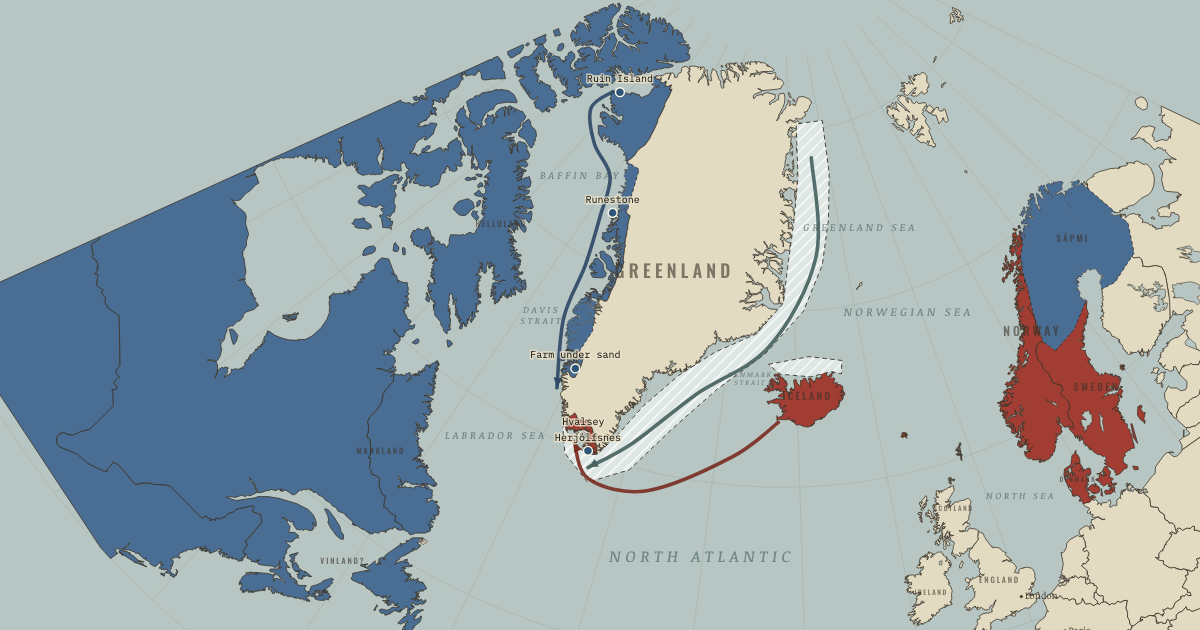
The Norse met the cold first by changing what they ate, which shows that they were adapting. Bones carry chemical signatures, called isotopes, that record whether a person’s protein came from land or sea, much as a till receipt records what a shopper bought, and Jette Arneborg’s team found that Norse diets shifted from about 20 percent marine food at settlement to about 80 percent by the end. A later study with 123 skeletons revised the early figure to 15–50 percent and showed the 50 percent mark being crossed in the late thirteenth century. Rubbish heaps tell the same story, since seal bones make up 30 to over 80 percent of the animal remains on Greenland farms, mostly harp and hooded seals caught in communal hunts on their spring migration. A people supposedly too proud to eat seafood was, in practice, living largely on seals.
The short answer
- Cooler and drier summers cut the hay. The Little Ice Age began abruptly between about 1275 and 1300 and intensified again between 1430 and 1455, according to Gifford Miller’s team. In south Greenland the clearest signal at Lake 578 is drying, which would have reduced the hay harvest even without much cooling. Because cattle needed stored hay for eight months, a few bad summers in a row forced culls that took years to rebuild, and the farms’ margin of safety shrank.
- Drift ice lengthened and endangered voyages. More summer drift ice along east and south Greenland made the passage from Iceland and Norway slower and more dangerous, and a late-medieval sailing guide claims the old route had been abandoned because of ice, though that sentence may be a later addition. Fewer ships meant less iron, timber and grain, and fewer chances for young people to leave or for new settlers to arrive, so isolation compounded every other pressure.
- The ivory economy weakened. Walrus ivory paid for the colony’s imports, but by the fourteenth century the hunters were taking smaller animals from further away, and Europe was again importing elephant ivory from Africa. In 1327 a cargo of about 520 tusks, paid as church dues, was still worth roughly as much as 780 cows, so the trade remained valuable while becoming less reliable. A colony with one export was exposed to every change in its buyers’ tastes.
- Plague and isolation in Norway. The Black Death reached Norway in 1349 and killed perhaps half or more of the population, shrinking the market for luxuries and the shipping that served the colonies. Bergen’s merchants turned to the profitable trade in dried cod, and the royal trading ship to Greenland was not replaced after it sank in 1369. Greenland’s link to Europe thinned just as its own economy weakened, and a colony that could no longer trade could no longer replace its iron tools.
THE TURNING POINT
Hvalsey church, 16 September 1408. On this day Þorsteinn Ólafsson and Sigríður Björnsdóttir were married in the stone church at Hvalsey, an event recorded because the couple later needed proof of the marriage in Iceland. It is the hinge of the chapter because it is the last written evidence of Norse Greenland, and after it the story can be told only through archaeology. The wedding also shows a community still functioning, with priests, a church and legal documents, only a generation before the end. That combination, normal life followed by silence, is why historians now speak of departure more often than of catastrophe.
What it changed
Greenland becomes Inuit land. By about 1500 the Inuit lived along most of Greenland’s west and south coasts, including the old Norse districts, and their descendants make up most of Greenland’s population today. On the map, the blue zones that step down the coast after 1300 represent this expansion. The Norse experiment had been replaced by a society far better equipped for the Arctic.
A debate that shaped modern environmental history. The fate of Norse Greenland became a classic case study for arguments about climate change and collapse, most famously in Jared Diamond’s book of 2005. The archaeological response has made the colony an example of adaptation under compounding pressures, a model now applied to many societies facing climate change, including the Mexica in the second half of this atlas, whose lake city faced flood, frost and drought.
Europe forgets and then searches. Norway lost contact with Greenland in the fifteenth century, and Europeans gradually forgot where the colony had been. When Danish and Norwegian rulers took renewed interest, they assumed the Norse descendants might still survive, which led to new voyages in the sixteenth to eighteenth centuries and eventually to the Danish colonisation of Greenland from 1721, discussed in the epilogue. The Skálholt map, drawn in Iceland around 1570, shows how much of that geography survived only in written memory.
The full answer, argued
The cold was a real pressure, but the evidence suggests it was decisive only in combination with economic decline and isolation. Cooling and drying reduced the hay harvest, and more drift ice made voyages harder, so the climate narrowed the colony’s margin. Yet the Norse adapted, eating mostly seal by the end, and the Inuit expanded into Greenland during the same cold centuries, which shows that the environment could support people with the right technology. The collapse of the ivory trade, the plague in Norway and the end of regular shipping removed the income and contact that had made a small European colony viable. Most scholars, following Dugmore and colleagues, therefore describe a conjuncture of pressures acting on a society too small to absorb them. The orderly abandonment of farms suggests that many people chose to leave. The transferable insight is that climate change often works slowly, exhausting a society’s alternatives one by one until leaving becomes the sensible choice.
An interesting fact
One of the most famous garments from Norse Greenland was misdated by two centuries. In 1921 the archaeologist Poul Nørlund excavated the churchyard at Herjólfsnes, where the permafrost had preserved woollen gowns, hoods and caps. One tall cap, cut in a style resembling fashions at the fifteenth-century Burgundian court, was taken as proof that Greenlanders were still following European fashion after 1500. Radiocarbon dating later placed it between about 1280 and 1380, while other grave clothes from the same churchyard dated to about 1430, which is the latest firm evidence of Norse people in Greenland.
This is the study layer of Why the Norse abandoned Greenland, chapter 5 of Climate and Innovation: The Norse and the Aztecs, c. 790–1521; the full index of the atlas is here.
Related questions
THE FREE PRINTABLE STUDY GUIDE
Join the Dispatch — a short welcome series, then a letter when a new atlas opens — and the printable study guide for Climate and Innovation is yours now, free.
NO TRACKING · YOUR ADDRESS IS USED FOR THE DISPATCH AND NOTHING ELSE · UNSUBSCRIBE ANYTIME