Norse and Aztecs · 1021
Was Vinland abandoned for lack of innovation or people?
The seminar question: “Does the abandonment of Vinland show the limits of Norse innovation or the limits of Norse numbers?”
In 985 or 986 Erik the Red led 25 ships west from Iceland and 14 arrived, founding Greenland’s Eastern and Western Settlements on fjord meadows the warm centuries had made green. The colony paid for its imports by hunting walrus for ivory, and Norse voyagers worked wood at L’Anse aux Meadows in Newfoundland in 1021.
Chapter 4 is part of membership. WW2 is free — every chapter. Try chapters 1–2 of any 2 other atlases (3 with a free account). Opening a new atlas uses one of them. Membership opens all 21 — Join.
Free printable Norse and Aztecs study guide, sent by email ↓
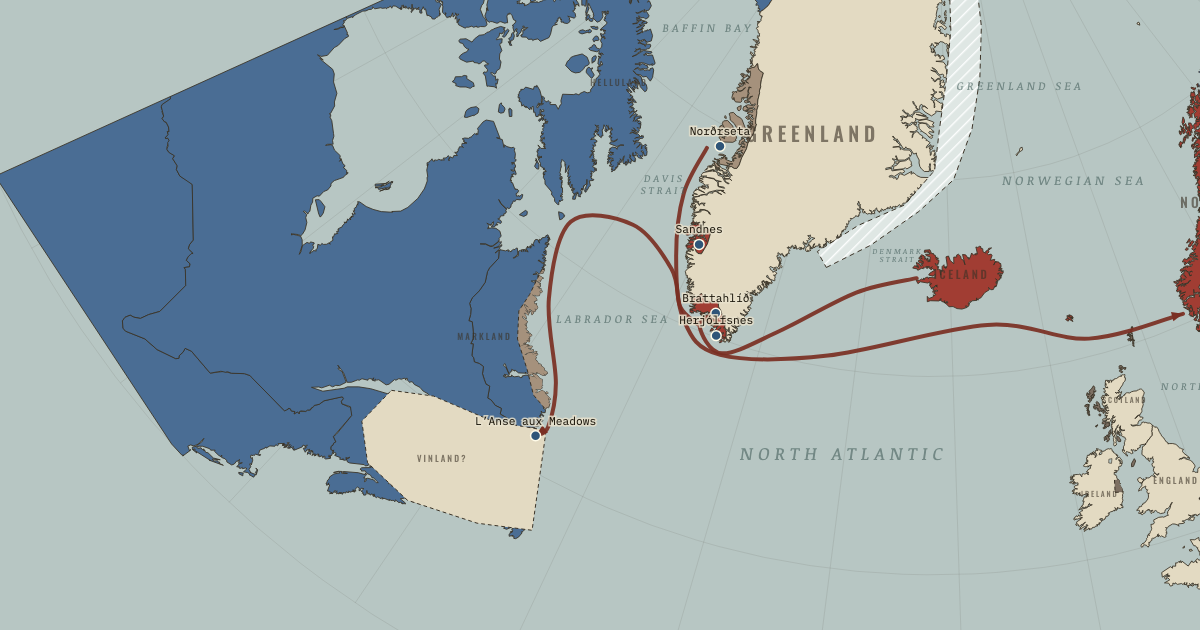
The Greenland colony was designed around hay, and its geography followed the meadows. The settlers built about 500 farms in the Eastern Settlement and perhaps 75–100 in the Western, most of them deep inside the fjords where summers were warmest and grass grew best, away from the cold fog of the outer coast. At its peak around 1200 the colony probably held about 2,000–2,500 people, though older estimates ran to 5,000. A farm’s wealth was measured in the number of cattle its byres, the stone-and-turf cattle sheds, could keep alive through eight winter months, so the whole community depended on the summer’s hay harvest. Erik’s own farm, Brattahlíð, stood at the head of a fjord on the best land, which is how leadership and good meadows came to coincide.
The short answer
- Warm summers greened the southern fjords. The colony’s timing fits the Medieval Climate Anomaly, when midge remains from Scoop Lake near the Eastern Settlement indicate summers about 1.5 °C warmer than in the centuries before and after. Warmer, longer summers allowed enough hay to grow at the heads of the fjords to keep cattle alive through the winter. Erik the Red was exploiting a climatic window that he could not have understood in those terms but could see in the grass.
- Iceland was already full and divided. By the 980s Iceland’s best land had been claimed for two or three generations, and younger sons and newcomers found few opportunities. Feuds also drove men out, since Erik himself was outlawed twice for killings. Greenland offered empty grassland to people who had lost out in Iceland, and the 25 ships that sailed in 985 or 986, carrying perhaps several hundred people with their animals, show how many were willing to gamble.
- A name chosen to attract settlers. According to the Icelandic sources, Erik called the new land Greenland because people would be more willing to go there if it had an attractive name. The story shows that founding a colony required persuasion as well as seamanship, much as a modern developer markets a new town. Erik needed enough families to make the settlement viable, and the name was part of his recruitment, as were the best meadows he kept for himself at Brattahlíð.
- European demand for walrus ivory. Walrus ivory was valued in Europe for carving religious objects and games, especially when African elephant ivory was scarce. Greenland’s walrus grounds in Norðrseta offered a supply that no one else could reach, and ancient DNA shows that by the twelfth century almost all European walrus ivory came from there. This demand gave the colony a reason to exist beyond subsistence and paid for the imports its farms could not produce.
THE TURNING POINT
L’Anse aux Meadows, 1021. The cutting of timber at L’Anse aux Meadows in 1021 is the hinge of this chapter because it marks the furthest point the Norse system could reach and the moment it began to pull back. Europeans and Indigenous Americans met across the Atlantic five centuries before Columbus, which proves that the ship and the settler society of the North Atlantic were capable of reaching a new continent. The withdrawal within a few years shows the limit of that capability. Reach depended on technology, while staying depended on numbers, supply and the consent of the people already there.
What it changed
A colony locked into hay and ivory. With Vinland abandoned, Greenland’s economy settled into its long pattern of cattle and sheep on the fjord meadows, seals and caribou for food, and walrus hunting in the north for export. That combination worked for about three centuries, but it depended on summers warm enough for hay and on European demand for ivory, and Chapter 5 shows both beginning to fail after 1250.
Timber trips to Markland continue. The Greenlanders kept sailing to Markland, probably the forested coast of Labrador, for the timber that their treeless land lacked. Icelandic annals for 1347 record a small Greenland ship, crewed by 17 or 18 men, that had been to Markland and was driven by storms to Iceland. The contact with America therefore did not end in 1021, though it never again became settlement.
Greenland enters the Church and the crown. The colony grew into a recognisable part of Christian Europe. It received its own bishop at Garðar in 1126 and built about fourteen to seventeen churches, and in 1261 it accepted the authority of the Norwegian king. These ties brought priests, ships and goods but also made the colony dependent on decisions taken in Bergen and Trondheim, as Chapter 6 explains.
The full answer, argued
The evidence points more strongly to numbers than to technology. The ships, seamanship and building skills on display at L’Anse aux Meadows were fully capable of crossing to America, repairing vessels there and housing 70–90 people through a winter, so their inventions were equal to the task. The limit was population, since Greenland itself held perhaps 2,000–2,500 people, too few to settle and defend a distant colony. The sagas also show that Indigenous peoples were numerous, organised and willing to fight, and that the Norse held no decisive advantage in weapons. Distance multiplied every one of these weaknesses. Historians who stress conflict and those who stress logistics are describing the same problem from two sides, since a larger colony could have absorbed both the losses and the long voyages. The transferable insight is that the reach of a technology can far outrun the size of the society using it, and expansion stops where numbers run out.
An interesting fact
According to the Saga of the Greenlanders, the first child of European parents born in the Americas was a boy named Snorri, born in Vinland to Gudrid Thorbjarnardóttir and her husband Thorfinn Karlsefni around 1010. The family returned to Iceland and farmed in the north, and the saga says that Gudrid, widowed, later made a pilgrimage to Rome before becoming a nun. The saga traces several Icelandic bishops among her descendants. Gudrid had travelled from Iceland to Greenland, Vinland, Norway and Rome, which makes her one of the most widely travelled people of her century.
This is the study layer of Vikings in Greenland and Vinland, chapter 4 of Climate and Innovation: The Norse and the Aztecs, c. 790–1521; the full index of the atlas is here.
Related questions
THE FREE PRINTABLE STUDY GUIDE
Join the Dispatch — a short welcome series, then a letter when a new atlas opens — and the printable study guide for Climate and Innovation is yours now, free.
NO TRACKING · YOUR ADDRESS IS USED FOR THE DISPATCH AND NOTHING ELSE · UNSUBSCRIBE ANYTIME