Norse and Aztecs · 930
Was the Althing a success if Iceland lost independence?
The seminar question: “Was the Althing a successful innovation if Iceland still fell into civil war and lost its independence in 1262–64?”
Norse settlers reached Iceland from the 870s, and within about sixty years the landnám had claimed every usable valley; many came from Ireland and Scotland, often enslaved. The Althing assembly met at Þingvellir from 930, while woodcutting and grazing stripped birch woodland that once covered a quarter to two-fifths of the land.
Chapter 3 is part of membership. WW2 is free — every chapter. Try chapters 1–2 of any 2 other atlases (3 with a free account). Opening a new atlas uses one of them. Membership opens all 21 — Join.
Free printable Norse and Aztecs study guide, sent by email ↓
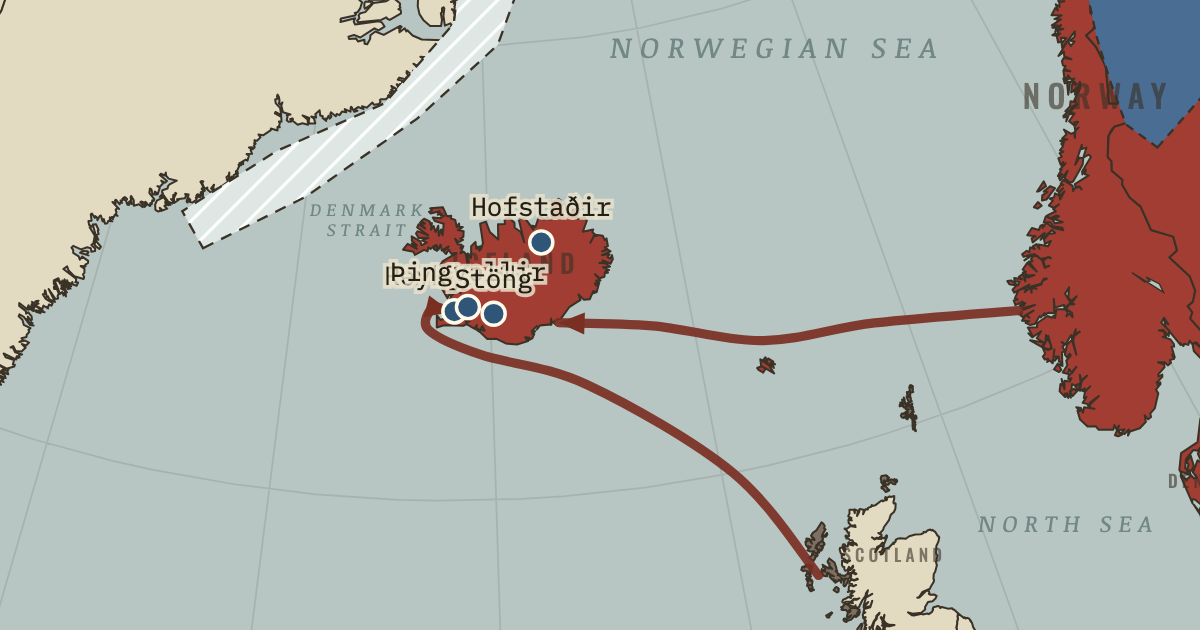
The settlement of Iceland was a planned migration of farmers, and its scale is now measurable from several directions. Landnámabók, the Book of Settlements, names nearly 400 leading settlers and about 1,400 places, and population geneticists estimate that some 8,000–16,000 people arrived in all. Ancient genomes, DNA read from the skeletons of the first settlers much as a modern ancestry test reads a living person’s, studied by Sunna Ebenesersdóttir’s team in 2018, show that the settlers were on average only about 57 percent Norse in ancestry, with most of the rest Gaelic, and earlier studies found that more than 60 percent of female lineages came from Ireland and Scotland. Many of these women and men came as slaves taken in raids, which means that the Gaelic west supplied much of the labour that built the new farms. The colony was therefore a Norse society with a mixed people at its foundation.
The short answer
- An empty island within reach of the ships. Iceland lies about 970 kilometres west of Norway but only about 450 from the Faroe Islands, which Norse settlers had already reached, so the ship technology of Chapter 2 made the crossing practical. Irish hermits may have visited before the Norse, but no settled population existed, so newcomers could claim land without conquest. That emptiness made Iceland the first true Norse colony, a society built from scratch on land that no other people held.
- Land hunger and politics in Norway. Later Icelandic writers explained the migration as flight from the tyranny of Harald Fairhair, who united much of Norway in the late ninth century. Historians treat that story with caution, because it flattered the settlers’ descendants, but scarce farmland and the growing power of kings do seem to have pushed ambitious families outward. Iceland offered the chance to be a chieftain answerable to no one, and the earliest settlers claimed vast estates that they later divided among followers and kin.
- Captives from the Gaelic west. Norse raiding in Ireland and Scotland produced captives, and the settlers took many of them to Iceland as slaves to clear land, herd animals and weave cloth. The genomes show how large this element was. Without forced labour from the Gaelic world, the rapid clearing of a whole island within about sixty years would have been much slower, so violence abroad was built into the foundations of the new society.
- The need for law without a king. Settlers who had left Norway partly to escape royal power still needed a way to settle quarrels over land, livestock and killings, which otherwise led to blood feuds that could destroy families. The answer was to borrow the Norwegian tradition of regional assemblies, called things, and to create one assembly for the whole island. The Althing grew out of this practical need for order among equals, and it was designed so that no single chieftain could dominate it.
THE TURNING POINT
Þingvellir, 930 — and the decision of 999/1000. The founding of the Althing at Þingvellir in 930 is the hinge because it gave a scattered population of farmers a single place and procedure for resolving conflict. Its value was tested around the year 1000, when Christian and pagan factions threatened civil war. Both sides agreed to let the lawspeaker Þorgeir decide, and after a day and a night under his cloak he ruled that all Icelanders should be baptised while some pagan practices might continue in private. A society without a king had found a way to make an enormous decision peacefully.
What it changed
A springboard further west. Iceland became the base for the next voyages. Erik the Red, outlawed from Norway and then from Iceland for killings, sailed west in the early 980s and returned with plans for a new colony. Chapter 4 follows the fleet that left Iceland for Greenland in 985 or 986. Each new colony was founded by people who had lost out in the last one, so the frontier kept moving west.
A durable legal culture. The Althing sat almost every summer until 1798 and was revived in the nineteenth century, and Icelanders call it one of the oldest parliaments in the world. The tradition of law recited and later written in the Grágás law codes gave Iceland a sense of identity that outlasted its independence, which ended when the chieftains accepted the Norwegian crown in 1262–64.
An environment slowly degraded. The loss of woodland meant that Icelanders soon lacked timber for houses and ships and relied on driftwood and imports. Erosion reduced the grazing land just as the climate cooled after 1300. Iceland survived, unlike Norse Greenland, but it became poorer and more dependent on trade with Norway, and that slow pressure on a farming society frames the colder centuries of Chapter 5.
The full answer, argued
Judged over three centuries, the Althing succeeded remarkably well. It resolved disputes among armed chieftains for more than 300 years without a king, an army or taxes, and its peaceful adoption of Christianity in 999 or 1000 shows that it could manage even a decision that divided society. Its weakness was the absence of enforcement, since winners of lawsuits had to carry out judgments with their own followers. As wealth and power concentrated in a few great families in the thirteenth century, those families fought the civil wars of the Sturlung Age and finally accepted the Norwegian king. The Althing’s failure was therefore a failure to adapt to changing inequality, which no medieval assembly anywhere had solved, and the institution itself survived as a symbol and later as a parliament. The transferable insight is that institutions which depend on rough equality among participants become fragile when that equality disappears.
An interesting fact
When the first settlers reached Iceland, the only land mammal living there was the arctic fox, which had probably crossed on sea ice at the end of the last Ice Age. Every sheep, cow, horse, goat, pig, dog and cat on the island arrived in Norse ships, and mice came with them as stowaways. The settlers’ animals therefore met plants that had never been grazed by anything larger than a goose, which helps explain why the birch woods and thin volcanic soils gave way so quickly once the farms were built.
This is the study layer of Settlement of Iceland, chapter 3 of Climate and Innovation: The Norse and the Aztecs, c. 790–1521; the full index of the atlas is here.
Related questions
THE FREE PRINTABLE STUDY GUIDE
Join the Dispatch — a short welcome series, then a letter when a new atlas opens — and the printable study guide for Climate and Innovation is yours now, free.
NO TRACKING · YOUR ADDRESS IS USED FOR THE DISPATCH AND NOTHING ELSE · UNSUBSCRIBE ANYTIME