Norse and Aztecs · 866
Was Viking expansion driven by the ship or the society?
The seminar question: “Was the Viking expansion driven more by the ship or by the society that built it?”
Viking expansion from about 790 rested on the longship, whose keel and clinker-built hull could ride ocean swells and land on any beach, and on the farms that built it: a warship’s sail needed over 1.5 tonnes of wool. Scarce farmland, Islamic silver and unguarded wealth drew raiders west, as at Lindisfarne in 793.
WW2 is free — every chapter. Try chapters 1–2 of any 2 other atlases (3 with a free account). Opening a new atlas uses one of them. Membership opens all 21 — Join.
Free printable Norse and Aztecs study guide, sent by email ↓
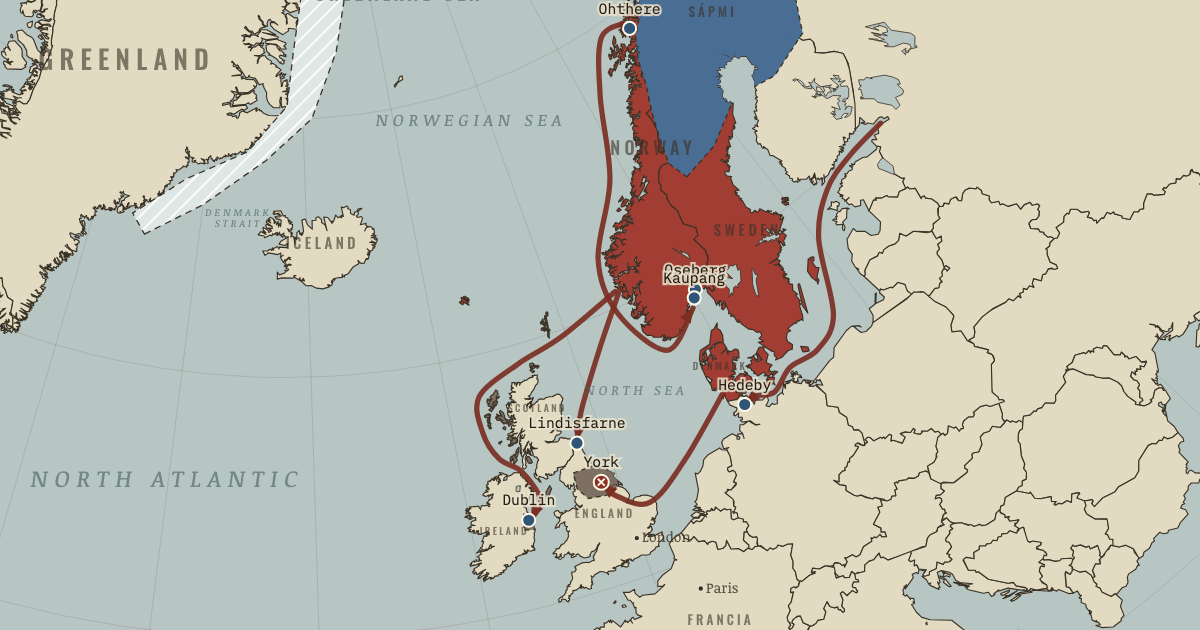
The ship was the decisive invention because it changed what distance meant for people living along the North Sea. Archaeologists know it from boats buried as graves and wrecks sunk as barriers. The Oseberg ship, built around 820 and buried in 834, is 21.5 metres long and was rowed by fifteen pairs of oars; the Gokstad ship, built of timber felled around 890, carried thirty-two. Its overlapping planks flexed with the waves and absorbed their force, and its draft, the depth of hull below the waterline, was only about a metre, roughly waist height on an adult, so crews could beach it on any strand. By the eleventh century the warship Skuldelev 2, built near Dublin in about 1042, was 30 metres long and carried a crew of 65–70. A fleet like that could appear at a coast with almost no warning, and that surprise was the source of Norse power.
The short answer
- A scarcity of farmland at home. Norway is mostly mountain, forest and rock, and only about 3 percent of its land can be cultivated, so good farms along the fjords were limited and passed to eldest sons. Younger sons and landless men needed another route to wealth. The ship gave them one, first by carrying them abroad to raid and trade, and later by carrying whole families to new land in the islands of the west, where a farm could be claimed by anyone willing to clear and defend it.
- Silver from the Islamic world. In the ninth and tenth centuries the Abbasid caliphate and its neighbours minted silver coins in enormous numbers, and a great share flowed north through the rivers of Russia and across the Baltic in exchange for furs and slaves. Scandinavian finds of these dirhams now run to hundreds of thousands. This flood of silver gave chieftains the means to reward followers and made trading towns such as Hedeby rich, which in turn drew raiders toward wealth wherever it gathered.
- Unguarded wealth across the North Sea. Christian monasteries in Britain and Ireland held gold, silver and books on coastal islands chosen for their solitude, and they had no defences against an attack from the sea. Kingdoms such as Northumbria were divided by civil wars, and the Frankish empire of Charlemagne’s heirs split after 840. The ship let Scandinavian crews pick targets where local power was weak, strike and be gone before an army could gather, so political division abroad multiplied the value of mobility.
- A society organised for voyages. Norse society could raise the crews and materials that voyages required because chieftains commanded followers bound to them by gifts and oaths, much as a modern company commands employees with pay and loyalty. Farms produced the wool for sails, and assemblies settled the quarrels that would otherwise have kept men at home. The voyages abroad were therefore the overseas extension of institutions and loyalties that already worked at home, carried across the sea by men who expected to return richer.
THE TURNING POINT
Lindisfarne, 793. The raid on the monastery of Lindisfarne, off the coast of Northumbria, is the conventional start of the Viking Age, and it earns that place because it changed how Europe perceived the sea. Scandinavians had probably traded with Britain for decades, and the number of people killed was small beside later attacks. What changed was that the most learned men of Europe now understood that the sea, which had protected holy places, had become a highway for anyone with the right ship. From this moment, coastal Europe began to reorganise its defences around a threat that came by water.
What it changed
Settlement follows the raiders west. Once the routes were known, raiders were followed by families seeking farms. Norse settlers took the Northern Isles, the Hebrides and the Faroe Islands in the ninth century, and the next step west, across 500 kilometres of open sea to an empty Iceland, came in the 870s. Chapter 3 follows those settlers into a volcanic island with no king and no native people.
Norse towns and kingdoms in Britain and Ireland. Within a generation, raiding had turned into rule over whole regions. Dublin became a Norse trading town from 841, York became the capital of a Norse kingdom after 866, and the Danelaw of the 870s and 880s placed eastern England under Scandinavian law. These places tied the Norse world into the economy of western Europe and gave it the markets and churches that later colonies would depend on.
Walrus ivory enters the story. Ohthere’s account shows that walrus tusks and hide ropes were already valuable goods in the 890s, traded from the far north to markets in the south. This luxury would later become the economic engine of the Greenland colony, whose hunters ranged far up its west coast for walrus. Chapter 4 shows how much a distant society can come to depend on a single export.
The full answer, argued
The ship was necessary, since without a seaworthy, shallow-drafted vessel no amount of ambition could have reached Lindisfarne, Dublin or Iceland. Yet similar ships existed in Scandinavia for a century before 793, which suggests that the technology waited on a reason to be used. The social evidence supplies that reason: scarce land, a surplus of young men without the means to marry, chieftains competing in silver and fame, and an inflow of Islamic coin. Lise Bender Jørgensen’s calculations also show the ship as a product of society, since one warship’s sail consumed decades of women’s labour that only a well-organised farming economy could spare. Historians still disagree about which social factor mattered most, partly because the written sources come from the victims and say little about Scandinavian motives. The transferable insight is that an innovation spreads when a society both can afford it and has a motive to use it, and either alone is not enough.
An interesting fact
The grandest Viking ship burial yet found was made for two women. In 834 the Oseberg ship was hauled ashore beside the Oslo fjord and buried under a mound of turf with the bodies of two women, one probably in her seventies or eighties and the other about fifty. Around them lay a carved wagon, three sledges, beds, tapestries, kitchen tools and the bodies of horses and oxen. The clay of the mound sealed out the air, so the ship survived to be excavated in 1904, and it shows that the most honoured burial of the age could belong to a woman.
This is the study layer of Viking expansion and the longship, chapter 2 of Climate and Innovation: The Norse and the Aztecs, c. 790–1521; the full index of the atlas is here.
Related questions
THE FREE PRINTABLE STUDY GUIDE
Join the Dispatch — a short welcome series, then a letter when a new atlas opens — and the printable study guide for Climate and Innovation is yours now, free.
NO TRACKING · YOUR ADDRESS IS USED FOR THE DISPATCH AND NOTHING ELSE · UNSUBSCRIBE ANYTIME