Feminism and the Tunisian Revolution · 2008
Did Ben Ali rule by repression or by consent?
The seminar question: “Was Ben Ali’s regime maintained more by repression or by consent?”
Zine el-Abidine Ben Ali took power on 7 November 1987 by having doctors declare Bourguiba unfit to govern, then ruled for 23 years through a police state, economic growth and patronage. After Ennahda’s strong showing in 1989 thousands of Islamists were arrested, and the 2008 Redeyef revolt in the Gafsa mining basin failed.
Chapter 8 is part of membership. WW2 is free — every chapter. Try chapters 1–2 of any 2 other atlases (3 with a free account). Opening a new atlas uses one of them. Membership opens all 21 — Join.
Free printable Feminism and the Tunisian Revolution study guide, sent by email ↓
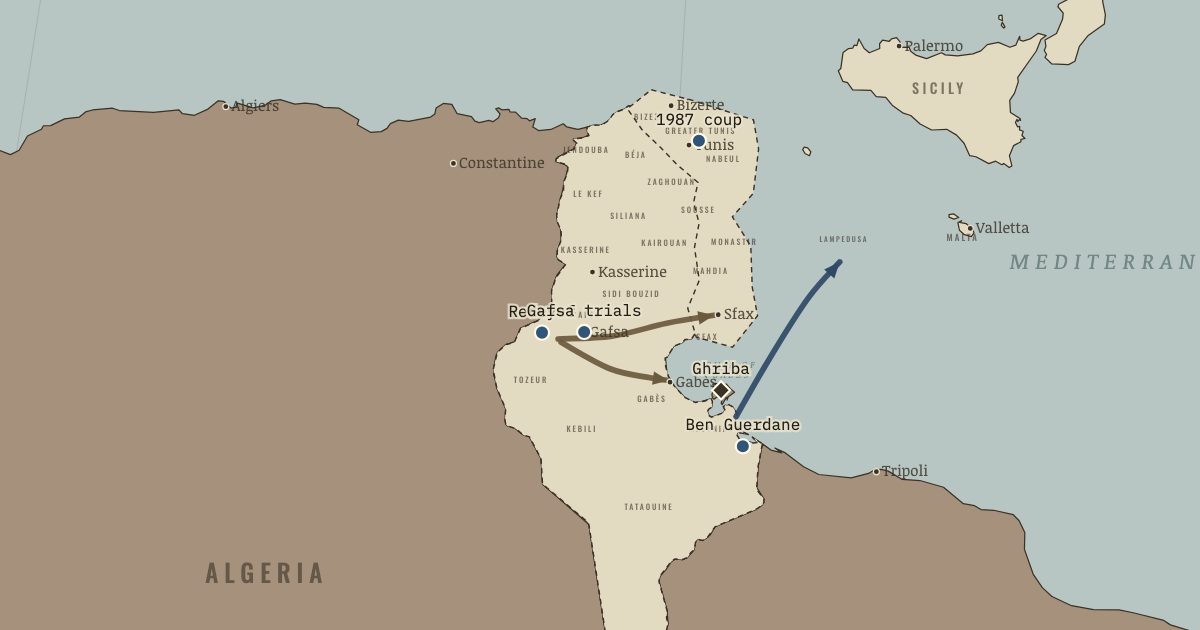
Ben Ali’s regime began with the promise of freedom and became one of the most thoroughly policed states in the Arab world. The “medical coup” of 7 November 1987 used Article 57 of the constitution, which transferred power if the president was incapacitated, and seven doctors signed the certificate. Ben Ali released political prisoners and in 1988 signed a National Pact with the opposition, the UGTT and even Islamist leaders. The UGTT, the General Tunisian Labour Union, was the national trade-union federation, large enough to call a general strike, much like a national union congress elsewhere. In the elections of April 1989, candidates backed by Ennahda, standing as independents because the party was not allowed to register, won around 14 per cent of the vote by the official count, and possibly more. That result convinced the regime that free competition was too dangerous. From 1990 thousands of Islamists were arrested, tortured and tried, and Ennahda’s leader Rached Ghannouchi went into exile in London. Newspapers, opposition parties and human-rights groups survived only as long as they were harmless. A regime that offers pluralism and then withdraws it teaches its citizens that only silence is safe.
The short answer
- A coup that promised freedom. Ben Ali removed a senile president constitutionally and without bloodshed, released prisoners and promised democracy, so many Tunisians, including opponents of Bourguiba, welcomed him in 1987. The promise bought him time to take control of the party, the police and the media. When he withdrew it after 1989, the opposition was divided and exhausted, which explains why resistance was so weak for two decades. His first months brought an amnesty, the abolition of the state security court and a new law on political parties.
- The Islamist threat as justification. Ennahda’s strong showing in 1989, and the civil war that began in neighbouring Algeria in 1992 after Islamists won an election there, allowed Ben Ali to present repression as protection. Many secular Tunisians, including some feminists and leftists, accepted the trade, because they feared an Islamist government more than a police state. Western governments accepted it for the same reason. The trade-off allowed the regime to present every critic, secular or religious, as a threat to stability.
- Education outrunning jobs. Tunisia expanded universities rapidly, and by 2010 graduates made up a growing share of the unemployed, about 23 per cent of them without work. Young people who had done what the state asked, studying hard, found no jobs without connections or bribes. Frustrated expectations are a classic cause of protest, because people revolt less against poverty than against blocked hopes. Graduate unemployment was highest in the interior, where private firms were fewest.
- A family that owned the economy. From the 1990s the president’s relatives and his wife’s family seized stakes in banks, airlines, car imports, telecoms and property. Their greed became visible to ordinary Tunisians and offended the coastal business class that had supported the regime. Corruption at the top turned a regime that claimed to deliver order into one that seemed simply to steal, weakening its support among its own elites. The US diplomatic cables published by WikiLeaks in December 2010 gave Tunisians written proof of what they had long whispered.
THE TURNING POINT
Redeyef, January–June 2008. The mining-basin revolt is the hinge of this chapter because it broke twenty years of silence and revealed both the regime’s weakness and its strength. For six months a small region defied the police state, organised by union activists and unemployed graduates, and made the grievances of the interior visible. The regime survived by isolating the basin and jailing its leaders, which proved that local revolts could still be contained. Yet the networks of activists, lawyers and union officials who defended the Gafsa prisoners in 2008 and 2009 were the same networks that spread the revolt of 2010. Failed protests often prepare successful ones by training the people who will lead them.
What it changed
A template for revolt. Gafsa established a repertoire that reappeared two years later: sit-ins outside local government buildings, hunger strikes, marches led by unemployed graduates, union backing at the local level, and videos filmed on phones. The protesters of Sidi Bouzid and Kasserine knew what had happened in the basin, and some of the same activists took part. What 2008 lacked, a way to spread, is the subject of the next chapter.
A divided union federation. The gap between the UGTT’s regime-friendly national leaders and its militant local and regional branches widened after 2008. In January 2011 the regional unions pushed the national leadership into authorising strikes, and the UGTT became the organisation that turned scattered protests into a national movement, and later the broker of the democratic transition. Its double character, part ally of the regime and part popular movement, made it the ideal intermediary between the street and the state.
Exit by sea. For many young people in the south and interior, the alternative to revolt was emigration, often illegal: the harga, literally “burning” the border, by boat to Lampedusa or Sicily. When the police state collapsed in 2011, about 20,000 Tunisians crossed to Lampedusa in three months, showing how many had been waiting to leave. For many young men the boat was a private answer to a public failure.
The full answer, argued
Repression was real and systematic: thousands of Islamists and leftists were imprisoned and tortured, the press and internet were censored, and the Gafsa revolt was crushed with bullets and long prison terms. Yet repression alone cannot explain twenty-three years of stability in a country without a large army. Hibou shows how economic dependence, through credit, subsidies, licences and party networks, gave many Tunisians a stake in the regime, and growth, rising education and women’s rights won the approval of the coastal middle class and of Western governments. The geography of protest suggests that consent was conditional and uneven: it was strongest where the economy delivered and weakest in the interior, where the regime relied more on the police. The best answer is that consent maintained the regime on the coast while repression maintained it in the interior, and that the balance shifted when growth stalled and corruption became visible. The transferable insight is that authoritarian regimes rarely rule by fear or by bribery alone, so they become vulnerable when the material side of their bargain fails in the places where fear was already doing most of the work.
An interesting fact
Tunisians gave their internet censor a nickname: “Ammar 404”, after the “Error 404, page not found” message that appeared when a blocked website was requested, as if an official called Ammar had personally switched it off. Under Ben Ali sites such as YouTube and Dailymotion were blocked for long periods, and police were reported to hack the email and Facebook accounts of dissidents. In November 2005 the same government hosted the second phase of the United Nations World Summit on the Information Society in Tunis, an international meeting about the free flow of information, while human-rights activists who tried to hold a parallel meeting in the city were harassed and beaten.
This is the study layer of Tunisia under Ben Ali, chapter 8 of Protest and Change: Second-Wave Feminism and Tunisia, 1945–2015; the full index of the atlas is here.
Related questions
THE FREE PRINTABLE STUDY GUIDE
Join the Dispatch — a short welcome series, then a letter when a new atlas opens — and the printable study guide for Protest and Change is yours now, free.
NO TRACKING · YOUR ADDRESS IS USED FOR THE DISPATCH AND NOTHING ELSE · UNSUBSCRIBE ANYTIME