Haiti and Kenya independence · CHAPTER 1 ·
Slavery in colonial Saint-Domingue
Chapter 1 of Two Roads to Independence: Haiti 1789–1838 and Kenya 1895–1978: “Saint-Domingue: The Richest Colony”
In 1789 Saint-Domingue, the western third of Hispaniola and today Haiti, produced roughly two-fifths of the sugar and three-fifths of the coffee consumed in Europe. That wealth was made by about half a million enslaved Africans and their children, who outnumbered the free by about eight to one, under the Code Noir of 1685.
WW2 is free — every chapter. Try chapters 1–2 of any 2 other atlases (3 with a free account). Opening a new atlas uses one of them. Membership opens all 21 — Join.
Free printable Haiti and Kenya independence study guide, sent by email ↓
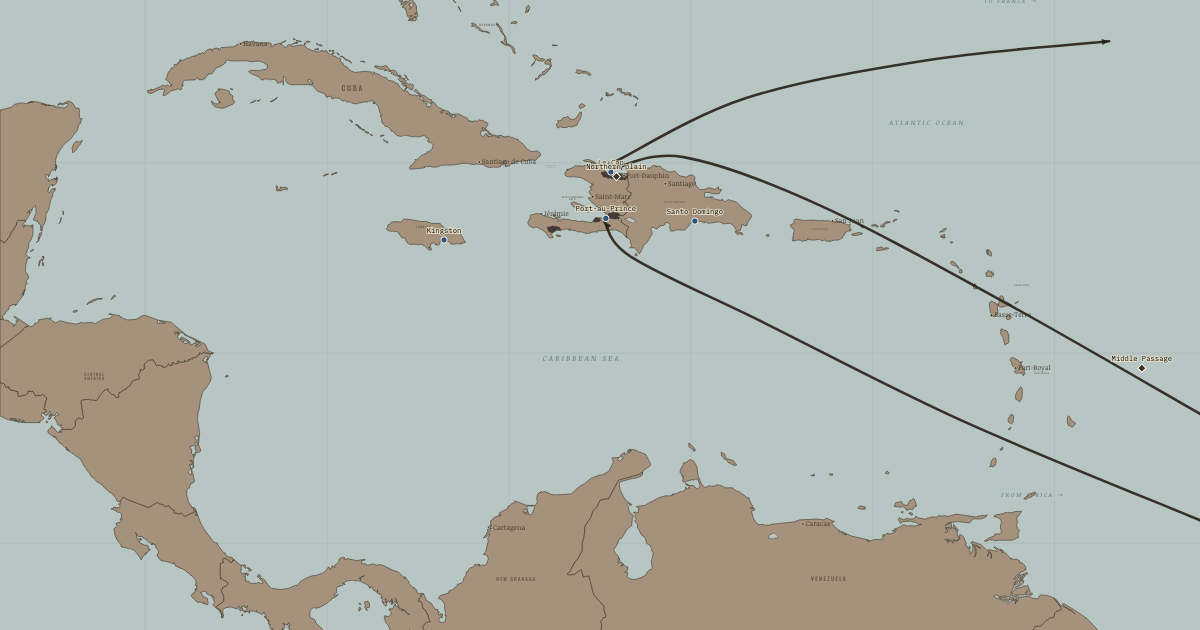
The map above is the world of Saint-Domingue, 1789 — The richest colony on earth.
Part of IB History: Haiti and Kenya →
BRIEF EXPLANATION — THE ESSENTIAL ARGUMENT
The central question of this whole atlas is how people under colonial rule built an independent identity, and how the way they won independence shaped what came after. It follows two roads: Haiti’s, fought by enslaved people against France between 1791 and 1804, and Kenya’s, won through rebellion and negotiation in 1963. The first road begins in Saint-Domingue, the western third of the Caribbean island of Hispaniola, French since 1697 and today Haiti. In 1789 it produced roughly two-fifths of the sugar and three-fifths of the coffee consumed in Europe, more sugar than all of Britain’s Caribbean islands together. That wealth was made by about half a million enslaved Africans and their children, who outnumbered the colony’s free people by about eight to one, so the richest colony in the Americas rested on the forced labour of a majority with every reason to destroy it.
Saint-Domingue was explosive because the system that made it rich also made it lethal and divided. Sugar estates worked people so hard that deaths outnumbered births, so planters bought some 30,000 Africans a year to replace them, along the routes the arrows trace into Le Cap, the colony’s main port, and Port-au-Prince. The Code Noir of 1685, the royal law that defined the enslaved as movable property, much like livestock in a farm inventory, promised food and clothing that owners rarely gave. Free society was split as well, between rich white planters, poorer whites and some 28,000 free people of colour, people of African or mixed descent who were not enslaved, barred by racial laws from equality much as segregation laws later barred Black citizens in the American South. The charcoal patches on the map mark the sugar plains where wealth and death were concentrated. A colony this rich, this divided and this dependent on terror needed only a crack among its masters to break apart.
The full story
Saint-Domingue’s wealth bound France, Africa and the Americas into a single system, and the arrows on the map show its working parts. Ships from Nantes, Bordeaux and Le Havre carried French goods to the African coast, bought captives there and landed nearly 30,000 people a year in the colony during the late 1780s, most of them from West Central Africa, the region of the Kongo kingdom, and from the Bight of Benin, the stretch of coast that is today Togo, Benin and south-western Nigeria. The colony’s 800 or so sugar estates and more than 3,000 coffee farms sent their produce back to French ports, to be refined and re-exported across Europe. Cap-Français, the main port, known to everyone as Le Cap, had a theatre, newspapers and a scientific society. The colony looked like a model of modern prosperity, and its prosperity depended on the most brutal labour system of the age.
The enslaved majority lived under a regime designed to extract work through terror, and the Code Noir set its legal frame. Issued by Louis XIV in March 1685, its sixty articles defined the enslaved as movable property, to be bought, sold and inherited like livestock or furniture, made a child’s status follow its mother’s and punished runaways with branding and mutilation, while its promises of rations and clothing were widely ignored. On the sugar plains, marked in charcoal around Le Cap, Port-au-Prince and Les Cayes, gangs cut cane and fed the mills in shifts through the harvest, and deaths outran births. Planters therefore kept buying Africans, so that by 1789 well over half of the enslaved, and perhaps two-thirds of the adults, had been born in Africa. Many had been soldiers in African wars before their capture. The terror that made the plantations profitable also filled them with people who had known freedom and knew how to fight.
Free society was divided by race and wealth, and its quarrels would open the door to revolution. At the top stood the grands blancs (“big whites”), white planters and officials who formed a landed upper class, much like the richest planter families of the American South, and many resented the French law that forced them to trade only with French merchants. Below them were the petits blancs (“little whites”), white artisans, overseers and sailors, who, like poor whites in later segregated societies, guarded their racial status jealously. Some 28,000 free people of colour, free men and women of African or mixed descent, were barred by laws passed since the 1760s from many professions and offices, much as segregation laws later shut Black Americans out of public life; some were wealthy, owning coffee estates and the enslaved people who worked them. The neighbours mattered too, because both would intervene once the colony split: Spanish Santo Domingo, the island’s eastern part and today the Dominican Republic, held far fewer enslaved people, while British Jamaica, around Kingston, lived by the same sugar regime and feared the spread of revolt. Every group in Saint-Domingue wanted something from France in 1789, and each would soon demand it in the language of rights.
DEEP EXPLANATION — EVIDENCE & INTERPRETATION
How historians count Saint-Domingue
The numbers that define Saint-Domingue come from the colony’s own records, and historians now read them as evidence to be tested. The census figures of the late 1780s, published by the planter-lawyer Moreau de Saint-Méry, give about 465,000 enslaved people, 31,000 whites and 28,000 free people of colour. David Geggus argues that planters understated their workforces to reduce a head tax, and his reconstruction suggests about 510,000 enslaved people by 1791. The Slave Voyages database, an online record of known slave-trading voyages compiled by historians, records some 263,000 Africans landed between 1784 and 1791, about 33,000 a year, and James Sweet (2024) concludes from it that almost half of the whole population was African-born, with African adults outnumbering locally born adults by more than two to one. Some famous figures need care: the claim that Saint-Domingue supplied two-thirds of France’s foreign trade, made by C. L. R. James in 1938, is probably too high, and the familiar shares of 40 percent of sugar and 60 percent of coffee measure shares of European consumption; their share of world production was smaller. Even the best counts were made by enslavers, which is why historians treat every colonial number as a clue to what its makers wanted to see.
African memories, African wars
The people who rose in 1791 brought political experience from Africa, and recognising this has changed how historians explain the revolution’s success. John Thornton’s essay “I Am the Subject of the King of Congo” (1993) points out that many captives landed in the 1780s came from the Kingdom of Kongo, then torn by civil wars, so that thousands of enslaved men had already served as soldiers and carried ideas about kingship and just rule. West Central Africa supplied about 44 percent of arrivals in 1784–91 according to the Slave Voyages data, and about half in Thornton’s estimate for the preceding decade; the Bight of Benin, home of Fon and Yoruba speakers, was the next largest source and shaped Vodou, the religion that blended West and Central African beliefs with Catholic saints and ritual. Resistance had a local history too: runaway communities, called maroons, survived in the mountains, and the poisoning conspiracy attributed to François Makandal, executed in 1758, lived on in memory. Carolyn Fick’s The Making of Haiti (1990) uses such evidence to argue for a revolution made from below. The revolutionaries were veterans of wars and believers in their own ideas before they ever heard the word “citizen”.
A revolution that was unthinkable
The Haitian Revolution lay so far outside what Europeans believed possible that it was, in the words of the Haitian anthropologist Michel-Rolph Trouillot in Silencing the Past (1995), “unthinkable” even as it happened, because colonists could not imagine enslaved Africans planning a revolution of their own. Planters explained revolts as the work of outside agitators, and European histories long treated the revolution as a footnote to the French one. This matters for evidence, since most surviving documents from Saint-Domingue were written by planters, officials and soldiers who shared that blindness. Historians therefore read them against the grain, looking for what the enslaved did in reports that describe them only as property or as threats. C. L. R. James’s The Black Jacobins (1938) was the first great modern history to put the enslaved at the centre, and a generation of scholars since has rebuilt their story from court records, letters and oral tradition. Kenya’s history faces a similar problem, because the colonial archive described Mau Mau, the Kenyan rebellion of the 1950s, as savagery. In both cases, the first task is to ask who was able to write the record.
Key places on the map
On this day
Why it happened
Sugar demanded an unending supply of labour. Sugar was the most profitable crop of the eighteenth century and the most demanding of labour, since cane had to be cut and milled within hours to avoid spoiling. Saint-Domingue’s planters expanded production rapidly after the 1760s, adding coffee in the mountains, and every new estate needed hundreds of workers. Because the work killed faster than families could grow, the colony’s wealth depended on buying ever more Africans. Prosperity and the slave trade grew together.
Death kept the plantations African. Deaths outnumbered births on the sugar estates, from overwork, poor food and disease, so the enslaved population could only be maintained by new purchases. The result was a workforce in which most adults had been born free in Africa, many of them former soldiers, and fewer had grown up knowing only slavery. Planters believed terror could control them. In fact the brutality that made the system profitable also created a majority with memories of freedom and the skills to fight for it.
A free society divided by colour. Free people of colour were nearly as numerous as whites by 1789, and many were prosperous planters, yet laws passed since the 1760s barred them from many offices and professions and even regulated their clothing. White colonists, rich and poor, defended these laws because racial status was the foundation of their own privileges. That quarrel between free people meant that any crisis in France would divide the colony’s masters at the very moment they needed unity.
Colonists who resented their mother country. France governed Saint-Domingue through the exclusif, a law obliging the colony to trade mainly with French merchants and ships, much like a company town forced to buy from the company store. Wealthy planters resented it and dreamed of governing themselves, as Britain’s North American colonies had recently done. Their hope for autonomy would lead them to challenge royal officials in 1789, and that challenge to authority, begun by the rich, would be taken up by everyone beneath them.
THE TURNING POINT
Cap-Français, autumn 1789. News from Paris reached Le Cap in the autumn of 1789, and it is the hinge of this chapter because it split the colony’s masters. The Estates-General, the king’s long-unused assembly of clergy, nobles and commoners, had declared itself a National Assembly, a parliament speaking for the nation; Parisians had stormed the Bastille; and the Assembly had issued a Declaration of the Rights of Man. Wealthy planters saw a chance to win self-government and sent deputies to the new National Assembly; poorer whites formed militias and demanded a share of power; free people of colour, led in Paris by Julien Raimond and Vincent Ogé, claimed the equal rights the Declaration seemed to promise. Each group appealed to France against the others. None of them imagined that the enslaved majority was listening, and that oversight would decide what came next.
What it changed
The colonists demand power. Planters elected colonial assemblies, the most radical meeting at Saint-Marc in 1790, and defied the royal governor in the name of colonial autonomy. They insisted that slavery and race were matters for colonists alone. Their revolt against Paris showed everyone else in the colony that authority could be challenged, and it invited poorer whites and free people of colour to press claims of their own, the lesson the next chapter follows.
Free people of colour claim equality. In Paris, free men of colour lobbied the National Assembly for the rights of citizens, while in the colony white militias answered them with violence. When Vincent Ogé took up arms to enforce those rights in October 1790, his defeat and public execution turned a legal claim into a war. The free people of colour would become a decisive force in every later phase of the revolution.
An African-born majority with its own aims. The enslaved watched the quarrels of their masters and drew their own conclusions. Their aims were shaped by African experience and by life on the estates: an end to the whip, free time to work their own plots, and for many the right to land. When they rose in August 1791 they acted on aims of their own, and that independence of purpose would define Haiti.
Plantation land, then settler land. The charcoal sugar plains of this map have a counterpart in the second case: Kenya’s White Highlands, where European settlers held the best land and African labour worked it. In both colonies the struggle for independence would turn on who owned the land, and in both the answer after independence would disappoint many of those who had fought for it.
DISCUSSION QUESTION — Was Saint-Domingue’s wealth the main reason it erupted into revolution?
Wealth explains the conditions: the sugar boom drove the massive purchases of Africans, created a mainly African-born workforce with military experience, and concentrated hundreds of thousands of people on the plains around Le Cap. Yet Jamaica was also rich, also run on sugar and slavery, and saw no successful revolution, so wealth alone cannot be the answer. The trigger came from outside, in the French Revolution, which divided planters, poor whites and free people of colour and weakened the forces that kept the enslaved in check. Historians such as Fick and Thornton add a third element, the political ideas and organisation of the enslaved themselves. A strong answer treats wealth as the necessary condition, the crisis among the free as the opening and the agency of the enslaved, their own capacity to plan and act, as the force that used it. The transferable lesson is that systems built on coercion are most fragile when their rulers fall out.
An interesting fact
Cap-Français was home to one of the first scientific societies in the Americas, the Cercle des Philadelphes, founded in 1784 and granted royal status in 1789. Its members studied tropical medicine, botany, natural history and the weather, and published their findings in France. Much of their research was aimed at the plantation: better ways to grow and mill sugar, to fight epidemics among soldiers and, in the language of the time, to keep enslaved workers alive long enough to repay their purchase. The historian James McClellan described the colony as a place where Enlightenment science served the slave economy.
Related
THE FREE PRINTABLE STUDY GUIDE
Join the Dispatch — a short welcome series, then a letter when a new atlas opens — and the printable study guide for Two Roads to Independence is yours now, free.
NO TRACKING · YOUR ADDRESS IS USED FOR THE DISPATCH AND NOTHING ELSE · UNSUBSCRIBE ANYTIME