Mao’s China · 1956
Was China’s First Five-Year Plan a success, and for whom?
The seminar question: “Was the First Five-Year Plan a success, and for whom?”
From 1953 China copied the Soviet model of central planning. The First Five-Year Plan of 1953–57 put heavy industry first around 156 Soviet-aided projects, raising steel output from 1.35 million tonnes in 1952 to 5.35 million in 1957, while the state took control of the harvest and then of the land.
Chapter 4 is part of membership. WW2 is free — every chapter. Try chapters 1–2 of any 2 other atlases (3 with a free account). Opening a new atlas uses one of them. Membership opens all 21 — Join.
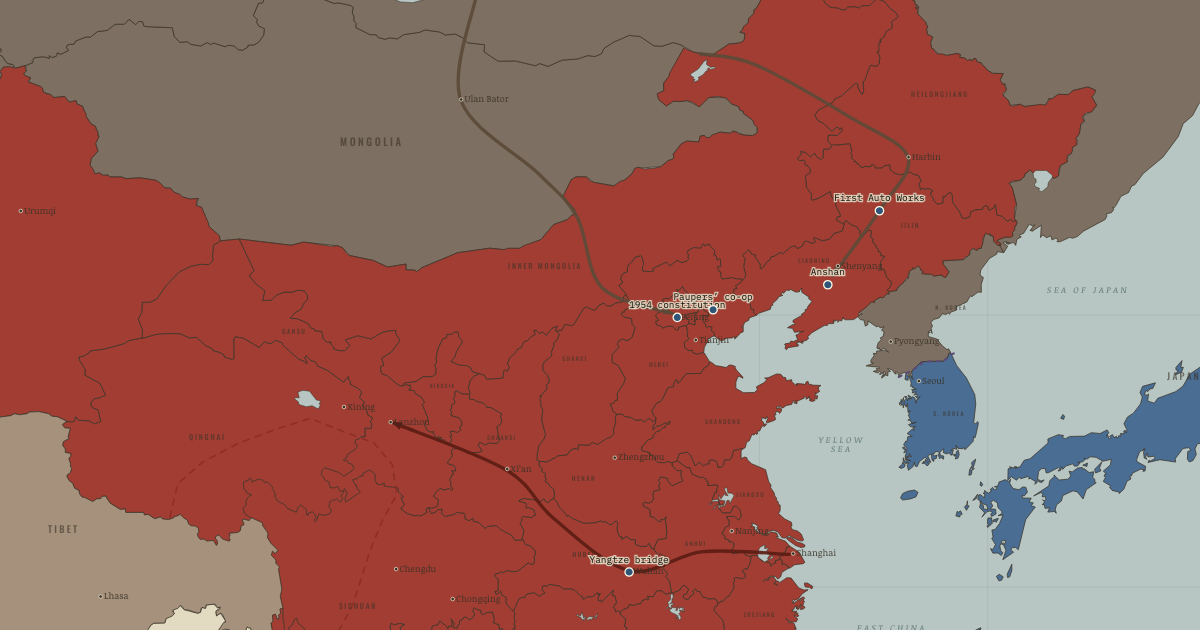
The Soviet Union was the only model China’s leaders trusted, and after the Korean War it was the only one available. Its model was central planning, in which ministries set every factory’s output much as a head office sets targets for each branch of a company, and China copied it in the First Five-Year Plan of 1953–57. An American-led embargo, a ban on trade with China, had closed off Western technology, while Moscow offered designs, machines and about 10,000 specialists over the decade. The north-east received the showpieces because it had the Japanese-built industrial base and lay nearest the Soviet railway, which the arrows follow to Harbin and Anshan. Anshan’s steelworks was rebuilt, and in Changchun the First Automobile Works produced China’s first truck in 1956. The Plan also placed new plants inland, at Wuhan, Baotou, Lanzhou and Xi’an, away from the vulnerable coast. Because the model fitted the alliance, China adopted it with little debate.
The short answer
- The war closed every other door. The Korean War left China under an American trade embargo and dependent on Soviet weapons, loans and advice. With Western technology out of reach, the Soviet Union was the only source of the blueprints, machine tools and engineers that industrialisation required, and Moscow agreed to help build 156 major projects. The alliance therefore decided the shape of China’s economy as well as its foreign policy, because a factory built to a Soviet design also needed Soviet parts, training and planning methods.
- A Marxist faith in heavy industry. The Party believed that a socialist country needed steel, coal, electricity and machines before anything else, both to create a working class and to defend itself. The Soviet example seemed to prove that a backward country could industrialise in a generation through central planning, so heavy industry received the great majority of industrial investment, and consumer goods and agriculture were left to wait. The choice meant that ordinary living standards would rise slowly, which the leaders accepted as the price of national strength.
- Grain was the bottleneck. Industrialisation meant more city workers to feed and more food to export in payment for Soviet machines. When private grain markets failed to deliver enough in 1953, the state imposed its monopoly on buying and selling grain, which let it set low prices and quotas. Collectives then made the monopoly easier to enforce, because the state could deal with a few hundred thousand co-operatives instead of over a hundred million households.
- Mao’s impatience with gradualism. Mao grew frustrated with planners and rural officials who wanted to move slowly after 1953, when he replaced New Democracy with a “general line” for the transition to socialism. His July 1955 speech attacked caution as a political error, and officials, who had learned in the campaigns that overfulfilment was safe, competed to enrol villages. The pace of change was set by the leader’s will and by the incentives of the system he had built.
THE TURNING POINT
The “high tide”, July 1955. Mao’s speech of 31 July 1955 is the hinge of the Plan years because it took the pace of change away from the planners and gave it to the campaign. Before it, collectivisation was meant to take fifteen years; within eighteen months almost every household was enrolled. The speed showed that the Party could reorganise half a billion people by command, and Mao read the success as proof that political will could overcome economic limits. He used Wang Guofan’s “paupers’ co-operative” as his image of the nation: poor, determined and eager to leap ahead. That belief carried directly into the Great Leap Forward.
What it changed
The Leap forward from the Plan. The Plan succeeded in industry and left agriculture lagging, and Mao concluded that the Soviet model was too slow and too bureaucratic for China. His answer, from 1958, was to mobilise labour instead of capital and to combine farming and industry in giant communes. The co-operatives of 1956 became the building blocks of the communes two years later, and the officials who had raced to collectivise raced again.
The state could now take the harvest. The grain monopoly and the collectives gave the state the power to decide how much food each village kept. In normal years this fed the cities and paid for imports. In 1959–60, when officials took grain on the basis of inflated harvest reports, the same machinery stripped villages bare and turned a policy failure into famine. The tools built to feed industry became the tools that starved the producers.
Two classes of citizen. The work-unit system and the 1958 household registration rules divided China into city people, with rations, pensions and health care, and rural people, who had to feed themselves from collective fields and could not move to the cities. The divide between urban and rural China created in these years outlasted Mao by decades, and it decided who lived and who died when food ran short in 1960.
Soviet ties that became a burden. China’s factories, schools and planning offices were built on Soviet designs and staffed with Soviet advisers. When the alliance broke down in 1960 and the experts left, unfinished plants and missing blueprints showed how deep the dependence had been, and the split forced China to improvise its own path. Self-reliance, later praised as a virtue, began as a necessity, and the Lanzhou uranium plant finished by Chinese engineers in 1964 became its proudest example.
The full answer, argued
By its own measures the Plan succeeded: steel output quadrupled, coal production doubled, and industrial output grew by around 18 percent a year, a pace few poor countries have matched. Urban workers gained steady jobs, housing and welfare through their work units, and China built industries it had never had. The costs were carried elsewhere. Peasants sold grain at prices set by the state, lost their land to co-operatives within a few years of receiving it, and were tied to their villages by household registration, so the countryside paid for the cities. Agricultural output grew only a little faster than population, which left no margin for error. Historians such as Naughton credit the Plan with real achievements while stressing these imbalances, and Meisner argues that it also created the bureaucratic elite Mao later turned against. A fair verdict is that the Plan was a success for the state and for city workers, and a sacrifice imposed on the peasant majority. It also shows how growth figures can conceal who pays for development.
An interesting fact
The alliance with Moscow reached into every classroom. In the early 1950s Russian replaced English as the main foreign language in Chinese schools and universities, and Soviet textbooks were translated by the thousand, from engineering manuals to novels. Beijing’s Friendship Hotel, a vast complex built in 1954 in a palace style with green-tiled roofs, was put up to house Soviet experts and their families near the new university district. When Khrushchev recalled the experts in 1960 its rooms emptied within weeks. It still operates as a hotel today, and its name is one of the few public reminders of the alliance.
This is the study layer of China’s First Five-Year Plan, chapter 4 of The People’s Republic under Mao, 1949–1976; the full index of the atlas is here.
Related questions
THE FREE PRINTABLE STUDY GUIDE
Join the Dispatch — a short welcome series, then a letter when a new atlas opens — and the printable study guide for The People’s Republic under Mao is yours now, free.
NO TRACKING · YOUR ADDRESS IS USED FOR THE DISPATCH AND NOTHING ELSE · UNSUBSCRIBE ANYTIME