Mao’s China · 1957
Was the Hundred Flowers campaign an opening or a trap?
The seminar question: “Was the Hundred Flowers campaign a genuine opening that failed, or a deliberate trap?”
In 1956–57 Mao invited China’s educated people to criticise the Communist Party under the slogan “Let a hundred flowers bloom”. After Khrushchev’s denunciation of Stalin and the Hungarian rising, criticism in May and June 1957 went to the Party’s foundations, and within weeks the critics were punished.
Chapter 5 is part of membership. WW2 is free — every chapter. Try chapters 1–2 of any 2 other atlases (3 with a free account). Opening a new atlas uses one of them. Membership opens all 21 — Join.
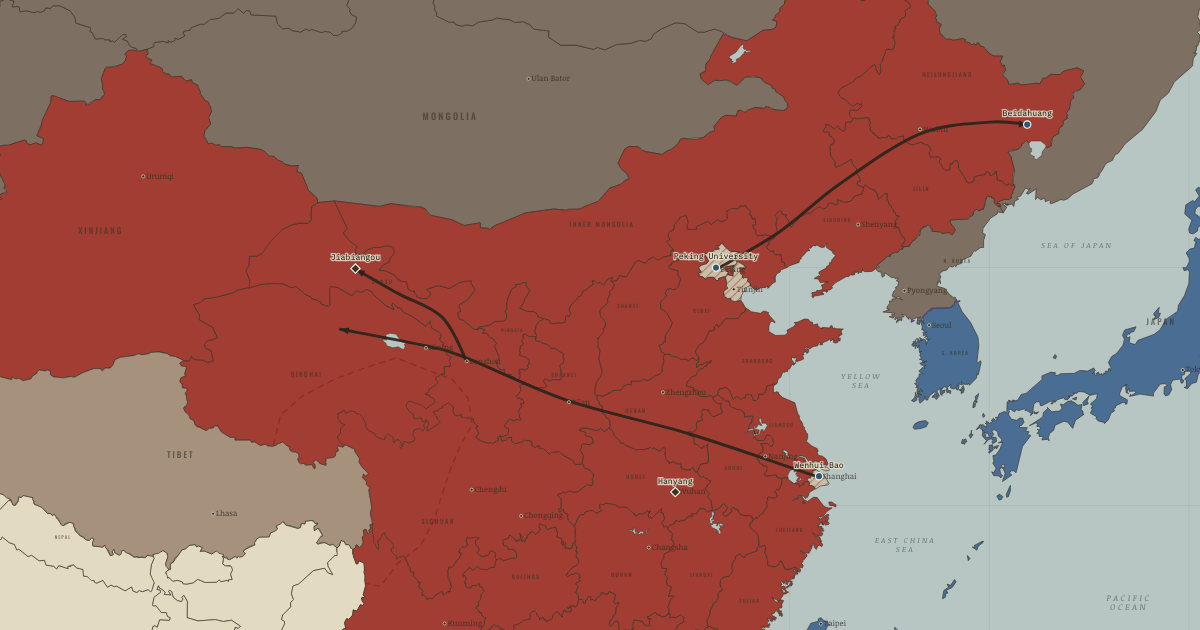
The Hundred Flowers grew out of a crisis in world communism and Mao’s confidence that China was different. Khrushchev’s secret speech of February 1956 had shown that a Communist leader could be judged and condemned by his own party, and the risings in Poland and Hungary that autumn showed what could happen when grievances were suppressed for too long. Mao’s speech of 27 February 1957, “On the Correct Handling of Contradictions among the People”, drew a line between disagreements among the people, which should be settled by discussion, and conflicts with enemies, which called for force. In April the Communist Party, which ruled alone at every level of government, launched a rectification campaign, a drive to correct its own faults much like an organisation inviting complaints about its managers. It asked outsiders to criticise its “bureaucratism, sectarianism and subjectivism”. Mao seems to have expected mild complaints from grateful intellectuals, and his confidence that the Party had won their loyalty was the premise of the whole experiment.
The short answer
- Khrushchev’s secret speech. On 25 February 1956 Khrushchev told the Soviet party congress that Stalin had been a criminal and a self-glorifying tyrant. The speech shook every Communist party, because it showed that a leader’s record could be condemned by his successors. Mao was uneasy about the attack on a personality cult that resembled his own, and he concluded that China needed its own way to air grievances before they built up. He also wanted to show that the Chinese party, unlike the Soviet one, could face criticism without collapsing.
- Hungary and Poland as warnings. Two risings in Eastern Europe convinced Mao that repression alone bred explosions. In October 1956 workers in Poland forced a change of leadership, and in Hungary a rising against the Communist government was crushed by Soviet tanks, with some 2,500 Hungarians killed. Letting people criticise officials, he argued, would allow the Party to correct its faults and prevent a Chinese Hungary. The lesson he drew was the opposite of the one Moscow drew, because Soviet leaders concluded that any opening invited revolt.
- Mao’s confidence after collectivisation. By the end of 1956 collectivisation was complete, private business had been absorbed, and the First Five-Year Plan was succeeding. Mao believed the Party had won the loyalty of the educated class and could afford to hear its complaints. That confidence, and his wish to use outside criticism to shake up a bureaucratic Party he distrusted, made the invitation seem safe. He misjudged how much the campaigns of the early 1950s had cost him in the trust of the people he was now inviting to speak.
- Real grievances after seven years. There was a great deal to criticise by 1957. Intellectuals had been through thought reform and the purges of 1951–55, the democratic parties had titles without power, workers had lost benefits when firms were nationalised, and students resented assignments and admissions quotas. Once permission was given, these grievances poured out faster and more sharply than anyone in the leadership had expected. The speed of the outpouring was itself evidence of how much had been suppressed since 1949.
THE TURNING POINT
8 June and 1 July 1957. The People’s Daily editorials of 8 June and 1 July 1957 are the hinge because they turned an invitation into a hunt and defined criticism of the Party as enmity to the state. Before them, the Party had presented itself as willing to be corrected; after them, the critics’ own words became the evidence against them, and the phrase “open plot” told everyone that frankness had been a test. The editorial attacking Shanghai’s Wenhui Bao, written by Mao, made clear that the leader himself had decided. No later invitation to criticise would be trusted, and the silence that followed shaped every decision of 1958.
What it changed
No one left to warn. The economists, engineers, statisticians and journalists who might have exposed the impossible targets of 1958 had been labelled, sent away or frightened into silence. When the Great Leap Forward began, the experts who remained in office competed to praise it, and doubts were kept private. The famine that followed was made possible in part by a silence that the Anti-Rightist Campaign had created a year earlier.
Re-education through labour. The punishment created in August 1957 allowed police to send people to camps for years without trial. It was used against rightists, petty offenders and later political suspects, and it lasted until 2013, one of the longest-lived institutions of the Mao era. Even in its final years it held well over a hundred thousand people, and it gave the police a way to punish without courts that every later campaign used.
From rightists to “right opportunists”. The language of 1957 was turned against the Party itself two years later. At Lushan in 1959 Mao called the defence minister’s criticism of the Leap “right opportunism”, and a campaign against it purged officials across the country, so the Anti-Rightist method moved from intellectuals to the Party’s own ranks. Officials who had watched the critics of 1957 punished now learned that even senior comrades could be labelled for honest doubts.
A generation of intellectuals broken. Rightists spent up to twenty years in camps, villages or menial jobs, and their children carried the label too. When the Cultural Revolution came, many of the 1957 victims were attacked again, and the rehabilitations of 1978–80 came too late for those who had died. Those who survived became a generation of cautious professionals who remembered that candour had been punished.
The full answer, argued
The evidence points to a gamble that Mao later disguised as a trap. Supporting a genuine opening are his speech of February 1957, which argued for settling disagreements by discussion, the international crisis of 1956 that made reform seem urgent, and the fact that the rectification campaign began with real criticism of officials. Supporting the trap thesis are Mao’s own later claims of an “open plot” and his internal article of 15 May, which shows him watching the critics and preparing a response before the counter-attack. MacFarquhar reads that article as a change of course, while Chang and Halliday read it as the plan unfolding; Teiwes stresses that other leaders were divided too. The documents cannot reveal Mao’s private intentions in March 1957, so any answer carries uncertainty. What can be said is that the outcome made the question almost irrelevant for those punished, and that a regime which can turn an invitation into evidence teaches its citizens never to answer the next invitation honestly.
An interesting fact
The best-known social scientist labelled a rightist, Fei Xiaotong, had trained in London under the anthropologist Bronisław Malinowski, and his study of a Yangtze delta village, Peasant Life in China (1939), is still read as a classic of fieldwork. After 1957 he was barred from research for more than twenty years and spent part of the Cultural Revolution doing manual labour. Rehabilitated in 1980, he returned to the study of small towns and rural industry, and from 1988 to 1998 he served as a vice-chairman of the National People’s Congress, the state he had once been accused of trying to overthrow.
This is the study layer of Hundred Flowers Campaign, chapter 5 of The People’s Republic under Mao, 1949–1976; the full index of the atlas is here.
Related questions
THE FREE PRINTABLE STUDY GUIDE
Join the Dispatch — a short welcome series, then a letter when a new atlas opens — and the printable study guide for The People’s Republic under Mao is yours now, free.
NO TRACKING · YOUR ADDRESS IS USED FOR THE DISPATCH AND NOTHING ELSE · UNSUBSCRIBE ANYTIME