Mao’s China · 1958
How far was Mao responsible for the Great Leap’s failure?
The seminar question: “How far was Mao personally responsible for the Great Leap Forward and its failure?”
The Great Leap Forward of 1958–60 was Mao’s attempt to industrialise China at breakneck speed through mass labour. Co-operatives became giant communes from April 1958, the deadline to overtake Britain in steel kept shrinking, and at Lushan in 1959 Mao dismissed his defence minister for criticising the Leap.
Chapter 6 is part of membership. WW2 is free — every chapter. Try chapters 1–2 of any 2 other atlases (3 with a free account). Opening a new atlas uses one of them. Membership opens all 21 — Join.
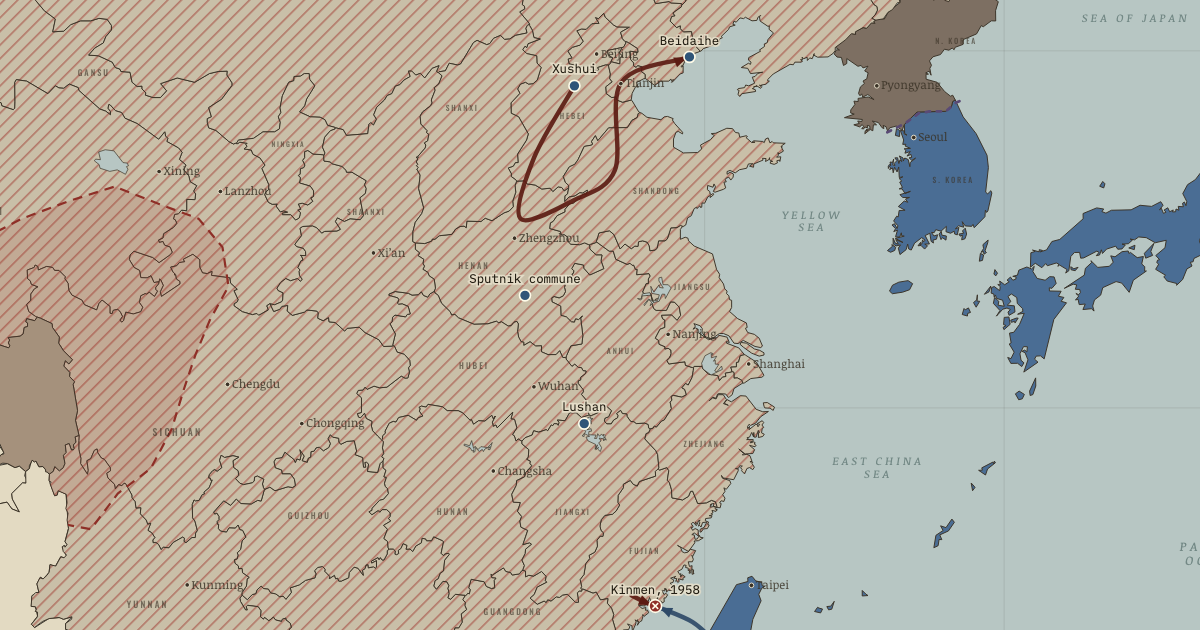
The Great Leap Forward, Mao’s drive of 1958–60 to industrialise China at breakneck speed through mass labour, grew from his impatience with the Soviet model and his confidence after collectivisation. The Soviet model was central planning, in which ministries set every factory’s output much as a head office sets targets for each branch of a company. Collectivisation had merged family farms in 1955–56 into co-operatives owned and worked by their members, much like a farmers’ co-operative made compulsory. In January 1958 Mao attacked the premier Zhou Enlai’s caution of 1956, which he called “opposition to rash advance”, so fiercely that Zhou offered to resign. In the winter of 1957–58 tens of millions of peasants were mobilised to dig irrigation works, and their success seemed to prove that labour could replace capital. Mao called China’s people “poor and blank”, and he saw that poverty as an advantage, because people with nothing to lose would leap.
The short answer
- The easy victory of collectivisation. Collectivisation had been completed in eighteen months without the famine that followed Stalin’s, and the irrigation campaign of the winter of 1957–58 mobilised tens of millions of peasants. These successes convinced Mao that organisation and enthusiasm could achieve in months what planners expected to take years. The co-operatives also provided the units that could be merged into communes, and the officials who had raced to enrol villages in 1955 were ready to race again.
- Overtaking Britain. Rivalry inside the Communist world gave the Leap its deadline. At the Moscow conference of Communist parties in November 1957, Khrushchev claimed that the Soviet Union would overtake the United States in fifteen years, and Mao answered that China would overtake Britain in steel in the same time. Rivalry within the Communist world turned this into a race, and in 1958 the target date was brought forward again and again. Steel output became the symbol by which success was measured.
- A Party that had silenced its critics. The Anti-Rightist Campaign of 1957 had removed or frightened the economists, engineers and journalists who might have challenged impossible targets. Within the Party, Mao’s attack on Zhou Enlai and Chen Yun for “opposing rash advance” in January 1958 showed that even the most senior leaders could be humiliated for caution, so nobody at any level had an incentive to say that a target was impossible. Silence at the top was copied at every level below, where the penalties for doubt were harsher still.
- Mao’s faith in human will. Mao’s revolutionary experience in Yan’an had taught him that a determined, well-organised people could defeat stronger enemies. He applied the same belief to the economy, holding that “politics in command” and mass mobilisation could replace capital, machinery and expertise. Ideas such as close planting and deep ploughing, borrowed from discredited Soviet agronomy, were imposed everywhere as proof that revolutionary methods beat conventional science. Agronomists who objected had often been labelled rightists the year before, so the scientific check on the policy was already gone.
THE TURNING POINT
Lushan, July–August 1959. Lushan is the hinge because it was the last moment at which the Leap could have been halted without catastrophe, and Mao chose to defend his authority instead. Peng Dehuai’s letter was moderate, and many leaders privately agreed with it. By treating it as an attack on himself, Mao turned the question of whether the targets were possible into the question of whether officials were loyal. The campaign against right opportunism that followed made every official at every level revive the inflated targets and the requisitions. The famine of 1959–61 was decided at a mountain resort in the summer of 1959.
What it changed
The Great Famine. With grain quotas set on false harvests, private food abolished and the mess halls running out, the countryside began to starve in the winter of 1958–59, and after Lushan the requisitions were pressed harder. Between 1959 and 1961 somewhere between 15 and 45 million people died, the largest famine in recorded history. The provinces whose leaders had been most zealous in 1958 suffered most.
Lin Biao takes the army. Peng Dehuai’s fall made Lin Biao defence minister, and Lin built his position by promoting the study of Mao’s thought throughout the army, culminating in the Little Red Book of quotations in 1964. The cult that the Cultural Revolution unleashed was first organised in the barracks after Lushan, and by 1969 Lin stood as Mao’s named successor. Two years later Mao turned against him, suspecting that the army’s new power threatened his own.
Mao on the second line. Mao’s retreat to what he called the “second line”, leaving daily government to colleagues, handed them the management of the crisis. In April 1959 he had given up the post of head of state to Liu Shaoqi, saying he wished to concentrate on theory. When the famine forced a retreat, Liu, Deng Xiaoping and Chen Yun ran it, which gave them authority Mao came to resent and set up the struggle of 1966. The famine’s managers became the Cultural Revolution’s targets.
Khrushchev’s scorn. Khrushchev mocked the communes in public in 1959, and Mao suspected that Peng Dehuai had discussed his criticisms with Soviet leaders during a visit to Eastern Europe that spring. The Leap thus deepened the quarrel with Moscow, and in 1960 the Soviet experts were withdrawn. Each side read the other’s policies as a betrayal of the revolution, and the alliance never recovered.
The full answer, argued
The case for Mao’s personal responsibility is strong. He devised the Leap’s central ideas, attacked colleagues who urged caution in January 1958, promoted the communes and the steel target, and at Lushan he chose to purge Peng Dehuai and revive the campaign when a correction was under way. Teiwes and Sun conclude that no other leader could have started or stopped it. Yet the Leap also depended on thousands of others. Provincial leaders such as Wu Zhipu in Henan and Li Jingquan in Sichuan competed to exceed targets, county officials invented harvests, and colleagues in Beijing who doubted the figures stayed silent. Some historians, including Andrew Walder, therefore stress the system: a party-state that rewarded zeal and punished honesty would have produced inflated claims under any leader in a campaign. The most convincing judgement is that Mao bore primary responsibility for the decisions, while the political system he built explains why those decisions could not be challenged. Responsibility in authoritarian systems is rarely the leader’s alone, and rarely anyone else’s first.
An interesting fact
One of the Leap’s campaigns was a war on the “Four Pests”: rats, flies, mosquitoes and sparrows, which were accused of eating grain. For three days in April 1958 Beijing’s residents banged pots, beat drums and waved flags from roofs and trees so that sparrows could not land until they fell from exhaustion. The birds also ate insects, and locust and pest damage worsened. After scientists such as the ornithologist Zheng Zuoxin warned the leadership, sparrows were quietly removed from the list in 1960 and replaced by bedbugs. The episode became a standard example, in China and abroad, of what happens when a campaign overrides expert advice.
This is the study layer of Great Leap Forward, chapter 6 of The People’s Republic under Mao, 1949–1976; the full index of the atlas is here.
Related questions
THE FREE PRINTABLE STUDY GUIDE
Join the Dispatch — a short welcome series, then a letter when a new atlas opens — and the printable study guide for The People’s Republic under Mao is yours now, free.
NO TRACKING · YOUR ADDRESS IS USED FOR THE DISPATCH AND NOTHING ELSE · UNSUBSCRIBE ANYTIME