Russian Revolution · AUG 1919
Why did some borderlands win independence and others not?
The seminar question: “Why did Finland, the Baltics and Poland win lasting independence while Ukraine and the Caucasus were reconquered?”
As the imperial centre fell in 1917–21, Finland, the Baltic states and Poland won independence, while Ukraine was fought over by nationalists, Germans, Whites, Reds, Poles and peasant armies. Pogroms murdered perhaps a hundred thousand Jews, and the Reds reconquered Ukraine, the Caucasus and Central Asia.
Chapter 11 is part of membership. WW2 is free — every chapter. Try chapters 1–2 of any 2 other atlases (3 with a free account). Opening a new atlas uses one of them. Membership opens all 21 — Join.
Free printable Russian Revolution study guide, sent by email ↓
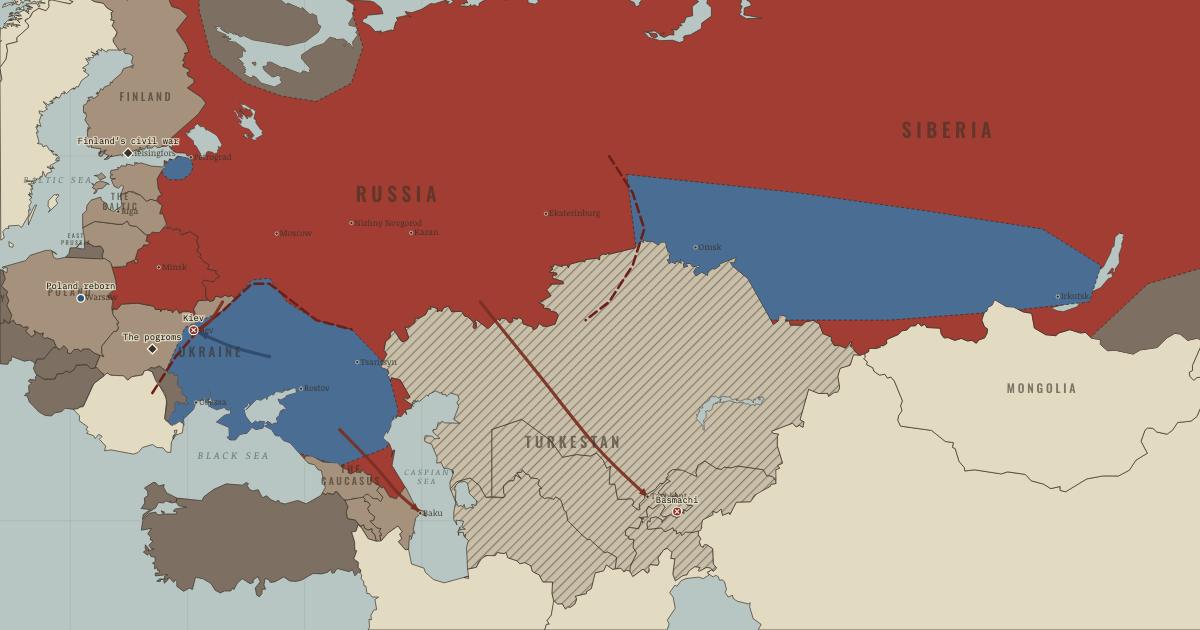
The fall of the imperial center opened several revolutions at the same time around the empire’s edge. Finland became independent in December 1917 and immediately tore itself apart in a civil war between Red workers and a German-backed White army, whose victors ran prison camps in which thousands of the defeated died. The Baltic states fought Soviet and other forces to a standstill with British naval help and their own riflemen, and Poland, restored after 123 years of partition among three empires, fielded an army and fought on every frontier to define its borders. These were not separate from the Russian Revolution; they were its centrifugal half, the outward flight of every nationalism the empire had held down.
The short answer
- Empire’s collapse is the nations’ opportunity. When the center falls, the peripheries rise. The abdication, October, and above all Brest-Litovsk removed the imperial hand and let every suppressed nationalism. Finnish, Polish, Ukrainian, Georgian, Azeri. Reach for statehood at once. The borderland revolutions were not separate from the Russian one. They were its centrifugal half.
- Great-power sponsorship decided who survived. The nations that kept their independence mostly had a great-power patron and defensible geography: Finland (German then Western backing, forests and distance), the Baltics and Poland (Western support, and the buffer of the Polish war). Those with neither. Ukraine open on the plain, the Caucasus republics isolated. Were reconquered. Independence in 1917–21 was as much about who backed you as about how hard you fought.
- The Reds’ double policy on nationality. The Bolsheviks proclaimed the right of nations to self-determination and then reconquered the nations that used it. Resolving the contradiction by making the reconquered lands “sovereign” Soviet republics. It was cynical and it worked: it let the Red Army pose as liberator, split moderate nationalists from separatists, and rebuild the empire as a federation.
- Ethnic hatred with no state to restrain it. The collapse of all authority across Ukraine turned old antisemitism into mass murder. With no state, no police and armies that lived off the land, the Jewish towns of the Pale became targets for every armed group. The pogroms were not incidental to the borderland wars. They were among their defining atrocities.
THE TURNING POINT
Kiev — the borderlands’ ordeal in one city. No place shows the borderland wars better than Kiev, which changed hands among Rada, Bolsheviks, Germans, Hetman, Directory, Whites, Poles and Reds more than a dozen times in three years. Each new master brought requisitions, conscription and, too often, a pogrom. Each was swept away by the next. Kiev’s agony is the borderlands’ story in miniature: nations reaching for freedom, ground between larger armies, and. For Ukraine, unlike Finland or Poland. Finally reconquered. The city that suffered most from the empire’s collapse ended the war back inside its successor.
What it changed
A ring of new nation-states — and a new border. Finland, Estonia, Latvia, Lithuania and Poland emerged as independent states that lasted (until 1939–40). Their survival redrew the map of eastern Europe and created the borderland that the next war would contest.
The empire rebuilt as a federation. Ukraine, Belorussia and the three Caucasus republics were reconquered and refounded as Soviet republics, joined in 1922 into the USSR. The revolution had promised self-determination and delivered a federal empire. The model that would hold together, and finally fall apart, seventy years later.
A memorial that must not be softened. The pogroms of 1918–20 killed on a scale that prefigured worse to come, and they were committed by nearly every armed force except, on the whole, the disciplined Red Army. A fact the Bolsheviks used, and one that helped turn many Jews toward the Soviet side. It is remembered here as memory, not as a point scored.
The full answer, argued
Three factors, in descending order of weight. First, great-power backing: the survivors had Western (and earlier German) support and, in Poland’s case, an army that could beat the Red Army in the field. The reconquered had little or none. Second, geography: Finland’s forests and the Baltic’s and Poland’s position behind the 1920 war gave defensible space, while Ukraine lay open on the plain astride the Reds’ interior lines and the Caucasus republics were isolated and encircled. Third, Red priorities and capacity: the Bolsheviks could reach and cared most about the grain of Ukraine and the oil of Baku, and reconquered them accordingly, while cutting their losses on the Baltic rim after Warsaw. Notice that national will was necessary everywhere and decisive nowhere by itself. The borderlands that survived combined determination with a patron and a defensible line. Self-determination, in 1921 as often since, went to those the great powers were willing to protect.
An interesting fact
Independent Finland very nearly began life as a monarchy. In October 1918 its parliament elected a German prince — Friedrich Karl of Hesse, the Kaiser’s brother-in-law — as King of Finland; Germany’s collapse a month later made the choice untenable before the king-elect had ever set foot in his kingdom. He renounced the throne in December, and Finland quietly became the republic it has been ever since — a reminder that the borderland states were improvising even their forms of government week by week, on the shifting fortunes of the great powers.
This is the study layer of Dissolution of the Russian Empire, chapter 11 of The Russian Revolution, 1855–1924; the full index of the atlas is here.
Related questions
THE FREE PRINTABLE STUDY GUIDE
Join the Dispatch — a short welcome series, then a letter when a new atlas opens — and the printable study guide for The Russian Revolution is yours now, free.
NO TRACKING · YOUR ADDRESS IS USED FOR THE DISPATCH AND NOTHING ELSE · UNSUBSCRIBE ANYTIME