MAPS OF HISTORY · IB HISTORY · THE COLD WAR
IB HISTORY · 1945 – 1991 · 12 CHAPTERS
IB History: The Cold War — notes, maps and essay questions
Blocs, walls and proxy wars: how forty-six years of armed peace nearly ended everything, several times — and then ended quietly, in a single autumn.
IB notes for this atlas are in preparation. Meanwhile, this page gathers the study notes every one of its 12 chapters already carries: why each episode happened, the moment it turned on, what it changed, and the question historians still argue about. It also shows where the atlas fits the IB course.
WW2 is free — every chapter. Try chapters 1–2 of any 2 other atlases (3 with a free account). Opening a new atlas uses one of them. Membership opens all 21 — Join.
Where it fits the course
The atlas is filed under Paper 2 (Conflict) and Paper 3 for Higher Level (Europe, the Americas, and Asia and Oceania). Its IB notes, with evidence lists, primary sources and model essay plans, are in preparation. These are the IB History pages for the parts of the course it serves:
Why it began
Causation questions start at the beginning. These are the causes the atlas’s opening chapters argue, each in a few sentences you can test against your own reading.
Chapter 1: The World the War Left
The security dilemma — two rational fears. The USSR, invaded twice through Poland in thirty years at a cost of 27 million dead, defined security as controlling everything between Berlin and Moscow. The United States, twice dragged into world wars by European collapse, defined security as ensuring no single power dominated Eurasia. Each definition made the other side’s nightmare true: Soviet buffer-building looked like expansion. American engagement looked like encirclement. No villain is required for this mechanism to run. Which is precisely what makes it worth studying.
Ideology made compromise read as defeat. This was not only a great-power rivalry. Leninism taught that capitalist encirclement guaranteed eventual war. American liberalism taught that closed societies breed aggression (the lesson of the 1930s). Both creeds were universal. Each side believed history itself was on its side. So every local dispute, from Polish ministries to Iranian oil, carried the weight of a verdict on the future of mankind.
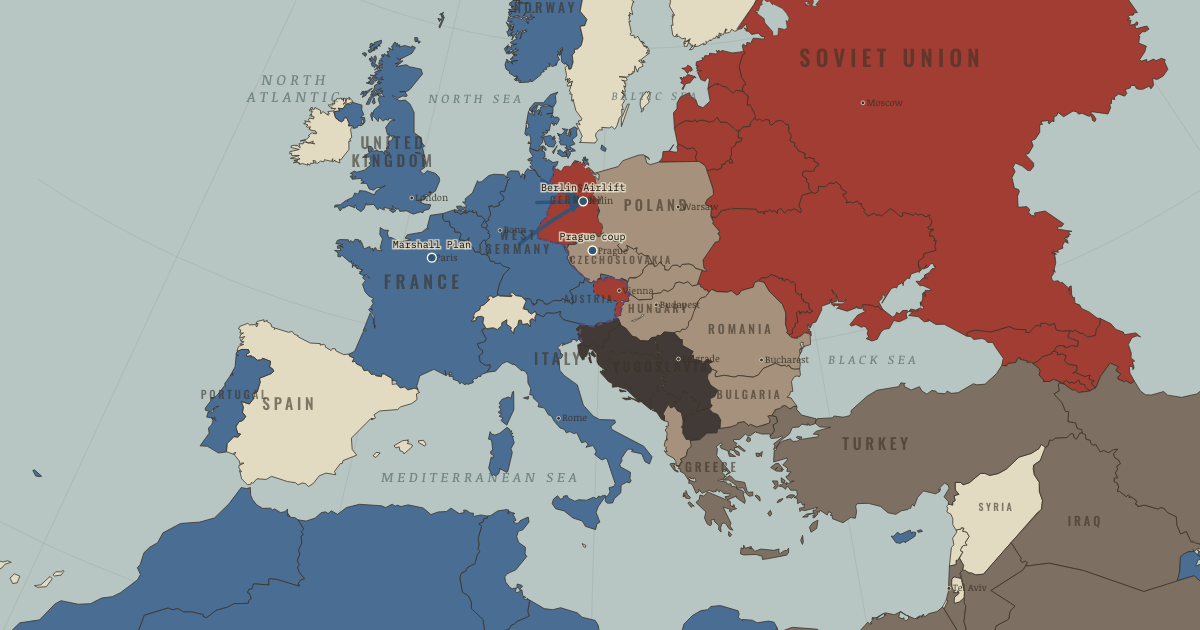
Poland: the test case that failed. Watch Poland on this map. The country Britain went to war for in 1939. At Yalta, Stalin conceded “free and unfettered elections”. What followed were arrests of Home Army leaders, a rigged referendum (1946) and a falsified election (1947). For Washington, Poland proved Soviet promises were worthless. For Moscow, Western protest over Poland proved the West meant to re-encircle Russia with hostile states. One country, two proofs.
A power vacuum with two occupants. Germany and Japan. The powers that had organized Eurasia’s two ends. Were rubble. Britain was bankrupt (it would devalue and retreat from Greece, India and Palestine within three years). France was humiliated. Only two states retained the means to shape the world, and nothing but each other stood between them. Bipolarity wasn’t chosen. It was the arithmetic of 1945.
Chapter 2: Containment
Europe was starving, and hunger votes. The brutal winter of 1946–47 froze canals, halved German rations and pushed French and Italian communist parties. Already a quarter of the vote. Toward power through the ballot box. Marshall’s planners argued that empty stomachs, not Soviet tanks, were the immediate threat. The Plan was containment aimed at despair. It worked: Western European output passed prewar levels by 1951, and the communist vote crested and receded.
Why Moscow refused the money. Marshall aid was offered to the USSR and its sphere. Sincerely or as a wedge, historians still argue. Stalin sent Molotov to Paris with ninety economists, then pulled him out: the Plan required open accounts and integration into a Western-run system, which for a command economy meant surrendering control of its buffer. Refusing was rational for the regime and ruinous for its subjects. Czechoslovakia had voted to attend, and was overruled by phone. The two Europes on this map begin as two answers to one memo.
Berlin: geography as leverage. The 1945 occupation plan left the Western sectors of Berlin deep inside the Soviet zone with no written guarantee of ground access. Only three agreed air corridors, each twenty miles wide (your three arrows). Stalin’s blockade was calibrated below the threshold of war: no shots, just closed gates. The airlift answered in kind. No convoy forced through, just physics and logistics. Both sides discovered the Cold War’s grammar: pressure everywhere short of the trigger.
The bomb behind the politeness. America’s atomic monopoly (until August 1949) shaped both sides’ caution. Stalin would not shoot down transports. Truman parked B-29s in England as a signal. The bombers were not actually atomic-configured, an early bluff in a long tradition. Neither side wanted the war both were preparing for. The entire crisis ran on nerve.
Chapter by chapter
The atlas has 12 chapters. For each, the causes it explains and the moment it turns on; the title opens the chapter’s free page with the full explanation, a discussion question and the map.
1. The World the War Left
CHAPTER 1 · 1945–1946
Why it happened: The security dilemma — two rational fears · Ideology made compromise read as defeat · Poland: the test case that failed · A power vacuum with two occupants
The turning point: Moscow, 22 February 1946.
2. Containment
CHAPTER 2 · 1947–1949
Why it happened: Europe was starving, and hunger votes · Why Moscow refused the money · Berlin: geography as leverage · The bomb behind the politeness
The turning point: Berlin, 24 June 1948 — the gates close.
3. Two Shocks of 1949
CHAPTER 3 · 1949
Why it happened: Why Chiang lost — and it wasn’t Moscow’s doing · Espionage plus industry, not either alone · NSC-68: worst-case logic in a frightened spring
The turning point: Semipalatinsk, 29 August 1949.
4. Korea: The Cold War Turns Hot
CHAPTER 4 · 1950–1953
Why it happened: Three men’s miscalculations, compounding · Why China came in · A war the UN could join by accident
The turning point: Inchon, 15 September 1950 — brilliance, then hubris.
5. Coexistence and Its Crises
CHAPTER 5 · 1953–1961
Why it happened: De-Stalinization was a controlled burn that escaped · Hungary and Suez: the linkage that saved Moscow · Sputnik and the politics of panic · Berlin: the pressure differential
The turning point: Berlin, 13 August 1961 — the admission.
6. Cuba: To the Brink
CHAPTER 6 · 1962
Why it happened: Khrushchev’s gamble: parity on the cheap · The Bay of Pigs, author of the crisis · The quarantine: force with a built-in pause
The turning point: 27 October, aboard B-59 — one man’s no.
7. Vietnam
CHAPTER 7 · 1955–1975
Why it happened: The domino logic and its critics · Attrition against patience — why the strongest power lost · The war the neighbors were drafted into
The turning point: Tet, 30 January 1968 — the hinge of perception.
8. The Third World Front
CHAPTER 8 · 1947–1979
Why it happened: Decolonization and bipolarity, mutually radicalizing · Non-alignment was a strategy, not a sentiment · Clients pulled patrons, not only the reverse · The oil weapon rewrites the ledger
The turning point: October 1973 — the war that moved the pivot.
9. Détente: The Triangle
CHAPTER 9 · 1969–1979
Why it happened: The split that made the triangle possible · Parity made arms control rational · Economics pressed both ways
The turning point: Beijing and Shanghai, 21–28 February 1972.
10. The Second Cold War
CHAPTER 10 · 1979–1985
Why it happened: Afghanistan: the trap of the client state · The Euromissile spiral, a security dilemma in miniature · Reagan’s buildup: bankrupting strategy or dangerous bluff? · Solidarity: the crack that martial law painted over
The turning point: Able Archer 83, 2–11 November 1983.
11. Gorbachev and the Unraveling
CHAPTER 11 · 1985–1989
Why it happened: Why reform — the numbers Gorbachev read · Chernobyl as accelerant · The Brezhnev Doctrine repealed — and believed · The West’s underrated role: steadiness, and a partner
The turning point: Berlin, 9 November 1989, 18:53.
12. The End — and the Arguments
EPILOGUE · 1990–1991
Why it happened: The August coup: the ratchet that broke · Ukraine votes, and the union is arithmetic · An economy that could no longer buy time
The turning point: Belovezha, 8 December 1991.
Essay questions, argued
Every chapter ends with a discussion question that historians still argue about, with our answer in brief. Use them as essay practice: plan your own answer, then read how we would argue it.
DISCUSSION QUESTION · CHAPTER 1
Was the Cold War inevitable in 1945 — or the product of avoidable choices?
The orthodox school blamed Stalin’s expansionism. Revisionists blamed American economic ambition. Post-revisionists (Gaddis and after) tend to answer: some confrontation was structurally likely. Two universalist superpowers in a vacuum. But its depth was chosen. Test the counterfactuals: a Poland with Finnish-style limited autonomy, or an early atomic-sharing deal, might have produced a colder peace rather than a forty-year siege. But note what the structure explains that personalities don’t: the same standoff logic emerged in Korea, Germany and Iran simultaneously, wherever the armies touched. The transferable lesson is the security dilemma itself. Watch for it whenever two powers each arm against the other’s defenses.
The chapter behind it: The World the War Left. Every chapter’s question is on the discussion questions page.
DISCUSSION QUESTION · CHAPTER 5
Was crushing Hungary a Soviet victory or a Soviet defeat?
By every immediate measure, victory: the bloc held, the West stayed out, and deterrence-by-example bought twelve quiet years. But run the longer ledger. Budapest cost Moscow the world’s communist parties (a third of French and Italian members quit within a year. The birth of Eurocommunism), armed the charge that Soviet anti-imperialism was fraud, and taught the satellites that the system rested on tanks alone. Knowledge that resurfaced intact in 1989, when the tanks stayed home and everything fell in months. Empires that can only compel have already lost the argument. The interesting question is how long compulsion can outlive consent. Here: thirty-three years, almost to the week.
The chapter behind it: Coexistence and Its Crises. Every chapter’s question is on the discussion questions page.
DISCUSSION QUESTION · CHAPTER 9
Détente collapsed within a decade. Was it therefore a failure?
Judge it against its stated goal. Permanently stabilized coexistence. And it failed: by 1980 the powers were rearming and boycotting each other’s Olympics. Judge it against the counterfactual and it looks different: the ABM Treaty and SALT capped a race at its most dangerous inflection. The triangle deterred a Soviet strike on China that was seriously studied in 1969. Berlin was finally regularized (the 1971 Quadripartite Agreement. No Berlin crisis ever recurred). And Helsinki seeded the legitimacy collapse of 1989. The deepest reading: détente was less a policy that failed than a phase in which both empires, briefly honest about their limits, wrote documents their successors could not unwrite. Institutions built in moments of realism keep working after the realism ends. Which is an argument for building them.
The chapter behind it: Détente: The Triangle. Every chapter’s question is on the discussion questions page.
DISCUSSION QUESTION · CHAPTER 12
“The Cold War ended without a war.” Defend and attack that sentence using three markers and two snapshots from this atlas.
Defense: between the superpowers it holds absolutely. Pick m-b59 and m-ablearcher as the near-misses that stayed near, and the e89→e91 snapshots showing an empire dissolving with Soviet garrisons standing down in place. No Kursk, no Berlin 1945, ends this map. Attack: pick any three of m-pyongyang-bomb, m-tet, m-kabul, m-luanda, m-khmer and the w62→w75 snapshots, and the sentence collapses into a European parochialism. The war was continuously hot from Korea to Angola, killing millions who never saw the “long peace.” The synthesis is the atlas’s core lesson: where the map was drawn in 1945 by two armies facing each other, deterrence froze it. Where the map was still being drawn. The decolonizing world. The Cold War was fought with live ammunition, by proxy, in other people’s houses. Whether you call the era a peace depends on where you stand on the map. That is true of most history. This atlas just makes it visible.
The chapter behind it: The End — and the Arguments. Every chapter’s question is on the discussion questions page.
What it changed
Consequence questions need the end of the story. The final chapter, The End — and the Arguments, sets out what the period left behind:
Who ended it? The four-way argument. Pressure (Reagan school): the buildup and SDI made the arms race unaffordable and emboldened reformers. Choice (Gorbachev school): nothing required a Soviet leader to renounce force. A Li Peng in Moscow shoots, and this atlas ends differently. Structure (economics school): a 1970s-technology command economy at 15–20% defense burden was doomed regardless. Leaders only chose the exit’s date and decency. People (1989 school): Solidarity, Leipzig, the Baltic chain. Legitimacy was withdrawn from below, and no Kremlin decision could have restored it. The honest synthesis: structure set the stage, pressure raised the rent, Gorbachev declined to burn the theater, and the audience walked out. Weight them yourself. The exam will not, but history teachers forever will.
What the new map inherits. Nuclear arsenals in four sudden states (Ukraine, Belarus, Kazakhstan disarm by treaty within years. A nonproliferation triumph with a long shadow). Yugoslavia already dissolving into Europe’s first wars since 1945. The hatching on this final map. NATO victorious and open-ended. Russia, shorn of empire and depression-struck, nursing the narrative that it was not defeated but dismantled. The post-Cold-War order’s crises. Expansion debates, frozen conflicts, the 2014 and 2022 wars over exactly the Belovezha borders. Are footnotes to this snapshot. The era ended. Its map kept legislating.
The ledger of the “long peace”. No direct great-power war in 46 years. Deterrence, bipolar discipline, or luck (Ch. 6 says: all three). But the chart below counts what “cold” cost where the war was hot: Korea, Vietnam, Afghanistan, Angola, Cambodia, Ethiopia, Central America. Something like 20 million people died in Cold War-connected conflicts, almost none of them in Europe, most of them in the countries this atlas’s Chapter 8 insists were players and not squares. Both facts. The peace and the price. Are true. Keeping them in one sentence is the era’s epitaph.
Revision tools
The atlas ends with a map quiz that asks you to find places and moments on the map itself (part of membership and of the Exam Sprint). The quick quiz and the discussion questions with our answers are free pages on this site, and the printable study guide gathers every chapter’s notes into one document for revision.
Read next
- The Second World War that made the blocs · WW2
- Refugees of the early Cold War and of Indochina · UPROOTED
- Stalin’s Soviet Union · THE SOVIET UNION UNDER STALIN
- Mao’s China · THE PEOPLE’S REPUBLIC UNDER MAO
Maps of History is independent and is not affiliated with or endorsed by the International Baccalaureate Organization. IB course names describe alignment only; paper, theme and section names follow the new course outline and may change when the final guide is published.
THE DISPATCH
A short welcome series, then a letter when a new atlas opens — and the printable study guide for The Cold War is yours now, free.
NO TRACKING · YOUR ADDRESS IS USED FOR THE DISPATCH AND NOTHING ELSE · UNSUBSCRIBE ANYTIME