Norse and Aztecs · CHAPTER 6 ·
Norse stockfish trade and legacy
Chapter 6 of Climate and Innovation: The Norse and the Aztecs, c. 790–1521: “What the Norse Left”
The most durable Norse innovations were the flexible ones. Clinker-built boats outlived the Viking raids by centuries; stockfish, cod dried on racks in Arctic Norway, became the backbone of Norway’s economy, shipped through Bergen; and Iceland’s law and assembly endured after it accepted the Norwegian king in 1262–64.
Chapter 6 is part of membership. WW2 is free — every chapter. Try chapters 1–2 of any 2 other atlases (3 with a free account). Opening a new atlas uses one of them. Membership opens all 21 — Join.
Free printable Norse and Aztecs study guide, sent by email ↓
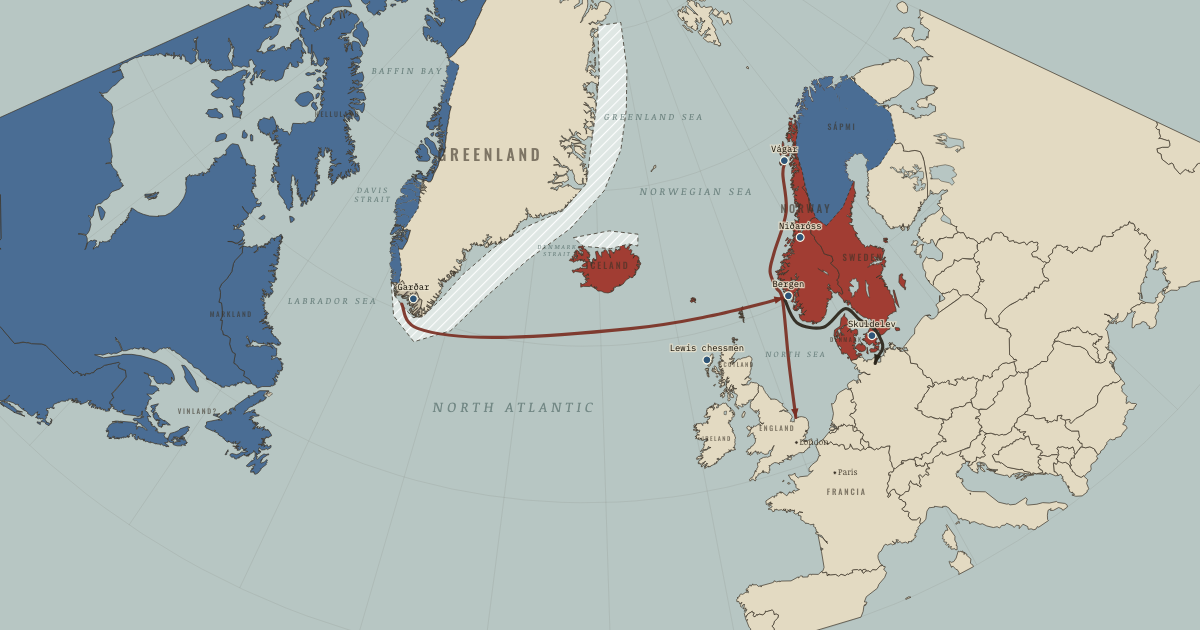
The map above is the world of The Norse North Atlantic, 1450 — The Eastern Settlement falls silent.
Part of IB History: The Norse and the Aztecs →
BRIEF EXPLANATION — THE ESSENTIAL ARGUMENT
Weighing what survived from the Norse world against what failed shows that the most durable innovations were the flexible ones, which could serve many purposes and draw on many resources. The clinker-built ship, made of overlapping planks riveted together, outlived the Viking raids by centuries, because the same technique built fishing boats, cargo ships and ferries along every Nordic coast. The trade in stockfish, cod caught off Arctic Norway and dried on wooden racks until it kept for years like a hard biscuit, became the backbone of Norway’s economy, shipped through Bergen to England and Germany. Iceland’s law and assembly endured even after the island accepted the Norwegian king in 1262–64. The church districts, or bishoprics, run from Niðaróss, modern Trondheim, worked like the branch offices of one international organisation and tied the islands of the west into Christian Europe. Every one of these survivors served more than one purpose or drew on more than one resource.
What failed was the most specialised system of all, the Greenland colony, which farmed cattle at the edge of their range and paid its way with a single luxury, walrus ivory, while holding no more than about 2,000–2,500 people. When the climate cooled, the ivory market faded and shipping thinned, the colony had nothing else to fall back on, and by the mid to late fifteenth century its last farms were empty. On the map, the Eastern Settlement is now hatched as abandoned, while the arrows show the stockfish routes and those of the Hanseatic League, a federation of German trading towns that worked like a modern trade bloc, which carried the Norse economy into the late Middle Ages. The Norse case therefore suggests that innovations last when they spread risk, which is the question the second case, a society that engineered a lake, tests from the other side.
The full story
The ship tradition lasted because the same design served war, trade and fishing. After the age of raids, the same clinker technique of overlapping planks produced cargo vessels like Skuldelev 1, a 16-metre ocean-going ship of pine built in western Norway around 1030, and later the broad trading ships that carried fish and grain. Boatbuilders along the Nordic coasts kept the method alive into the twentieth century, and in 2021 UNESCO recognised Nordic clinker boat traditions as part of the world’s intangible heritage. A technique that could be scaled up or down and adapted to any cargo survived every change in politics and climate, since some boat was always needed.
The stockfish trade shows how an economy could adapt to a colder North Atlantic. Fishermen around the Lofoten islands, at the market of Vágar, caught spawning cod each winter and dried them on racks in the cold, dry wind, producing food that could travel for years without salt. Archaeologists led by James Barrett have found a sudden rise in sea fish bones on English sites around the year 1000, a change they call the fish event horizon, and chemical testing of cod bones links part of this trade to Arctic Norway. By the fourteenth century German merchants of the Hanseatic League, a federation of trading towns that worked much like a modern trade bloc, ran a permanent office at Bergen from about 1360. Christian Keller estimates that a cargo of walrus tusks shipped from Greenland in 1327 was worth nearly 60 tonnes of stockfish, which shows which commodity was becoming the real currency of the north.
Greenland’s failure was the price of specialisation, and comparing it with Iceland makes the point. Both colonies were Norse, Christian and subject to Norway after the 1260s, and both suffered the colder centuries. Iceland, with perhaps 40,000–60,000 people around 1100, estimated from a count of 4,560 tax-paying farmers, could sell stockfish and wool and absorb bad years, and it survived plague, volcanoes and poverty. Greenland, with a twentieth of that population, depended on hay and ivory, both of which failed together. The Church linked the colony to Europe through its bishop at Garðar, appointed in 1126, and the archbishopric of Niðaróss from 1153, a church province run from Trondheim much like a regional headquarters, but such ties were only as strong as the shipping that carried them. The surviving Norse world was the part that could feed itself from the sea and sell what it caught.
DEEP EXPLANATION — EVIDENCE & INTERPRETATION
Stockfish and the fish event horizon
The rise of the stockfish trade has been traced through fish bones, which survive in rubbish pits far better than written records. In 2004 James Barrett, Alison Locker and Callum Roberts showed that fish bones from English settlements changed sharply around the year 1000, when cod and herring from the open sea suddenly outnumbered freshwater and estuary fish, and they called the shift the fish event horizon. Later studies used chemical isotopes in cod bones to identify where the fish had been caught, linking dried cod found in England and Germany to the waters of northern Norway. The written sources then pick up the story, as Bergen became the hub through which Arctic fish flowed south and Hanseatic merchants gained privileges there in the fourteenth century. The evidence shows a northern economy reorienting from raiding and luxury goods to the steady export of a staple food, and the cooling climate did not interrupt it, since cod thrived in cold water.
Church and crown: networks that bound and limited
The Church and the Norwegian crown were institutional innovations that held the scattered North Atlantic together, and they also made the colonies dependent. When the archbishopric of Niðaróss was created in 1153, its province stretched from Norway to Orkney, the Hebrides, the Isle of Man, the Faroes, Iceland and Greenland, so a bishop in Greenland answered to an archbishop about 2,800 kilometres away. Greenland paid church dues in walrus tusks and accepted the king in 1261, and Iceland in 1262–64, in return for promises of regular ships. Arne Nedkvitne argues that these ties brought real benefits, including priests, law and trade, but that they also concentrated decisions in Bergen and Trondheim. When plague and changing trade reduced Norway’s interest after 1349, the network that had sustained Greenland simply stopped sending ships. An institution that links distant places is only as reliable as the self-interest of its centre, and Greenland’s centre lay in a country that had lost perhaps half its people and found more profitable trades.
Specialisation, scale and the limits of the Greenland system
Comparing Iceland and Greenland isolates the variables that historians think decided their different fates. Both were settled by the same people with the same ships, animals and law, and both endured the Little Ice Age. The differences were population, which was perhaps twenty times larger in Iceland, and the range of goods each could sell, since Iceland had fish and wool while Greenland relied on ivory. Thomas McGovern argued in 1980 that Greenland’s elite, centred on great farms and churches, steered resources toward cattle and display, and later work by Dugmore and Jackson presents the colony as flexible but too small to absorb shocks that arrived together. The lesson these scholars draw is about resilience, meaning the capacity to absorb a shock and keep functioning. A society that is small, distant and dependent on one product has little resilience, however skilled its people are, and that is the standard against which the Mexica system, larger and more concentrated, will be measured.
Key places on the map
Why it happened
Versatile technology survives changing purposes. The clinker ship survived the end of raiding because it was a general-purpose technology, a tool like the modern lorry that serves many trades at once. The same method built warships, cargo ships and fishing boats in sizes from rowing boats to 30-metre vessels. When raiding ended, the ships found new work carrying fish, timber and grain, so the investment in shipbuilding skills, timber and wool never became obsolete. Its flexibility worked as a kind of insurance against change.
Cod suited a colder sea. The cooling of the North Atlantic harmed farms on the edge of their range but did not harm cod, which thrive in cold water and gather to spawn off Lofoten each winter. Air-drying in cold, dry wind preserved the catch without salt, which was expensive in the north. The stockfish trade therefore turned the northern climate into an advantage, a rare case in which colder conditions favoured an existing industry.
Iceland’s size and variety gave it resilience. Iceland’s population of perhaps 40,000–60,000 around 1100 and its mix of livestock, fishing and trade allowed it to absorb disasters that would have ended a smaller colony. Even the plague of 1402–04 did not end the society. Older estimates say it killed half or more of Iceland’s people, while recent studies put the toll nearer a quarter to 45 percent. Size and variety acted as insurance, spreading each loss across many farms and trades, which Greenland, with a twentieth of the population, never had.
Greenland depended on one export and one link. Greenland’s imports of iron, timber and grain were paid for almost entirely with walrus ivory and carried by a few ships from Bergen. When European buyers turned back to elephant ivory and the royal ship sank in 1369 without replacement, both the income and the link failed at once. Dependence on a single product and a single route left the colony with no fallback when conditions changed, however hard its people worked.
THE TURNING POINT
Bergen, c. 1360. The founding of the Hanseatic League’s permanent office at Bergen around 1360 is the hinge of this chapter because it shows where the Norse North Atlantic economy was heading. The future lay in bulk trade in a staple food, dried cod, managed by German merchants with access to the large markets of the Baltic and the North Sea. Greenland, with its luxury export and its long, icy route, had no place in that system. The same decades that made Bergen a great fish market saw the last royal ship sail for Greenland.
What it changed
Norway becomes a fish economy. For the next five centuries the stockfish of northern Norway, shipped through Bergen, remained one of the country’s largest exports, and the wooden merchant houses of Bryggen still stand as a UNESCO World Heritage site. The trade showed how a northern society could profit from the cold, a contrast with Greenland’s defeat by it, and it tied Norway’s fortunes to German merchants for centuries.
Iceland endures as a fishing and farming society. Iceland passed under Norwegian and then Danish rule and grew poorer in the colder centuries, but it survived with its language, law codes and saga literature intact. Its manuscripts, including the sagas that preserve the Vinland voyages, became the chief source through which later Europeans learned of the Norse Atlantic, and that literary survival is itself a legacy of the Althing’s culture.
A second experiment begins far to the south. While the last Norse farms in Greenland emptied, the Mexica of central Mexico were completing an empire built on the opposite strategy: one dense, engineered landscape fed by tribute from a wide region. Chapter 7 turns to that second case, which tests whether concentration and engineering could do better than mobility and dispersal against a demanding environment. The comparison makes each case clearer than either would be alone.
DISCUSSION QUESTION — Which Norse innovation was most significant in the long run: the ship, the stockfish trade or the Althing?
Each can claim significance, and the answer depends on what significance measures. The ship made everything else possible, carrying settlers to Iceland and Greenland and later carrying the fish and grain on which the North Atlantic economy depended, and its building tradition survived into the twentieth century. The stockfish trade had the greatest economic weight after about 1100, turning a cold sea into a lasting export and binding Norway to the markets of England and the Hanseatic towns. The Althing mattered most for identity and political culture, giving Iceland a tradition of law and assembly that outlived independence and shaped its modern parliament. A strong answer might argue that the ship was the enabling condition while the stockfish trade was what actually sustained Norse societies through the colder centuries. The transferable insight is that the most significant innovations are often those that keep finding new uses after their original purpose has gone.
An interesting fact
The most famous objects made from Greenland’s exports were found on a beach in the Outer Hebrides. In 1831 a hoard of 93 carved pieces turned up near Uig on the Isle of Lewis: 78 chessmen, 14 round playing pieces and a belt buckle, carved around 1150–1200 mostly from walrus ivory and some whale teeth, and probably made in Trondheim. The pieces include kings, queens, bishops and warders biting the tops of their shields. Eighty-two are in the British Museum and eleven in National Museums Scotland, and much of their ivory may have come from the hunting grounds of Norðrseta.
Related
THE FREE PRINTABLE STUDY GUIDE
Join the Dispatch — a short welcome series, then a letter when a new atlas opens — and the printable study guide for Climate and Innovation is yours now, free.
NO TRACKING · YOUR ADDRESS IS USED FOR THE DISPATCH AND NOTHING ELSE · UNSUBSCRIBE ANYTIME