Refugee crises · CHAPTER 7 ·
Fall of Saigon and the 1975 exodus
Chapter 7 of Uprooted: Refugees in Europe 1945–1960 and Indochina 1975–1990: “Communist Victory”
Between April and December 1975 communists took power in Vietnam, Cambodia and Laos. On 29–30 April US helicopters carried about 7,000 people out of Saigon, and over 110,000 evacuees passed through tent cities on Guam. In Cambodia the Khmer Rouge entered Phnom Penh on 17 April and emptied it of two million or more people.
Chapter 7 is part of membership. WW2 is free — every chapter. Try chapters 1–2 of any 2 other atlases (3 with a free account). Opening a new atlas uses one of them. Membership opens all 21 — Join.
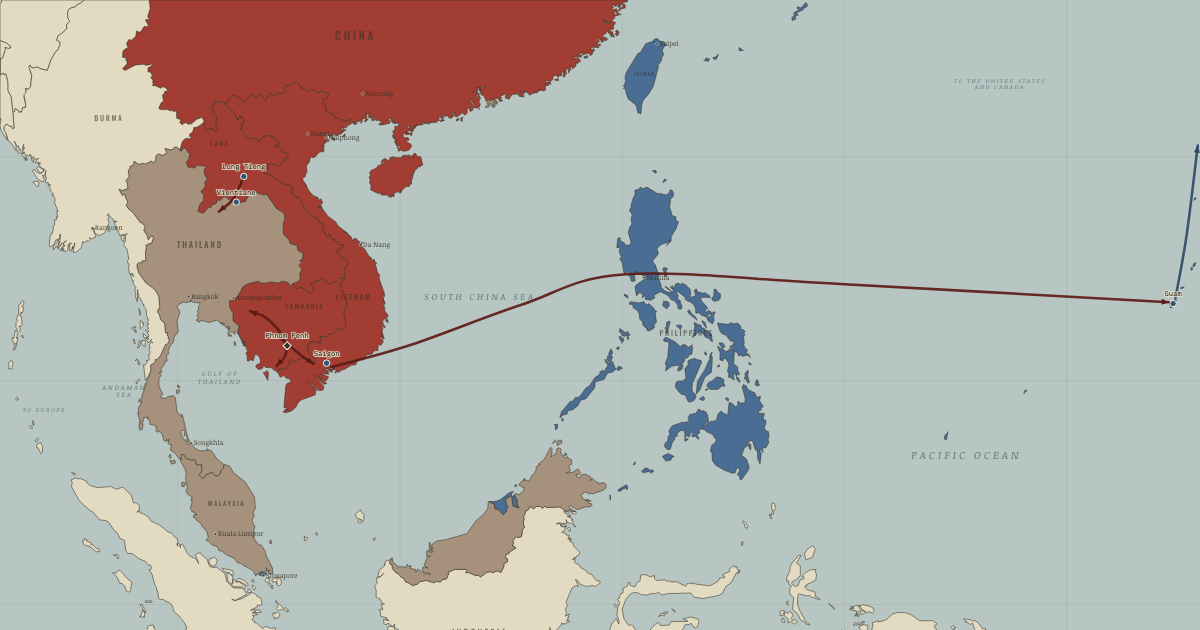
The map above is the world of Refugees in Southeast Asia, December 1975 — Laos turns communist.
Part of IB History: Refugees in Europe and Indochina →
BRIEF EXPLANATION — THE ESSENTIAL ARGUMENT
The communist victories of 1975 opened Indochina’s refugee crisis, because each new regime treated the people tied to the old order, and in Cambodia the whole urban population, as enemies to be removed or remade. Indochina here means the three states of former French Indochina: Vietnam, Cambodia and Laos. Between April and December 1975 communist parties took power in all three after a war in which the United States had backed their opponents, and on the map the peninsula turns red. Thailand, painted tan, became the main state of first asylum, the first safe country that refugees reach. The arrows show three different kinds of departure, and which one a family faced depended on whom the new rulers counted as enemies.
In each country the new rulers’ programme decided who fled and how. In Vietnam, because the victors would punish those tied to the old order, about 130,000 to 140,000 people linked to the United States and the Saigon government, the American-backed regime of South Vietnam, left with the Americans, including about 7,000 lifted out by helicopter on 29 and 30 April, and passed through tent cities on Guam on their way to camps in the United States. In Cambodia, because the Khmer Rouge, the communist guerrilla army led by Pol Pot, saw cities as enemies, it emptied Phnom Penh of about two million people within days, the first act of a regime under which 1.5 to 2.2 million people would die. In Laos the Hmong, a highland people whose men had fought in an army funded by the CIA, the American intelligence service, fled across the Mekong River to Thailand because they feared reprisal. There was a precedent: when the Geneva agreements that ended French rule divided Vietnam in 1954, about a million northerners moved south. In both decades victory in a civil war left the losers a choice between submission and flight.
The full story
Vietnam’s exodus of 1975 was an evacuation of the defeated, and its scale was set by how suddenly the war ended. The Republic of Vietnam, the American-backed South, collapsed in eight weeks after the North’s spring offensive began in March, so plans to remove the officials, officers and employees most at risk were improvised at the last moment. On 29 and 30 April American helicopters carried about 7,000 people from Saigon to warships offshore, while others left by aircraft, fishing boats and the ships of the South Vietnamese navy. The long red arrow on the map follows them to the Philippines and to Guam, an American island territory where more than 110,000 people passed through tent cities that summer. From there they flew to four reception camps in the United States, and Congress funded their resettlement through the Indochina Migration and Refugee Assistance Act of May 1975. The first wave was therefore made up largely of people with American connections, and its arrival was managed as the closing chapter of a lost war.
Cambodia’s displacement in 1975 happened mostly inside the country, which is why it fell outside the reach of refugee law, since that law protects only people who have crossed an international border. When the Khmer Rouge, Pol Pot’s communist army, entered Phnom Penh on 17 April, they ordered its two million or more inhabitants, many of them refugees from years of fighting and American bombing, to leave at once, telling them they could return in three days. Hospital patients were pushed out in their beds, and thousands died on the roads, though the number remains uncertain. The regime then named its state Democratic Kampuchea, abolished money, markets and schools, and set the population to forced agricultural labour in a society rebuilt from “Year Zero”. It also expelled about 150,000 ethnic Vietnamese across the eastern border, the short arrow toward Saigon. Few Cambodians could reach Thailand in these years, so the world learned what was happening mainly from the small number who escaped.
Laos produced the third kind of flight, a minority allied to the losing side crossing a river to safety. For over a decade the CIA, the American foreign intelligence service, had armed and paid an army of Hmong, a highland people of northern Laos, under General Vang Pao, to fight the Pathet Lao, the Lao communist movement, and North Vietnamese troops. When the Pathet Lao took control in May 1975, American aircraft lifted Vang Pao and about 2,500 Hmong out of their base at Long Tieng, the arrow’s starting point, while tens of thousands of others walked through the forest to the Mekong. By December 1975, when the king abdicated and the Lao People’s Democratic Republic was proclaimed, about 54,000 Laotians were already in Thailand, most of them Hmong. The three exoduses had different causes, an elite’s escape, a state’s war on its own cities and a minority’s flight from reprisal, and that variety would make a single international answer hard to find.
DEEP EXPLANATION — EVIDENCE & INTERPRETATION
The precedent of 1954
Partition in 1954 had already shown that a settlement of a civil war sends the losers into flight. The Geneva agreements of July 1954, which ended the French war in Indochina, divided Vietnam at the 17th parallel and gave civilians 300 days to move to the zone of their choice. More than a million people went south, about 800,000 of them Roman Catholics, while about 130,000 supporters of the Viet Minh, the communist-led independence movement, went north; the US Navy’s Operation Passage to Freedom carried nearly 310,000 people on its ships. Older accounts stressed American psychological warfare, including leaflets claiming that the Virgin Mary had gone south, as the cause of the Catholic exodus. Peter Hansen’s research on the northern Catholics (2009) argues instead that parish priests and communities made their own decisions, based on experience of Viet Minh rule and fear of religious persecution, so the migrants had agency of their own. The northern refugees became a pillar of Ngô Đình Diệm’s government in the South, which helps explain why many of their children were among those most at risk in 1975. The 1954 movement shows that partitions produce flight in both directions and that the people who move become political assets for the state that receives them.
Evacuation and reception, 1975
American planning for an evacuation of Vietnamese at risk began late, partly because Ambassador Graham Martin feared that visible preparations would cause panic and hasten the collapse. Between March and June 1975 about 131,000 Vietnamese and Cambodians entered the American refugee system, according to State Department records, most of them on Guam, where 111,919 passed through Operation New Life. They then waited in camps at Camp Pendleton in California, Fort Chaffee in Arkansas, Eglin Air Force Base in Florida and Fort Indiantown Gap in Pennsylvania until a sponsor, often a church, a family or a voluntary agency, agreed to take responsibility for them. Polls that spring found many Americans opposed to admitting them, and the government deliberately scattered families across the country to avoid concentrations, a policy that later broke down as people moved to California and Texas. Congress authorised up to $455 million for the programme. The episode shows a receiving state treating resettlement as an obligation of honour toward wartime allies, which shaped American responses to every later wave from Indochina.
The emptying of Phnom Penh
Historians explain the evacuation of Phnom Penh through both ideology and calculation. The Khmer Rouge leadership saw cities as parasitic and corrupt and wanted a nation of peasant labour, and it also feared that a city of two million would be impossible to control or feed and might hide enemies. François Ponchaud’s Cambodia Year Zero (1977), based on refugee testimony gathered in Thailand, was the first detailed account, and Ben Kiernan’s The Pol Pot Regime (1996) placed the evacuation within a programme of social and racial transformation. Deaths during the evacuation are disputed, with estimates from about 2,000 to 20,000. In 2016 the Supreme Court Chamber of the Extraordinary Chambers in the Courts of Cambodia, the UN-backed tribunal, upheld convictions of the surviving leaders Nuon Chea and Khieu Samphan for murder, persecution and other inhumane acts during the evacuation while finding too little evidence of deaths to sustain the charge of extermination for that phase. The legal caution reflects a historical point: the city’s emptying was the beginning of the catastrophe, and most of the 1.5 to 2.2 million deaths came later, in the labour cooperatives.
Key places on the map
On this day
Why it happened
Thirty years of war. Indochina had been at war almost continuously since 1945, first against French rule and then in a conflict between the communist North and the American-backed South that spread into Laos and Cambodia. American bombing and ground fighting had already driven millions from the countryside into the cities, so Phnom Penh and Saigon were swollen with internal refugees. The end of the war therefore found populations uprooted, impoverished and divided by loyalties that the victors would punish.
American withdrawal. The South fell faster than anyone had planned because its patron had withdrawn. The Paris agreements of January 1973 withdrew American troops, and in 1974–75 Congress cut aid to Saigon and Phnom Penh. When the North launched its offensive in March 1975, the southern army collapsed faster than anyone had planned for, and Cambodia’s government fell on 17 April. The speed of defeat explains why evacuation was improvised and why so many people at risk were left behind.
Revolutionary programmes. Each victorious party had a programme for remaking society. Hanoi aimed at reunification and the socialist transformation of the South, the Khmer Rouge at a classless peasant nation built from Year Zero, and the Pathet Lao at a socialist state aligned with Vietnam. Programmes that defined whole classes and groups as enemies turned political victory into displacement, which is the central link between 1975 in Indochina and 1945 in Europe.
Alliances with the losing side. Hundreds of thousands of people had worked with the Americans or the old regimes: soldiers, officials, interpreters and the Hmong fighters of the CIA’s army in Laos. Victory turned them into suspects, and many fled first because they had most to fear. Their alliance with a foreign power also gave them a claim on that power, which is why the United States took them in.
THE TURNING POINT
Saigon, 29–30 April 1975. The helicopter evacuation from Saigon is the hinge because it marked both the end of the American war and the start of an American obligation. In two days about 7,000 people were lifted to the fleet, and over that spring about 130,000 left, which made the United States the principal country of resettlement for Indochina for the next twenty years. The images of the evacuation also fixed the refugees in American eyes as allies left behind by defeat, a framing that later helped the boat people win admission. What did not leave on those helicopters, the millions linked to the old regime who stayed, became the reason for the larger flight to come.
What it changed
Those left behind. Hundreds of thousands of former officers and officials who stayed in Vietnam were sent to re-education camps, and city dwellers were pushed toward New Economic Zones in the countryside. The next chapter shows how these policies, and the attack on private trade in 1978, turned a political defeat into a mass flight. The people who could not leave in 1975 became the boat people of 1978 and 1979.
Year Zero. The emptying of the cities was the first step of Democratic Kampuchea’s attempt to build a society without money, markets, religion or families as people had known them. Over the next four years forced labour, starvation and execution killed 1.5 to 2.2 million people, a catastrophe the next chapter records with memorial markers and sober ranges of figures. Its survivors would reach the Thai border only in 1979, after the regime fell.
Thailand on the front line. Thailand became the front-line state of the crisis. From 1975 it received Lao, Hmong and later Cambodian refugees across long land borders, while it feared Vietnamese power and communist insurgency at home. Its shifting policy, open in some years and harsh in others, explains why its colour changes repeatedly on this map in chapters 9 to 11. Like Austria in 1956, it was a small state asked to carry a burden created by a larger conflict.
A resettlement commitment. The reception of 1975 created a constituency of Vietnamese Americans and a precedent of federal responsibility, both of which pressed Washington to act when the boat people appeared in 1978–79. Chapter 10 follows how the United States turned that precedent into law with the Refugee Act of 1980. Communities formed by the first wave also sponsored relatives, so each arrival made the next easier.
DISCUSSION QUESTION — Why did the communist victories of 1975 produce such different kinds of displacement in Vietnam, Cambodia and Laos?
The differences reflect each regime’s programme and each population’s relationship to the losing side. In Vietnam the victors aimed to absorb the South, so the immediate flight was of people most exposed by their American links, an evacuation of about 130,000 that the United States organised and funded. In Cambodia the Khmer Rouge pursued a radical transformation in which cities themselves were enemies, so displacement was internal, total and violent, and few could escape abroad. In Laos the decisive factor was ethnicity combined with alliance, since the Hmong had fought for the CIA and feared reprisal. A comparison should also note similarities: all three regimes treated political loyalty as collective, and all three created populations that neighbours and distant powers then had to receive. The transferable insight for this Paper 1 study is that the type of displacement depends above all on what the victor intends to do with the defeated.
An interesting fact
One of the first refugee landings of the crisis came by chance. In the first days of May 1975 the Danish container ship Clara Maersk, sailing for Hong Kong, came upon a crowded freighter in the South China Sea and took about 3,700 people on board, a load far beyond anything the ship had been built to carry. The crew fed them from the ship’s stores and landed them in Hong Kong on 4 May, the colony’s first boat people. Rescues by passing merchant ships would remain one of the main ways boat people survived, and UNHCR later counted about 67,000 people rescued at sea between 1975 and 1990.
Related
THE FREE PRINTABLE STUDY GUIDE
Join the Dispatch — a short welcome series, then a letter when a new atlas opens — and the printable study guide for Uprooted is yours now, free.
NO TRACKING · YOUR ADDRESS IS USED FOR THE DISPATCH AND NOTHING ELSE · UNSUBSCRIBE ANYTIME