Refugee crises · 1975
Why did displacement differ in Vietnam, Cambodia and Laos?
The seminar question: “Why did the communist victories of 1975 produce such different kinds of displacement in Vietnam, Cambodia and Laos?”
Between April and December 1975 communists took power in Vietnam, Cambodia and Laos. On 29–30 April US helicopters carried about 7,000 people out of Saigon, and over 110,000 evacuees passed through tent cities on Guam. In Cambodia the Khmer Rouge entered Phnom Penh on 17 April and emptied it of two million or more people.
Chapter 7 is part of membership. WW2 is free — every chapter. Try chapters 1–2 of any 2 other atlases (3 with a free account). Opening a new atlas uses one of them. Membership opens all 21 — Join.
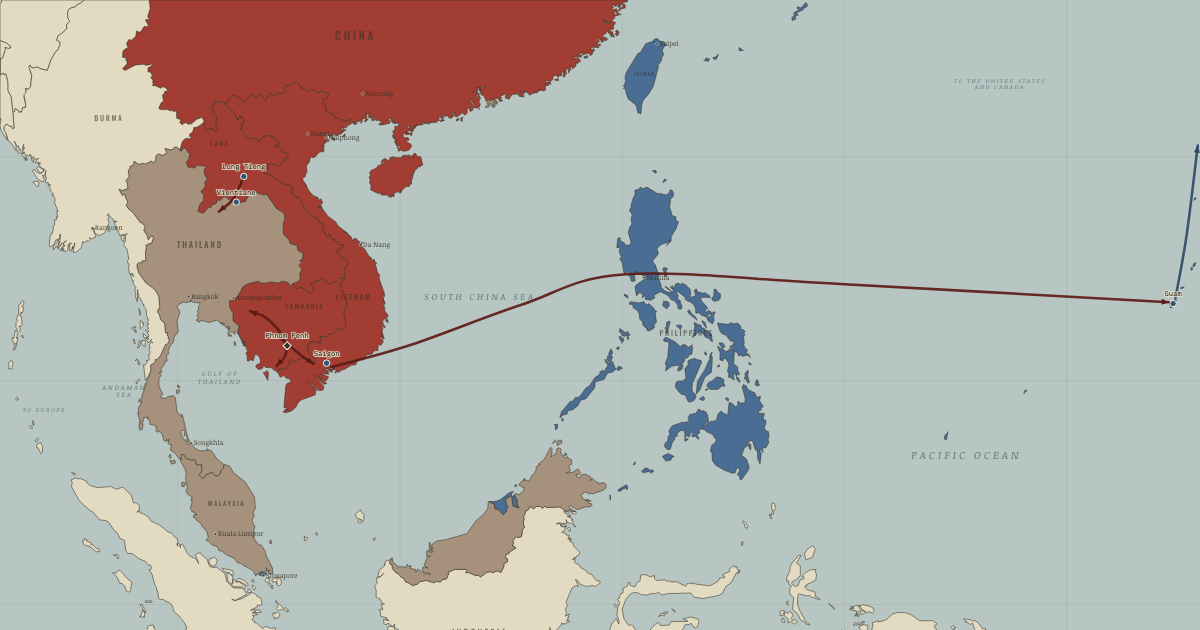
Vietnam’s exodus of 1975 was an evacuation of the defeated, and its scale was set by how suddenly the war ended. The Republic of Vietnam, the American-backed South, collapsed in eight weeks after the North’s spring offensive began in March, so plans to remove the officials, officers and employees most at risk were improvised at the last moment. On 29 and 30 April American helicopters carried about 7,000 people from Saigon to warships offshore, while others left by aircraft, fishing boats and the ships of the South Vietnamese navy. The long red arrow on the map follows them to the Philippines and to Guam, an American island territory where more than 110,000 people passed through tent cities that summer. From there they flew to four reception camps in the United States, and Congress funded their resettlement through the Indochina Migration and Refugee Assistance Act of May 1975. The first wave was therefore made up largely of people with American connections, and its arrival was managed as the closing chapter of a lost war.
The short answer
- Thirty years of war. Indochina had been at war almost continuously since 1945, first against French rule and then in a conflict between the communist North and the American-backed South that spread into Laos and Cambodia. American bombing and ground fighting had already driven millions from the countryside into the cities, so Phnom Penh and Saigon were swollen with internal refugees. The end of the war therefore found populations uprooted, impoverished and divided by loyalties that the victors would punish.
- American withdrawal. The South fell faster than anyone had planned because its patron had withdrawn. The Paris agreements of January 1973 withdrew American troops, and in 1974–75 Congress cut aid to Saigon and Phnom Penh. When the North launched its offensive in March 1975, the southern army collapsed faster than anyone had planned for, and Cambodia’s government fell on 17 April. The speed of defeat explains why evacuation was improvised and why so many people at risk were left behind.
- Revolutionary programmes. Each victorious party had a programme for remaking society. Hanoi aimed at reunification and the socialist transformation of the South, the Khmer Rouge at a classless peasant nation built from Year Zero, and the Pathet Lao at a socialist state aligned with Vietnam. Programmes that defined whole classes and groups as enemies turned political victory into displacement, which is the central link between 1975 in Indochina and 1945 in Europe.
- Alliances with the losing side. Hundreds of thousands of people had worked with the Americans or the old regimes: soldiers, officials, interpreters and the Hmong fighters of the CIA’s army in Laos. Victory turned them into suspects, and many fled first because they had most to fear. Their alliance with a foreign power also gave them a claim on that power, which is why the United States took them in.
THE TURNING POINT
Saigon, 29–30 April 1975. The helicopter evacuation from Saigon is the hinge because it marked both the end of the American war and the start of an American obligation. In two days about 7,000 people were lifted to the fleet, and over that spring about 130,000 left, which made the United States the principal country of resettlement for Indochina for the next twenty years. The images of the evacuation also fixed the refugees in American eyes as allies left behind by defeat, a framing that later helped the boat people win admission. What did not leave on those helicopters, the millions linked to the old regime who stayed, became the reason for the larger flight to come.
What it changed
Those left behind. Hundreds of thousands of former officers and officials who stayed in Vietnam were sent to re-education camps, and city dwellers were pushed toward New Economic Zones in the countryside. The next chapter shows how these policies, and the attack on private trade in 1978, turned a political defeat into a mass flight. The people who could not leave in 1975 became the boat people of 1978 and 1979.
Year Zero. The emptying of the cities was the first step of Democratic Kampuchea’s attempt to build a society without money, markets, religion or families as people had known them. Over the next four years forced labour, starvation and execution killed 1.5 to 2.2 million people, a catastrophe the next chapter records with memorial markers and sober ranges of figures. Its survivors would reach the Thai border only in 1979, after the regime fell.
Thailand on the front line. Thailand became the front-line state of the crisis. From 1975 it received Lao, Hmong and later Cambodian refugees across long land borders, while it feared Vietnamese power and communist insurgency at home. Its shifting policy, open in some years and harsh in others, explains why its colour changes repeatedly on this map in chapters 9 to 11. Like Austria in 1956, it was a small state asked to carry a burden created by a larger conflict.
A resettlement commitment. The reception of 1975 created a constituency of Vietnamese Americans and a precedent of federal responsibility, both of which pressed Washington to act when the boat people appeared in 1978–79. Chapter 10 follows how the United States turned that precedent into law with the Refugee Act of 1980. Communities formed by the first wave also sponsored relatives, so each arrival made the next easier.
The full answer, argued
The differences reflect each regime’s programme and each population’s relationship to the losing side. In Vietnam the victors aimed to absorb the South, so the immediate flight was of people most exposed by their American links, an evacuation of about 130,000 that the United States organised and funded. In Cambodia the Khmer Rouge pursued a radical transformation in which cities themselves were enemies, so displacement was internal, total and violent, and few could escape abroad. In Laos the decisive factor was ethnicity combined with alliance, since the Hmong had fought for the CIA and feared reprisal. A comparison should also note similarities: all three regimes treated political loyalty as collective, and all three created populations that neighbours and distant powers then had to receive. The transferable insight for this Paper 1 study is that the type of displacement depends above all on what the victor intends to do with the defeated.
An interesting fact
One of the first refugee landings of the crisis came by chance. In the first days of May 1975 the Danish container ship Clara Maersk, sailing for Hong Kong, came upon a crowded freighter in the South China Sea and took about 3,700 people on board, a load far beyond anything the ship had been built to carry. The crew fed them from the ship’s stores and landed them in Hong Kong on 4 May, the colony’s first boat people. Rescues by passing merchant ships would remain one of the main ways boat people survived, and UNHCR later counted about 67,000 people rescued at sea between 1975 and 1990.
This is the study layer of Fall of Saigon and the 1975 exodus, chapter 7 of Uprooted: Refugees in Europe 1945–1960 and Indochina 1975–1990; the full index of the atlas is here.
Related questions
THE FREE PRINTABLE STUDY GUIDE
Join the Dispatch — a short welcome series, then a letter when a new atlas opens — and the printable study guide for Uprooted is yours now, free.
NO TRACKING · YOUR ADDRESS IS USED FOR THE DISPATCH AND NOTHING ELSE · UNSUBSCRIBE ANYTIME