Refugee crises · CHAPTER 6 ·
Expellee integration in West Germany
Chapter 6 of Uprooted: Refugees in Europe 1945–1960 and Indochina 1975–1990: “Integration and the Cold War”
West Germany, home to 7.9 million expellees, treated them as citizens, and its 1952 Equalisation of Burdens law made owners of surviving property pay half its value into a fund for those who had lost everything. Refugees from communist states, among them East Germans leaving steadily for the West, became symbols of the Cold War.
Chapter 6 is part of membership. WW2 is free — every chapter. Try chapters 1–2 of any 2 other atlases (3 with a free account). Opening a new atlas uses one of them. Membership opens all 21 — Join.
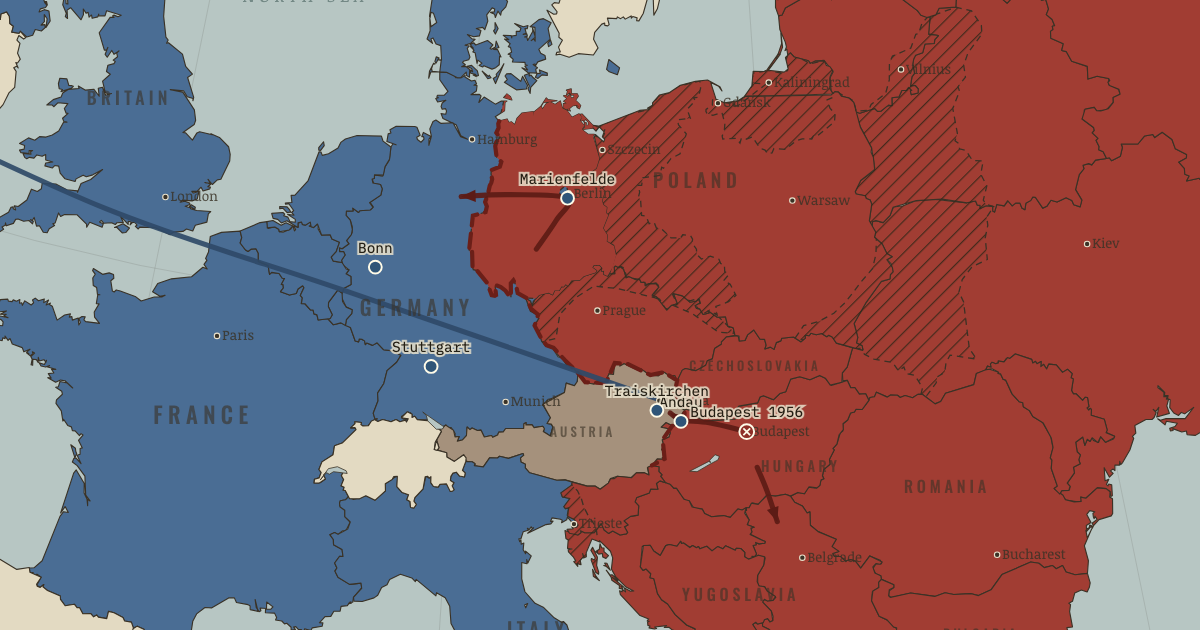
The map above is the world of Refugees in Europe, November 1956 — Hungarians flee to Austria.
Part of IB History: Refugees in Europe and Indochina →
BRIEF EXPLANATION — THE ESSENTIAL ARGUMENT
Europe’s refugee story ran on two tracks in the 1950s: the Germans uprooted in 1945 were absorbed as citizens, while new refugees from communist states became symbols of the Cold War, the rivalry between the American-led West and the Soviet bloc. West Germany, home to 7.9 million expellees, the Germans driven from the east, treated them as fellow citizens with claims on the nation. In 1952 the Bundestag, West Germany’s parliament, passed the Lastenausgleich, or Equalisation of Burdens law, which made owners of property that had survived the war pay half its value over thirty years into a fund for those who had lost everything, much as an insurance pool spreads one group’s losses across all its members. Together with an economic boom that needed workers, the law helped turn an impoverished population into one of the foundations of the new state.
The second track of flight came from the communist states, and the West welcomed it because every refugee confirmed its case against communism. The dashed line on the map marks the sealed border from the Baltic to Yugoslavia, so about 2.7 million East Germans who left between 1949 and 1961 went mostly through the one open gap, Berlin. In November 1956 about 200,000 Hungarians fled after Soviet tanks crushed their revolution, and Austria, painted tan as a first-asylum state, the first safe country refugees reach, took in about 180,000. Because 37 countries resettled them within months, and UNHCR, the UN’s refugee agency, stretched a treaty that covered only events before 1951, Austria was never left alone. World Refugee Year in 1959–60 then paid to close the last camps for displaced persons, and the Berlin Wall of August 1961 shut the remaining door. Europe’s post-war crisis ended with a system that worked well for the refugees the West wanted to receive.
The full story
West Germany integrated its expellees, the Germans driven out of the east, because it had to and because they could vote. In 1950 one resident in six was an expellee, most of them crowded into the rural states of Schleswig-Holstein, Lower Saxony and Bavaria, living in barracks and farm attics far from industrial jobs, often amid open local hostility. The state responded with housing programmes, schemes that moved hundreds of thousands to the industrial west, the Federal Expellee Law of 1953, and the Equalisation of Burdens law of August 1952, the marker at Bonn, which levied half the value of surviving property to compensate those who had lost everything. Expellees organised too: their Charter, proclaimed at Stuttgart in August 1950, renounced “revenge and retaliation”, and their party won 5.9 percent of the vote in 1953 and joined the government of the West German chancellor Konrad Adenauer. The boom of the 1950s, hungry for labour, did the rest, so integration was the joint work of policy, politics and growth.
East Germany handled the same problem by forbidding anyone to name it, and it lost people steadily to the West. Its four million or so expellees were called Umsiedler, “resettlers”, and in the Görlitz treaty of July 1950 the East German government recognised the Oder–Neisse line, the frontier with Poland along those two rivers, as a “border of peace”, closing the subject. Meanwhile about 2.7 million people left the German Democratic Republic, as East Germany was officially called, between 1949 and 1961, a flight the regime called Republikflucht, “flight from the republic”, and later made a crime. The peak year was 1953, with about 331,000 departures around the crushed uprising of June, and after East Germany sealed its western border in May 1952, the dashed line on the map, Berlin was the remaining gap. Refugees crossed into the city’s western sectors, run by the Western Allies, registered at centres such as Marienfelde and flew west, until the Wall went up on 13 August 1961. The Wall was the regime’s admission that it could keep its people only by force.
Hungary’s revolution of October 1956 produced the decade’s great refugee emergency and showed how fast the system could move when states wanted it to. After Soviet troops returned on 4 November, about 200,000 Hungarians, one in fifty, crossed into Austria and Yugoslavia, many over a small canal bridge at Andau until Soviet army engineers blew it up on 21 November. Austria, neutral and free of occupation only since 1955, opened reception camps such as Traiskirchen and appealed for help. The 1951 Convention covered only events before 1951, but Paul Weis, legal adviser to UNHCR, the UN’s refugee agency, argued that the flight stemmed from the communist takeover after the war. The Hungarians were therefore recognised as refugees as a group, and within ten weeks the first 100,000 had been resettled abroad. The generosity was real, and it depended on conditions that would be missing in 1979: sympathy in the Cold War rivalry for anyone fleeing communism, a booming Western economy, refugees who looked like their hosts and a crisis that ended quickly.
DEEP EXPLANATION — EVIDENCE & INTERPRETATION
The myth and the reality of integration
For decades West German public memory told the absorption of the expellees as a success story, the “integration miracle” beside the economic one. Andreas Kossert’s Kalte Heimat (2008), whose title means “cold homeland”, challenged it by documenting how locals called newcomers “Polacken” and “refugee rabble”, refused to rent them rooms, opposed mixed marriages and fought billeting orders. Ian Connor’s Refugees and Expellees in Post-war Germany (2007) shows the political radicalism that officials feared in the early years. The Equalisation of Burdens law paid out more than 130 billion marks by 1986, yet individual compensation was often modest and came slowly, so historians weigh it as a political promise of solidarity as much as an economic transfer. Pertti Ahonen’s After the Expulsion (2003) traces how the expellee lobby kept the claim to the lost east in West German politics and helped delay recognition of the Oder–Neisse line until Willy Brandt’s Warsaw Treaty of 1970. The best reading is that integration succeeded in material terms within about fifteen years, while full social acceptance and an honest account of the past took far longer.
Hungary 1956 and the stretching of the Convention
The Hungarian emergency was UNHCR’s first great test, and it changed how the agency worked. The 1951 Convention covered only refugees from events before 1 January 1951, and the revolution plainly happened later. Paul Weis, UNHCR’s legal adviser, argued that the flight was a consequence of the communist takeover after the war, so the Hungarians qualified, and the agency treated them as refugees as a group, without examining each person’s story, the practice later called prima facie recognition, meaning recognition “at first sight” because the reason for flight is obvious. The new High Commissioner, Auguste Lindt, coordinated aid to Austria and a resettlement drive in which 37 countries took about 180,000 people. The United States admitted about 38,000, processing more than 32,000 at Camp Kilmer in New Jersey under a presidential power to admit people outside normal quotas, and Britain, Canada, Switzerland and others took tens of thousands more. Historians such as Gil Loescher see 1956 as the moment UNHCR proved its value to Western donors, and as the start of a habit of generous, fast resettlement for people fleeing communism that would shape responses to Indochina in 1975 and 1979.
Flight or desertion: leaving the GDR
The same act had opposite names on either side of the line. West Germany called East Germans who came over “Sowjetzonenflüchtlinge”, refugees from the Soviet zone, and ran an emergency reception procedure that screened them for spies and granted residence and help; the GDR called them deserters and, from 1957, made leaving without permission a crime. Patrick Major’s Behind the Berlin Wall (2010) shows that most people left for mixed reasons: political repression, the collectivisation of farms, pressure on churches and private businesses, and the pull of higher Western wages. The flight drained the GDR of the young and the skilled, including doctors, engineers and teachers, which is why the regime finally built the Wall in August 1961 to stop it. For refugee history the case shows that a state of origin can treat departure itself as disloyalty, and that a receiving state can welcome arrivals partly as a verdict on its rival. Both patterns returned in Indochina, where Hanoi called boat people traitors and the United States long treated people fleeing communism as refugees by definition.
Key places on the map
On this day
Why it happened
Citizens with a vote. Unlike the stateless DPs, the expellees arriving in West Germany were German citizens who could vote, organise and stand for office. Their numbers, one voter in six, made them impossible to ignore, and their own party entered government in 1953. Integration was therefore driven by democratic pressure as much as by generosity, which explains why the Equalisation of Burdens law was passed in the hungry early years of the state.
The economic miracle. West Germany’s output grew rapidly through the 1950s, and Marshall Plan aid, currency reform in 1948 and booming exports created a hunger for labour. The expellees, skilled and willing to move, filled that demand and helped create the boom itself. Growth turned a burden into an asset and made it possible to fund housing and compensation without crushing the rest of society.
Repression in the Soviet bloc. Collectivisation, purges and the crushing of the East German uprising of June 1953 and the Hungarian revolution of 1956 gave millions reasons to leave. Each crackdown produced a wave of refugees, and the open border in Berlin and the brief gap on the Austrian frontier in 1956 gave them a way out. Repression created the flight, and geography decided where it could happen.
Western interest in the East’s refugees. For Western governments people escaping communism were proof that their system was preferred. Generous treatment of Hungarians and East Germans was humanitarian and also a form of Cold War argument, which is why resettlement places appeared so fast in 1956 and why West Germany granted East Germans citizenship on arrival. The politics of asylum had become part of the struggle between the blocs.
THE TURNING POINT
The bridge at Andau, November 1956. The flight across the canal bridge at Andau is the hinge of this chapter because it showed the post-war refugee system working at speed for the first time. A neutral state of first asylum opened its border, UNHCR found a legal route around its own date limit, and 37 countries shared the burden within months, so that Austria was never left alone with the problem. That pattern of first asylum backed by guaranteed resettlement elsewhere was the formula the world would try to repeat for the Indochinese boat people in 1979, under very different conditions.
What it changed
A template for burden-sharing. The Hungarian operation established the formula that a front-line state keeps its border open if others promise to take the refugees off its hands. The Geneva meeting of July 1979 applied exactly this bargain to Southeast Asia, trading first asylum in Malaysia, Thailand and Indonesia for resettlement places in the West, as chapter 10 explains. The difference in 1979 was scale and sympathy, since the boat people were far more numerous and far less familiar to Western voters.
The Wall closes Europe’s door. The Berlin Wall of August 1961 ended mass flight from East Germany for 28 years, and with it Europe’s era of mass post-war displacement. Refugees from the bloc continued to arrive in smaller numbers, after Prague in 1968 for example, until the borders opened again in 1989, the year in which the epilogue’s map of reunited Germany begins. A sealed border solved the GDR’s problem by turning would-be refugees into prisoners.
UNHCR goes global. Having proved itself in Hungary, UNHCR expanded in the 1960s to help refugees from wars of independence in Africa and Asia, and the 1967 Protocol removed the Convention’s time and place limits. By 1975 the agency was ready to work in Southeast Asia, although the states there had not signed the treaty it administered, as chapter 7 shows. Its authority there would rest chiefly on money and diplomacy.
The expellees in politics. Expellee organisations remained a force in West German politics, opposing Willy Brandt’s recognition of the Oder–Neisse line in 1970 and shaping debates about memory into the twenty-first century. The epilogue follows that argument to the border treaty of 1990 and the documentation centre that opened in Berlin in 2021. Their story shows that integration can succeed economically while memory remains unsettled for generations.
DISCUSSION QUESTION — How far was the integration of West Germany’s expellees the result of deliberate government policy?
Policy mattered: the Equalisation of Burdens law redistributed more than 130 billion marks over three decades, the Federal Expellee Law gave people a legal status, and housing and resettlement programmes moved hundreds of thousands from rural camps to industrial jobs. Yet policy alone cannot explain the speed of integration. The economic boom of the 1950s created the jobs that made housing and compensation affordable, and the expellees’ own work, organisation and votes forced politicians to act. Historians such as Andreas Kossert also remind us that local hostility slowed social acceptance for a generation, so “integration” meant economic success long before it meant belonging. A strong answer therefore treats policy as necessary but not sufficient, and growth and political pressure as its partners. The comparison with Indochina is telling, because Vietnamese refugees resettled abroad depended on the policies of foreign states in which they had, at first, no vote at all.
An interesting fact
World Refugee Year began with a magazine article. In 1958 four young British Conservatives, Christopher Chataway, Colin Jones, Trevor Philpott and Timothy Raison, proposed it in the journal Crossbow, and the UN General Assembly adopted the idea that December. Chataway was already famous as an athlete: on 6 May 1954 he had been one of the two pacemakers, with Chris Brasher, when Roger Bannister ran the first mile in under four minutes at Oxford. By UNHCR’s count the year raised about 90 million dollars from 97 countries and territories, some £9 million of it in Britain, and its four founders received the Nansen Medal in 1960.
Related
THE FREE PRINTABLE STUDY GUIDE
Join the Dispatch — a short welcome series, then a letter when a new atlas opens — and the printable study guide for Uprooted is yours now, free.
NO TRACKING · YOUR ADDRESS IS USED FOR THE DISPATCH AND NOTHING ELSE · UNSUBSCRIBE ANYTIME