Industrial Revolution · CHAPTER 5 ·
Urbanisation and the Factory Acts
Chapter 5 of The Industrial Revolution, 1750–1914: “Industrial Society”
By 1851 just over half the population of England and Wales lived in towns, and Manchester grew from about 70,000 people in 1801 to over 300,000. Crowded housing without clean water or sewers spread disease, cholera killed about 32,000 people in 1831–32, and from the Factory Act of 1833 the state began to act.
Chapter 5 is part of membership. WW2 is free — every chapter. Try chapters 1–2 of any 2 other atlases (3 with a free account). Opening a new atlas uses one of them. Membership opens all 21 — Join.
Free printable Industrial Revolution study guide, sent by email ↓
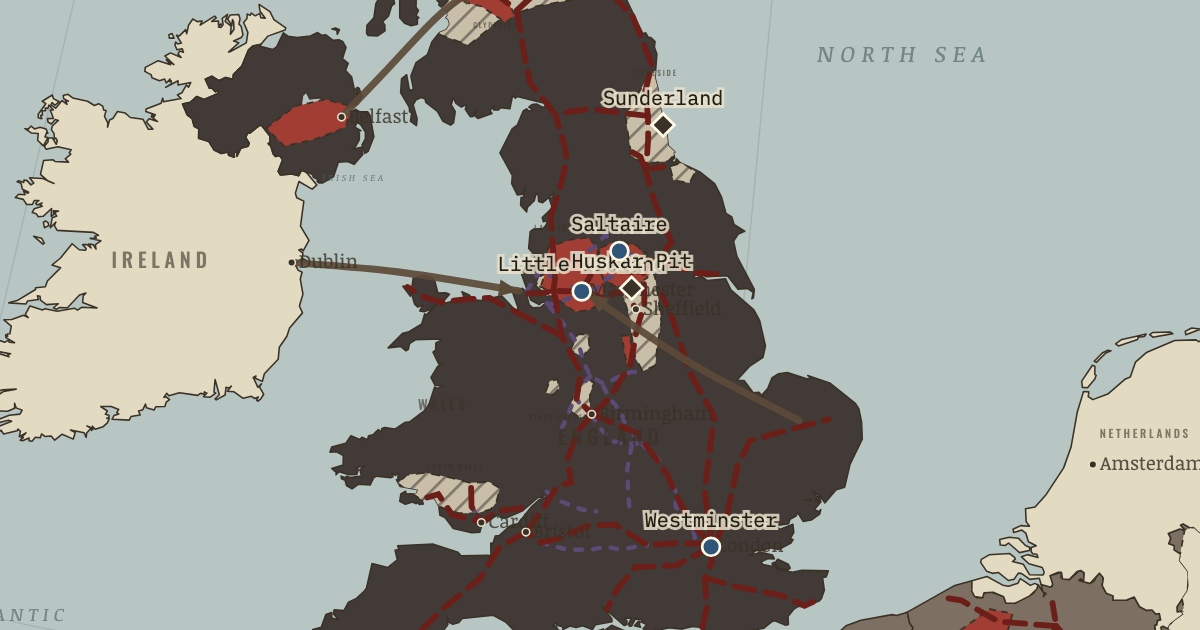
The map above is the world of The Industrial Revolution in Europe, 1851 — The census of 1851 — an urban nation.
Part of IB History: The Industrial Revolution →
BRIEF EXPLANATION — THE ESSENTIAL ARGUMENT
Industrialisation transformed where and how people lived, and this chapter asks what those changes meant for the people who lived through them. Britain became the first society in which most people lived in towns: the census of 1851 found that just over half the population of England and Wales was urban. Industrial towns grew faster than anyone could house, drain or govern them. Manchester grew from about 70,000 people in 1801 to over 300,000 in 1851. Many newcomers crowded into cellars and back-to-back houses, cheap terraces built against each other’s rear walls with no yard or through-draught, and few had clean water or sewers, so disease spread easily. Cholera, an intestinal infection carried in contaminated water, reached Britain at Sunderland in 1831 and killed about 32,000 people in its first epidemic. The crisis of the towns was the first price industrial society paid for growing faster than it could organise itself.
Children, women and the poor paid most, and their suffering produced the first laws to regulate industry anywhere. Children worked twelve-hour days in mills and from the age of seven in mines, and the drowning of 26 children at Huskar Pit, a Yorkshire coal mine, in 1838 shocked the public. Parliament at Westminster passed the Factory Act of 1833, which limited children’s hours in textile mills, the Mines Act of 1842, which kept women and young children out of the pits, and the Public Health Act of 1848, which let towns set up boards to provide drains and water. Governments today act in much the same way when they regulate a new industry once its harms become visible. On the map the cotton district now covers south Lancashire, and the arrows show migrants, many of them Irish, moving into the industrial towns. Whether ordinary people were better or worse off is still debated, and the evidence of heights and life expectancy suggests that the first industrial generations paid heavily.
The full story
The industrial town was the new environment of the age, and the speed of its growth explains most of its problems. Factories needed workers close by, and workers poured in from the countryside, from Scotland and from Ireland, especially after the Great Famine of 1845–52, when the potato crop failed, killed about a million people and drove many more abroad; the map’s arrows trace them into Liverpool, Manchester and Glasgow. Builders put up the cheapest housing they could: back-to-back terraces sharing a rear wall and therefore without through-draughts, courts of houses crowded around small yards and reached by narrow passages, and cellars that flooded. In Little Ireland, a slum beside the River Medlock in Manchester, Friedrich Engels, a young German working for his family’s cotton firm, found families living in cellars, a single outdoor toilet shared by dozens of people and a river black with dye and sewage. Towns had no authority responsible for drains, water or rubbish, so disease filled the gap.
Disease and early death were the measurable cost of urban growth, and they slowly forced the state to act. Cholera, a waterborne infection of the gut, reached Sunderland in October 1831 and killed about 32,000 people in Britain in 1831–32, and in 1848–49 it killed over 53,000 in England and Wales; typhus, a fever spread by lice, and tuberculosis killed more steadily still. The civil servant Edwin Chadwick’s Report on the Sanitary Condition of the Labouring Population (1842) showed the gap in stark numbers. In Manchester the average age at death was 38 for professional families and 17 for labourers, against 52 and 38 in rural Rutland, averages pulled down by the deaths of infants. Chadwick, who believed foul air caused disease, argued that drains and clean water would save money as well as lives. The Public Health Act of 1848 created a General Board of Health and let towns set up local boards, a cautious first step toward the sanitary city.
Work itself was the other great question, and the campaign against child labour turned it into law. Children had always worked on farms and in workshops, but factories and mines made their work visible, regimented and long. A parliamentary committee led by the reforming MP Michael Sadler took testimony from mill workers in 1832, and the Factory Act passed at Westminster in 1833 banned children under nine from textile mills, limited those aged nine to thirteen to nine hours a day and appointed four inspectors to enforce it. After 26 children drowned at Huskar Pit, a Yorkshire coal mine, in 1838, the Mines Act of 1842 banned women, girls and boys under ten from working underground, and the Ten Hours Act of 1847 limited the working day of women and young people. Paternalist owners, who offered housing, schools and order in return for loyalty, much like a company town today, gave another answer, such as the wool manufacturer Titus Salt’s model village for his workers at Saltaire. These laws were narrow and often evaded, yet they established the principle that the state could limit how industry used human beings.
DEEP EXPLANATION — EVIDENCE & INTERPRETATION
Were workers better or worse off? The standard-of-living debate
Historians have argued for a century about whether industrialisation raised or lowered the living standards of working people before 1850, and the debate shows how the choice of evidence shapes the answer. Optimists, from the economic historian John Clapham to the economists Peter Lindert and Jeffrey Williamson, used wage and price series to measure real wages, meaning pay adjusted for the cost of living; Lindert and Williamson concluded in 1983 that the real wages of manual workers nearly doubled between 1820 and 1850. Pessimists, among them the historians Eric Hobsbawm and E. P. Thompson, pointed to unemployment, the destruction of skilled trades and the loss of independence. The economic historian Charles Feinstein’s careful revision of 1998, which adjusted for unemployment, the number of dependants and the costs of urban life, found that working-class living standards rose by less than 15 per cent from the 1780s to the 1850s. Anthropometric history, which uses human measurements, added a new kind of evidence: the economic historian Roderick Floud and his co-authors Kenneth Wachter and Annabel Gregory found that average heights fell for men born in the second quarter of the century, a sign of worse nutrition and more disease in childhood. The current consensus is that real gains came late, mostly after 1850, so the rewards of industrial Britain went largely to the grandchildren of the people who built it.
Child labour: what the evidence shows
Child labour grew during the Industrial Revolution, and the clearest evidence comes from working people’s own memories. The economic historian Jane Humphries’ Childhood and Child Labour in the British Industrial Revolution (2010) used 617 autobiographies written by working men and women to reconstruct when and why children went to work. She found that it intensified between about 1790 and 1850, that children typically started work at around ten and often younger, and that those from fatherless or large families started earliest. Factory children were a minority of child workers, most of whom worked on farms, in domestic service, in workshops and in mines; official factory statistics for 1835 counted about 55,000 children under thirteen among some 355,000 textile workers, about one in six. The sources need careful reading, however. The reforming MP Michael Sadler’s parliamentary committee of 1832 gathered harrowing testimony, but it was a campaigning body and some witnesses were coached, while the government inquiry of 1833 that followed found conditions varied widely between mills. Historians also debate the motives for reform: humanitarian Tories, conservatives such as the campaigner Richard Oastler and the MP Lord Ashley, who wanted the state to protect the weak; evangelical Christian conscience; and adult male workers who hoped that limiting children’s hours would shorten their own, since mills could not run without the children who assisted them. Reform passed because it served several interests at once.
Public health and the reluctant state
Britain’s first public health reforms came from people who were wrong about how disease spread and right that filth caused it. The civil servant Edwin Chadwick believed in miasma, the theory that disease came from foul-smelling air, so he campaigned for drains, sewers and the removal of filth. The theory misled as well as helped. As a leading member of London’s sewer commission in 1847–49, Chadwick had cesspools, household pits of sewage, flushed into the Thames, from which much of the city drew its drinking water, just as the physician John Snow was arguing that cholera spread through contaminated water, which he demonstrated in London in 1854. Chadwick was also the architect of the New Poor Law of 1834, which forced the able-bodied poor into deliberately harsh workhouses, where they had to live and work in return for food and shelter, and was bitterly resisted in the industrial north. The Public Health Act of 1848 was permissive, meaning towns could adopt it but did not have to, unless their death rate exceeded 23 per thousand. Estimates by the historians Simon Szreter and Graham Mooney suggest that life expectancy at birth in the largest industrial cities fell to around thirty in the 1830s and 1840s, well below the national average of about forty. Historians call this gap the urban penalty, and it closed only when towns paid for the sewers, clean water and inspectors that the reluctant state had long avoided.
Key places on the map
On this day
Why it happened
Factories pulled workers into towns. Steam power let mills and works gather where coal, canals and railways met, and the jobs they offered drew people from a countryside where enclosure, the fencing of common land into private farms, falling demand for hand spinning and a growing population left many underemployed. The population of England and Wales roughly doubled between 1801 and 1851, from about 8.9 to 17.9 million, and most of the growth went to the towns. Wages there were higher than in farming, which is why people came despite the conditions.
No one was in charge of the towns. Most industrial towns had no elected council with power over building, drains or water until the Municipal Corporations Act of 1835, which gave the old boroughs elected councils, and many new towns had none even then. Builders and landlords faced almost no regulation, and private water companies supplied only those who could pay. This absence of authority, together with the sheer speed of growth, explains why towns grew for decades without sewers. Reform had to wait until disease made the cost of doing nothing impossible to ignore.
Families needed children’s wages. Working-class families depended on several earners, because one adult wage rarely covered rent and food, especially when a father was sick, dead or out of work. The economic historian Jane Humphries’ study of working-class autobiographies shows that children from fatherless and large families started work earliest, often before the age of ten. Mill owners valued children for tasks such as piecing broken threads and for their low wages, so demand met supply. Poverty sent most children to work, and employers were glad to hire them.
Evidence made the costs visible. Industrial Britain counted itself as no society had done before. Censuses from 1801, the civil registration of births and deaths from 1837, parliamentary inquiries and newly appointed inspectors produced numbers and testimony that campaigners could use. The civil servant Edwin Chadwick’s mortality tables and the evidence gathered after the Huskar Pit disaster, in which 26 children drowned in a flooded mine, turned private suffering into public facts that Parliament could not ignore. Statistics became a tool of reform. Numbers persuaded MPs who would never visit a mill or a mine.
THE TURNING POINT
The Factory Act, Westminster, 1833. The Factory Act of 1833 is the hinge because it was the first law to regulate industrial employers that a government actually enforced. Earlier acts of 1802 and 1819 had limited children’s work in cotton mills, but they had no inspectors and were widely ignored. The 1833 Act covered most textile mills, banned children under nine, limited the hours of older children, required two hours of schooling a day for those under thirteen and appointed four paid inspectors with power to enter mills and prosecute. It accepted that the market alone would not protect workers, and every later factory, mines and public health law built on that principle.
What it changed
Protest grows from hardship. Low wages, hunger and the loss of skilled trades fed the protest movements of the same decades, from machine-breaking to Chartism, a mass movement demanding the vote for all men. The crowded industrial towns described in this chapter were their recruiting grounds, and their meetings filled the moors and squares outside them. The towns that concentrated hardship also concentrated the people who suffered it, which made mass protest possible for the first time.
Living standards rise after 1850. Real wages, life expectancy and heights improved clearly only after about 1850, as food grew cheaper, sanitation spread and working hours were limited. The gains of industrialisation reached most workers a generation or two after its costs. Trade unions and the vote, won by many working men in 1867 and 1884, helped them claim a larger share, so what workers received depended on political power as well as productivity.
Regulation spreads abroad. Britain’s factory and public health laws became models elsewhere. Prussia, the largest German state, limited child labour in 1839 and France in 1841, and by the end of the century most industrial countries had factory inspectors and public health boards, as chapters 7 and 8 show. The idea that the state should regulate industry became one of the Industrial Revolution’s most lasting legacies. Each new industrial country rediscovered the problems that Britain had met first.
DISCUSSION QUESTION — Did the first industrial generations gain or lose from industrialisation?
The answer depends on which evidence carries the most weight. Wage data show modest gains: the economic historian Charles Feinstein’s careful series suggests that working-class living standards rose by less than 15 per cent between the 1780s and the 1850s, while optimists such as the economists Peter Lindert and Jeffrey Williamson found much larger rises. Other evidence points the other way. Average heights fell for men born between the 1820s and 1850, a sign of poorer nutrition and more childhood disease, and life expectancy in the largest industrial towns fell far below the national average. Child labour, on the evidence of the economic historian Jane Humphries, grew more intense. Yet many migrants chose the towns because wages there were higher than on the land, and the factory laws, sanitation and cheaper goods of later decades rested on the wealth those years created. Most historians conclude that the first generations bore heavy costs for gains their grandchildren enjoyed. In judging any transformation, the useful questions are who paid and when, as well as whether average incomes rose.
An interesting fact
The most famous account of Manchester’s slums was written by a young clerk in his family’s cotton firm. Friedrich Engels, the son of a German textile manufacturer, came to Manchester in 1842 to work for his family’s firm, Ermen & Engels, and wrote The Condition of the Working Class in England (1845) from what he saw there. He returned in 1850 and stayed for almost twenty years, eventually as a partner, and much of the income he earned from cotton supported his friend Karl Marx, the revolutionary thinker, while Marx wrote Capital, his critique of capitalism. The two founders of modern communism were in part financed by a Lancashire cotton mill.
Related
THE FREE PRINTABLE STUDY GUIDE
Join the Dispatch — a short welcome series, then a letter when a new atlas opens — and the printable study guide for The Industrial Revolution is yours now, free.
NO TRACKING · YOUR ADDRESS IS USED FOR THE DISPATCH AND NOTHING ELSE · UNSUBSCRIBE ANYTIME