Mao’s China · CHAPTER 10 ·
Down to the Countryside Movement
Chapter 10 of The People’s Republic under Mao, 1949–1976: “Down to the Countryside”
From December 1968 Mao sent educated urban youth to be “re-educated” by peasants, and over the next decade about seventeen million school leavers went to villages and army-run frontier farms. The policy dispersed the Red Guards, and in September 1971 Mao’s chosen heir Lin Biao died fleeing China.
Chapter 10 is part of membership. WW2 is free — every chapter. Try chapters 1–2 of any 2 other atlases (3 with a free account). Opening a new atlas uses one of them. Membership opens all 21 — Join.
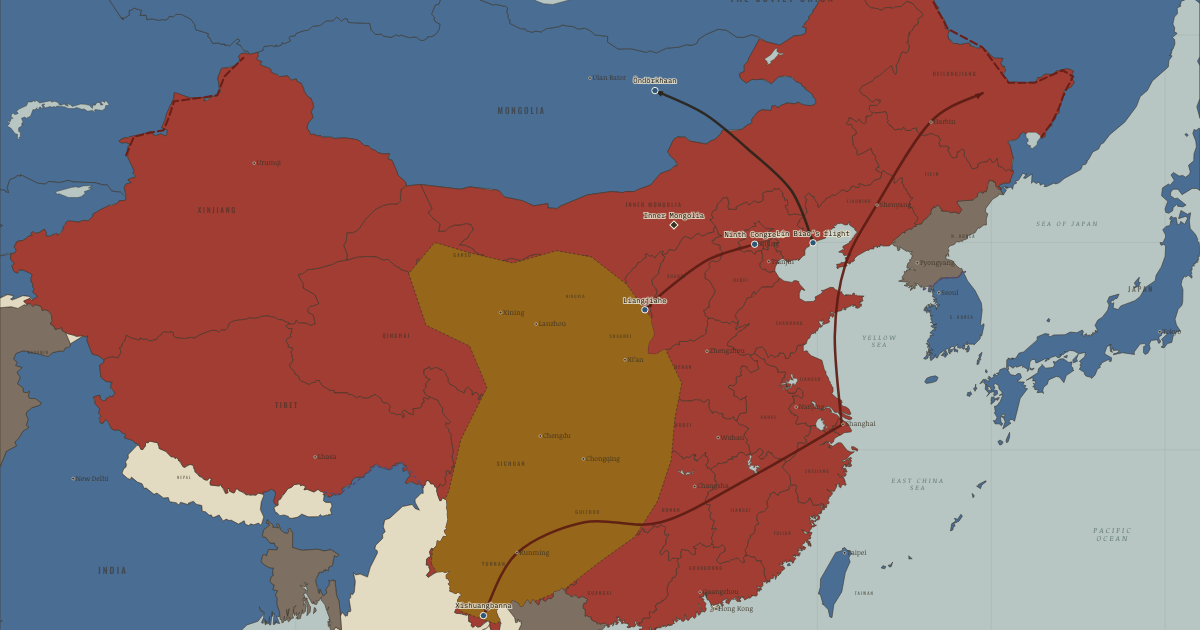
The map above is the world of China, September 1971 — Lin Biao’s flight; Beijing takes China’s UN seat.
Part of IB History: The People’s Republic under Mao →
BRIEF EXPLANATION — THE ESSENTIAL ARGUMENT
The army rebuilt order after 1968, and the price of that order was paid by the young people who had made the Cultural Revolution, Mao’s movement of 1966 against his own Communist Party, the single party that ran every level of government. In December 1968 Mao declared that educated youth must go to the countryside to be “re-educated by the poor and lower-middle peasants”. Over the next decade about seventeen million urban school leavers were sent “up to the mountains and down to the villages”, along routes like the red arrows from Shanghai and Beijing. Most joined production teams, the village work groups of a few dozen households into which the communes were divided, much like the smallest branch of a very large firm; others went to army-run state farms on the frontiers. The policy dispersed the Red Guards, the student militants of 1966–68 who had acted much like a youth militia, eased unemployment in cities whose economies had stalled, and served Mao’s belief that city people must learn from peasants. For a generation it meant years of hard labour, interrupted education and separation from their families, an experience many compared to exile.
The army governed China in these years more directly than at any time since 1949. Soldiers dominated the revolutionary committees, the army-backed local governments set up in 1967–68 much like emergency administrations after a coup, ran factories and schools, and led new purges, including the hunt for a supposed “Inner Mongolian People’s Party” that killed tens of thousands. In April 1969 the Ninth Party Congress, a national conference of Party delegates much like a party convention elsewhere, wrote Defence Minister Lin Biao into the Party constitution as Mao’s successor. Within two years Mao had come to distrust him, and on 13 September 1971, after a plot by Lin’s son against Mao was exposed, Lin fled with his family in a jet that crashed in Mongolia, shown by the dark arrow and the marker at Öndörkhaan. On the map the provinces are solid red and the northern border is armed, yet the army that had restored Mao’s order had also produced the one rival he could not tolerate. The death of the chosen successor as an alleged traitor shook public faith in Mao more deeply than anything since 1949.
The full story
Sending urban youth to the countryside served several purposes at once, which explains its scale. Mao’s directive of 22 December 1968 turned an old, small policy into a mass movement. Schools had been closed since 1966, so three years of graduates had nowhere to go in the cities. Moving them out ended the Red Guards, the student militants who had fought in Mao’s name since 1966, as a political force and relieved the cities of mouths to feed. Mao also believed that the young had to be toughened by labour and taught the peasants’ values, as his own generation had been in the Communists’ wartime base at Yan’an. Some volunteers went with real enthusiasm. Most went because refusing meant losing their household registration, the internal residence permit that tied each person to one place much like a passport valid in one town, and with it their ration book. Among those sent to a cave village in northern Shaanxi in January 1969 was fifteen-year-old Xi Jinping, a reminder that the generation sent down in these years went on to rule China.
The experience divided a generation by place and luck. Those sent to production teams, the village work groups of a few dozen households into which the communes were divided, lived among peasants who often resented extra mouths. They earned work points, credits for labour paid out in shares of the harvest, which were too small to live on. For food, housing and the chance to leave they depended on cadres, the local officials of the ruling Communist Party, who acted as employer, landlord and police at once. On the army-run farms from Heilongjiang to Yunnan, young people cleared forest and marsh under military discipline. Abuse was common, including the sexual abuse of young women by local officials, which the state acknowledged in the 1970s. Education stopped for most, and marriage and family life were delayed. In 1978–79 sent-down youth on the rubber farms of Xishuangbanna struck and petitioned Beijing, and others blocked railways in Shanghai, so the policy was abandoned and most returned to the cities by 1980. The historian Michel Bonnin calls them a “lost generation”, and their testimony shaped how China remembered the Mao years.
At the top, the army’s new power produced a struggle over succession. The Ninth Congress of April 1969, the Party’s national conference, named Lin Biao Mao’s “close comrade-in-arms and successor”, and nearly half the new Central Committee, the Party’s ruling council of some two hundred members and roughly its national executive, came from the military. The war scare with the Soviet Union that year raised the army’s importance still further. At Lushan in August 1970 Lin’s supporters pressed to restore the post of head of state, which Mao read as a bid for power. In 1971 Lin’s son, Lin Liguo, drew up a plan for a coup, codenamed Project 571, and when it collapsed the family fled north from Shanhaiguan. Their plane crashed near Öndörkhaan on 13 September, killing all nine aboard. For many Chinese, the official story of a treacherous successor made the infallible chairman look fallible for the first time.
DEEP EXPLANATION — EVIDENCE & INTERPRETATION
Why send seventeen million young people down?
Historians explain the rustication movement by combining ideology, politics and economics, and the weight given to each has shifted as the sources have opened. Michel Bonnin’s The Lost Generation, based on official statistics and documents, shows that the decisive pressure was employment: with the economy disrupted and universities closed, the cities could not absorb millions of school leavers from the baby-boom years. Political motives mattered too, since dispersing the Red Guards ended the factional fighting that the army had struggled to contain. Ideology supplied the justification, and Mao’s belief that the young should learn from peasants and close the gap between town and countryside was sincere. Pan Yihong’s study of the youth sent to the frontier state farms stresses the enthusiasm of some volunteers and the disillusionment that followed. The figures themselves are well documented, with about seventeen million sent down between 1968 and 1980. The movement shows how a policy presented as revolutionary idealism could also be a practical solution to an economic problem.
The army state, 1968–71
China was governed more directly by soldiers between 1968 and 1971 than at any time since 1949, and the evidence for this shows in personnel and practice. Officers chaired most revolutionary committees, and the army’s programme of “three supports and two militaries”, supporting the left, industry and agriculture and imposing military control and training, put soldiers into factories, schools and ministries. Workers’ and soldiers’ propaganda teams took over the universities. The army also led the bloodiest purges of these years: the “cleansing of the class ranks”, the “One Strike, Three Anti” campaign of 1970, and in Inner Mongolia the hunt for a fictional Inner Mongolian People’s Party, for which official figures later acknowledged 16,222 deaths and scholars estimate up to 100,000. Government officials, meanwhile, were sent to “May Seventh Cadre Schools”, farms where they did manual labour and studied Mao’s works. Historians such as Andrew Walder describe these years as a period of military rule, and Lin Biao’s fall in 1971 began its dismantling.
What really happened to Lin Biao?
The official account presented Lin Biao as a traitor who plotted to kill Mao and fled to the Soviet Union, and historians have since complicated almost every part of it. Frederick Teiwes and Warren Sun, in The Tragedy of Lin Biao, argue that Lin was an ill and passive man who never sought the succession and had little to do with the plan for a coup, which was the work of his son Lin Liguo and a few young officers. Jin Qiu, whose father was one of those officers, reconstructs the family’s last days. Lin’s daughter, Lin Liheng, alerted the authorities to her family’s flight, and Zhou Enlai tracked the plane but did not have it shot down. Whether the plane ran out of fuel or attempted a forced landing is still debated. What is certain is the political effect. The documents of Project 571 were circulated for study, and their criticism of Mao as a modern “First Emperor” reached millions, who had to read it in order to condemn it.
Key places on the map
On this day
Why it happened
The Red Guards had served their purpose. Mao sent the Red Guards away because they had become a problem. By 1968 the student factions were fighting each other with guns, universities such as Tsinghua had become battlegrounds, and the army was tired of policing them. In July 1968 Mao told Red Guard leaders that they had failed him, and workers’ propaganda teams took over the campuses. Sending the students to the countryside removed them from politics without admitting that the movement had gone wrong. The same young people who had been told they were the revolution’s vanguard were now told they needed re-education.
No jobs in the cities. Factories had been disrupted by two years of fighting, schools and universities had closed in 1966, and the large generation born in the baby boom of the 1950s was leaving school with nowhere to go. City governments could not feed or employ them. Sending them to villages and frontier farms shifted the burden onto the countryside, which had no say in the decision. Household registration made the move enforceable, because a young person who refused could not legally live or eat in the city.
Mao’s faith in the peasant revolution. Mao believed that city people, and especially the educated, risked becoming a privileged class cut off from the masses. His own revolution had been won in the villages, and he wanted the young to be toughened by labour and taught by peasants. The language of “re-education” turned a practical measure into a moral duty, which made opposing it look like opposing the revolution itself. Parents who hoped to keep their children at home had to argue against the Chairman’s own words.
An army that had become indispensable. The army had restored order through the revolutionary committees, and the border war with the Soviet Union in 1969 made it more important still. Its leader, Lin Biao, became Mao’s designated successor and its officers filled the Central Committee. That concentration of power alarmed Mao, who had used the army to defeat the Party and now feared the army itself. Lin Biao’s position depended on Mao’s favour, and the same favour could be withdrawn.
THE TURNING POINT
Öndörkhaan, 13 September 1971. The crash at Öndörkhaan is the hinge because it destroyed the cult’s claim that Mao was always right. Lin Biao had been the cult’s chief architect and Mao’s chosen heir, written into the Party constitution; now he was announced as a traitor who had plotted murder. Many people later said that this was the moment they stopped believing. The affair also ended the army’s political dominance, as Lin’s generals were arrested within days, and it pushed Mao to rely on Zhou Enlai, to bring back purged officials such as Deng Xiaoping, and to pursue the opening to the United States.
What it changed
Washington becomes the answer. With Lin gone and the Soviet threat on the northern border, Mao and Zhou Enlai accelerated the secret approach to the United States. Within months Nixon’s visit was confirmed, and in October 1971 the People’s Republic took China’s seat at the United Nations. The crisis at home and the opening abroad moved together, and Zhou Enlai, who managed both, became the most powerful figure after Mao.
The soldiers sent back to barracks. Lin’s leading generals were arrested within days of the crash, civilian Party committees regained authority in the provinces, and in December 1973 Mao rotated the commanders of eight military regions so that none could build a personal power base. The period of military government was over, although soldiers remained powerful. Mao had used the army to break the Party, and then used the Party to rein in the army.
Deng Xiaoping returns. Needing experienced administrators, Mao allowed many purged officials back to work. Deng Xiaoping returned as a vice-premier in 1973 and soon ran the government for the ailing Zhou Enlai, which made him the radicals’ main target and set up the struggle over the succession that would decide China after Mao. Rehabilitated officials became a quiet constituency for ending the campaigns.
A generation that remembered. The sent-down youth returned to the cities from 1978 with lost years and a sceptical view of slogans. Their memoirs, stories and films, beginning with the “scar literature” of the late 1970s, shaped how China remembered the Mao years, and some of them, including Xi Jinping and Li Keqiang, later led the country. Their years in the villages taught them how poor rural China was and how little slogans could change it.
DISCUSSION QUESTION — How far did the movement to send urban youth “up to the mountains and down to the villages” achieve Mao’s aims?
Judged by its political aim, the movement succeeded quickly: the Red Guards were dispersed, the factional fighting in the cities ended, and urban unemployment fell, because millions of young people were moved out of the cities within two years. Judged by Mao’s ideological aim, it largely failed. The young were supposed to learn revolutionary values from peasants and to narrow the gap between town and country, yet many peasants resented them, and most of the youth longed to return home. Bonnin’s research shows that the urban-rural divide was reinforced, since the young people’s greatest wish was to recover the urban residence permits that the state had taken away. Some former sent-down youth remember the experience as formative, a source of resilience and of knowledge about rural poverty, and memory varies with where people were sent and what happened to them. The movement ended in strikes and protests in 1978–79. Its history shows that coercive social engineering can meet short-term political goals while producing the opposite of the society it promised.
An interesting fact
A primary-school teacher in Fujian, Li Qinglin, wrote to Mao in December 1972 that his son, sent down to a village, could not earn enough food to live on and that other young people were being exploited and abused. Mao answered in April 1973 in his own hand, in words that translate roughly as: “Comrade Li Qinglin, I am sending you 300 yuan to make up for your shortage.” He added that such problems existed throughout the country and needed an overall solution. The letter was circulated to officials, and a national conference that summer raised allowances and ordered the punishment of officials who abused sent-down youth.
Related
THE FREE PRINTABLE STUDY GUIDE
Join the Dispatch — a short welcome series, then a letter when a new atlas opens — and the printable study guide for The People’s Republic under Mao is yours now, free.
NO TRACKING · YOUR ADDRESS IS USED FOR THE DISPATCH AND NOTHING ELSE · UNSUBSCRIBE ANYTIME