Feminism and the Tunisian Revolution · CHAPTER 2 ·
Title VII and the founding of NOW
Chapter 2 of Protest and Change: Second-Wave Feminism and Tunisia, 1945–2015: “Organising for Equality”
In 1964 Title VII of the Civil Rights Act banned sex discrimination in employment, but the agency created to enforce it, the EEOC, at first treated the word “sex” as a joke. In 1966 Betty Friedan, Pauli Murray and others founded the National Organization for Women (NOW) to make the government keep its promise.
WW2 is free — every chapter. Try chapters 1–2 of any 2 other atlases (3 with a free account). Opening a new atlas uses one of them. Membership opens all 21 — Join.
Free printable Feminism and the Tunisian Revolution study guide, sent by email ↓
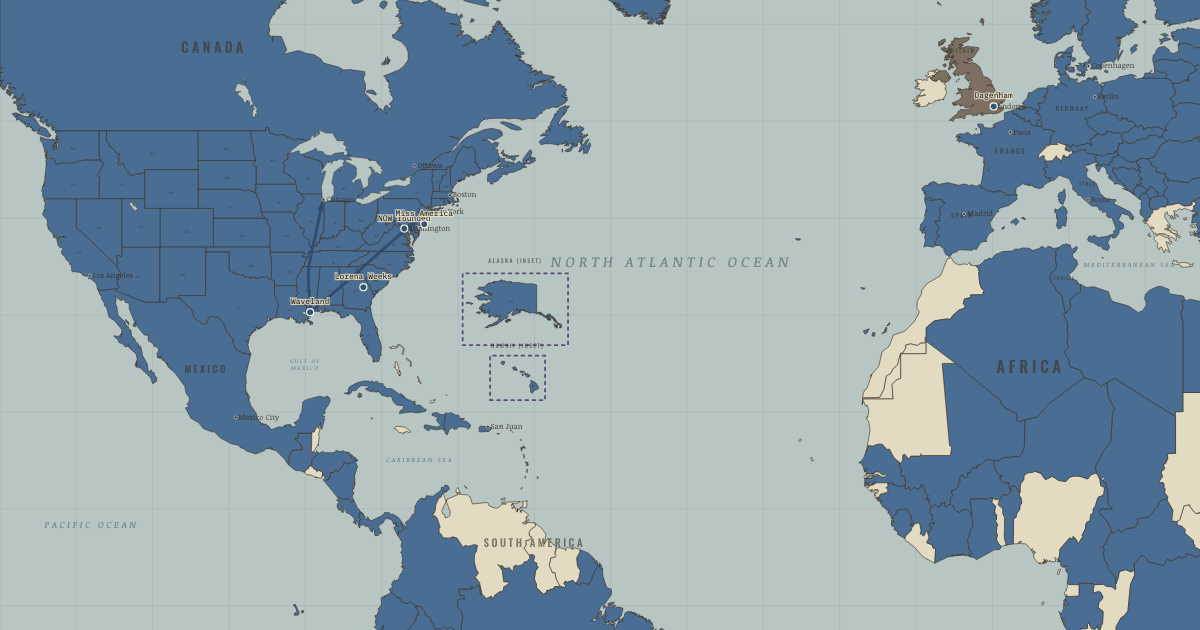
The map above is the world of Women’s rights, May 1970 — Equal pay required by law or ratified treaty.
Part of IB History: Second-wave feminism and Tunisia →
BRIEF EXPLANATION — THE ESSENTIAL ARGUMENT
Grievances become a movement only when people build organisations to press them, and between 1963 and 1970 women did this in three different ways. The first began with a new law that women then organised to enforce. In 1964 the Civil Rights Act, passed to end racial discrimination, also banned discrimination by “sex” in its section on employment, known as Title VII. The agency created to enforce it, the Equal Employment Opportunity Commission (EEOC), at first treated that word as a joke. In response, in 1966 Betty Friedan, author of The Feminine Mystique, the lawyer Pauli Murray and others founded the National Organization for Women (NOW) to make the government keep its promise, much as a modern pressure group lobbies a regulator to enforce existing rules. NOW represented “liberal feminism”, the belief that women could win equality by changing laws and opening institutions to them.
The second route came from younger women trained in the civil-rights and anti-war movements, who concluded that the problem lay deeper than the law. Their “radical feminism” argued that male power was built into family, sexuality and culture, and they chose spectacular direct action, such as the protest at the Miss America pageant in 1968. The third came from women workers, and in Britain it was decisive: when 187 sewing machinists at Ford’s Dagenham factory struck in 1968, they helped win the Equal Pay Act of 1970. The map shows equal pay in law in May 1970: every US state is blue under federal law, while Britain is grey-tan because its Act had passed but would not take effect until 1975. By 1970 there were three feminisms, liberal, radical and working-class, and their quarrels would shape everything that followed.
The full story
The law opened the door before anyone was ready to walk through it, and the reason lies in how the word “sex” entered Title VII, the employment section of the new civil-rights law. On 8 February 1964 Howard Smith, a Virginia congressman who opposed the bill, proposed adding “sex” to the forbidden grounds for discrimination. His motives are still debated, because he opposed civil rights yet had long supported the Equal Rights Amendment (ERA), a proposed constitutional guarantee of equal rights regardless of sex. Martha Griffiths and other congresswomen seized the amendment and it passed. In its first year about a third of the complaints to the EEOC, the agency created to enforce the law, concerned sex discrimination, yet a senior official called the sex provision a “fluke” and sex-segregated job advertisements continued. A right without enforcement is only a promise, and the lesson pushed women to organise.
Two kinds of organisation grew out of the law’s failure, and the first was the National Organization for Women (NOW), a national lobby born of insiders’ frustration. On 30 June 1966 women at a national conference of the state commissions on the status of women, government advisory bodies much like a modern task force, were barred even from urging the EEOC to act, so they founded NOW on the spot. Its method was litigation and lobbying. Lorena Weeks, a Georgia telephone clerk denied a better-paid job by a state rule barring women from lifting more than 30 pounds, showed how it worked: in 1969 a federal appeals court ruled that Title VII overrode such “protective” laws. The second kind grew from younger women in the Student Nonviolent Coordinating Committee (SNCC), a student civil-rights group registering Black voters in the South, who wrote in 1964–65 that they typed and cooked while men decided. The two arrows trace that experience north from Mississippi to New York and Chicago, where they formed women’s liberation groups without leaders, because SNCC had taught them that even a movement for freedom could reproduce inequality.
Two other groups looked beyond the courtroom: radical feminists, who saw male power built into family, sexuality and culture, believed publicity could change minds faster than lawsuits, and British women workers believed a strike could change pay. The Miss America protest of 7 September 1968 shows both the power and the cost of the first belief. A few hundred women picketed the pageant at Atlantic City, threw bras and girdles into a “Freedom Trash Can” and crowned a sheep, arguing that the contest judged women like livestock. Nothing was burned, yet the press invented the “bra-burner”, an image that made the movement famous and easy to mock. The 187 women who sewed car-seat covers at Ford’s Dagenham plant showed the power of the second. Their three-week strike against a regrading that classed their skilled work as less skilled stopped car production and helped persuade the Employment Secretary, Barbara Castle, to steer the Equal Pay Act through Parliament in May 1970. The courtroom, the street and the picket line were complementary routes to change, because each reached people the others could not.
DEEP EXPLANATION — EVIDENCE & INTERPRETATION
Why “sex” entered Title VII
The amendment that made Title VII a feminist law is often told as a joke that backfired, and historians now treat that story as at best half true. Howard Smith was a segregationist who wanted to defeat the bill, and the House laughed during the debate, which supports the idea of a wrecking amendment. Yet Smith had sponsored the Equal Rights Amendment since the 1940s at the urging of the National Woman’s Party, whose leader Alice Paul lobbied for the change. He and his allies also argued that without the word “sex” a white woman would have less protection under the new law than a Black woman, a motive historians describe as racist as well as feminist. Martha Griffiths of Michigan had planned to propose the amendment herself and made the same argument about white women when she defended it on the floor. Nancy MacLean and others emphasise that working women, many of them Black, then used Title VII far more than middle-class professionals did, filing thousands of complaints about seniority lists, pay and job ladders. The law’s meaning was therefore decided by the women who used it, which is a reminder that the intentions of lawmakers are often the least important part of a law’s history.
Three feminisms: liberal, radical and labour
Historians once told the 1960s as a story of two branches, an older liberal wing in NOW and a younger radical wing in small collectives, and Alice Echols’s Daring to Be Bad (1989) remains the classic account of the radicals’ ideas and quarrels. Sara Evans traced their origins to the civil-rights movement, where women learned organising skills and a language of oppression and liberation, and then turned both on the men around them. Dorothy Sue Cobble has since argued that this two-branch picture leaves out a third, “labour feminism”: trade-union women who had campaigned since the 1940s for equal pay, childcare and maternity leave, and who initially opposed the Equal Rights Amendment because it threatened protective laws. The British case supports Cobble’s view, since the Dagenham strike and the campaign it inspired came from union women before any women’s liberation group existed in Britain. The labels matter because each feminism asked different questions: liberals asked how to get in, radicals asked what had to be torn down, and labour feminists asked who would do the caring work if women were treated as men at work.
What Dagenham won, and what it did not
The Dagenham strike is remembered as a strike for equal pay, and the machinists themselves often described it as a fight for recognition of their skill, since their grievance was that they had been placed in grade B, below men doing comparable work, instead of the skilled grade C. Barbara Castle’s settlement raised their pay from 85 to 92 per cent of the men’s rate for the same grade, but it did not regrade them, and they won skilled status only after another strike in 1984. The Equal Pay Act that followed gave employers five years to comply, and many used the time to rewrite job descriptions so that women and men no longer did “the same or broadly similar” work. Economists who studied the period, such as Zabalza and Tzannatos, nevertheless found that women’s hourly earnings rose from roughly two-thirds to about three-quarters of men’s between 1970 and 1977, one of the fastest narrowings on record. Britain was forced to add an “equal value” rule in 1983, after the European Court of Justice, the highest court of what is now the European Union, ruled that the original Act fell short of European law. The episode shows how a single strike can start a legal process whose effects are larger, slower and more contested than the strikers’ original demand.
Key places on the map
On this day
Why it happened
A civil-rights law with a sex clause. Title VII gave women a legal weapon that existed almost by accident, and a weapon creates a constituency of people who want it used. Once discrimination by sex was illegal on paper, every job advertisement marked “male” and every lower pay scale became evidence of an unenforced law. The distance between the statute and its enforcement gave women a precise, winnable demand, which is the kind of demand that builds organisations.
Experienced women with nowhere to take their anger. The state commissions of the early 1960s had trained hundreds of women in law, research and lobbying. At their third national conference in June 1966 they learned that the commissions could pass no resolutions and had no power to press the EEOC. Frustrated insiders who know how institutions work are among the most effective founders of protest organisations, and NOW was founded by exactly such people on the last day of that conference.
The civil-rights and anti-war movements as schools. Young women who had registered voters in Mississippi or organised against the Vietnam War learned to run meetings, write leaflets and confront authority. They also experienced sexism inside these movements: in 1964 and 1965 SNCC women wrote papers describing how they were kept from leadership. They took both the skills and the anger into women’s liberation, which explains its language of oppression, liberation and solidarity. The same pattern appeared in Britain and France, where women’s liberation grew out of the student and anti-war protests of 1968.
Women workers who could stop production. At Dagenham 187 machinists sewed the seat covers without which no car could leave the factory, so a strike by a small group halted one of Britain’s largest plants. This gave them leverage that middle-class lobbyists lacked, and their success showed working women across Britain that equal pay could be won by industrial action. Bargaining power, more than numbers, decides whether a protest can force concessions. The machinists also had the backing of their union, the National Union of Vehicle Builders, which turned a grading dispute in one factory into a national argument about women’s pay.
THE TURNING POINT
The founding of NOW, 30 June 1966. The founding of NOW is the hinge because it gave second-wave feminism a permanent national organisation with a programme, a membership and a legal strategy, something no number of books or commissions could provide. Within a few years NOW had chapters across the country and was suing employers, petitioning the EEOC and, from 1967, campaigning for the Equal Rights Amendment and the repeal of abortion laws. Its founding also defined the movement’s mainstream as liberal and reformist, which is why later radical, Black and working-class feminists defined themselves in part against it. Movements become durable when they build institutions, and NOW was the institution.
What it changed
The EEOC is forced to act. Pressure from NOW and from thousands of complaints pushed the EEOC to rule in 1968 that sex-segregated job advertisements broke the law, and in 1969 courts began striking down “protective” laws that barred women from better-paid work. The legal ground of the workplace shifted within five years, although the pay gap barely moved. In 1973 the Supreme Court upheld a ban on sex-segregated newspaper advertisements in the Pittsburgh Press case, which began with a complaint by a local NOW chapter.
A movement split by method and goal. Liberal feminists wanted equality inside existing institutions; radicals wanted to transform marriage, sexuality and culture; labour feminists wanted pay, childcare and protection. These differences produced creative energy and bitter quarrels, including NOW’s internal fights over abortion and over lesbian members, whom Friedan called a “lavender menace” in 1969. The quarrels were also a sign of growth, because a movement that argues about whom it represents has become large enough to represent many different women.
Equal pay becomes law in Britain. The Equal Pay Act of 29 May 1970 gave employers five years to remove separate rates for women, and it came into force in December 1975 alongside the Sex Discrimination Act. On the map Britain is grey-tan because in 1970 the law had passed but did not yet apply. Women at Dagenham struck again in 1984, because their work was still not graded as skilled.
DISCUSSION QUESTION — Which did more to create change for American women in the 1960s: the law, or the movement that formed to enforce it?
The law came first and gave women something they could not have won alone, a federal ban on sex discrimination at work, and it arrived through the politics of race, a congressman’s motives and the lobbying of a few veteran feminists, before any mass movement existed. Yet the evidence of the EEOC’s first years shows that a law without an organised constituency can sit almost unused: the agency treated the sex clause as a fluke until NOW, the complaints of thousands of working women and cases such as Weeks forced it to act. The movement also did things the law could not, such as changing what women expected of their own lives. The fairest judgement is that the law and the movement were mutually dependent: Title VII gave feminists a target and a tool, and feminists gave Title VII its meaning. The transferable insight is that legal change and protest usually work in a cycle, with each new right becoming the starting point for the next campaign, which is why movements so often grow stronger after their first victories.
An interesting fact
The equal-pay principle the Dagenham women fought for had been written into the founding treaty of the European Economic Community in 1957, whose Article 119 required member states to ensure equal pay for equal work. France had insisted on it, partly because its own law already demanded equal pay and its industries feared being undercut by cheaper female labour elsewhere. The clause sat largely unenforced until a Belgian air hostess, Gabrielle Defrenne, sued the airline Sabena, which had forced her to retire at 40 while male stewards flew on. In 1976 the European Court of Justice ruled that Article 119 gave individuals rights they could enforce in national courts.
Related
THE FREE PRINTABLE STUDY GUIDE
Join the Dispatch — a short welcome series, then a letter when a new atlas opens — and the printable study guide for Protest and Change is yours now, free.
NO TRACKING · YOUR ADDRESS IS USED FOR THE DISPATCH AND NOTHING ELSE · UNSUBSCRIBE ANYTIME