Feminism and the Tunisian Revolution · CHAPTER 1 ·
Origins of second-wave feminism
Chapter 1 of Protest and Change: Second-Wave Feminism and Tunisia, 1945–2015: “The Problem That Has No Name”
By 1945 women in the United States, Britain and France could vote, yet the law still treated them as second-class citizens: in 1961 three Southern states barred women from juries. Married women entered paid work in growing numbers while the suburban homemaker became the ideal, and The Feminine Mystique appeared in February 1963.
WW2 is free — every chapter. Try chapters 1–2 of any 2 other atlases (3 with a free account). Opening a new atlas uses one of them. Membership opens all 21 — Join.
Free printable Feminism and the Tunisian Revolution study guide, sent by email ↓
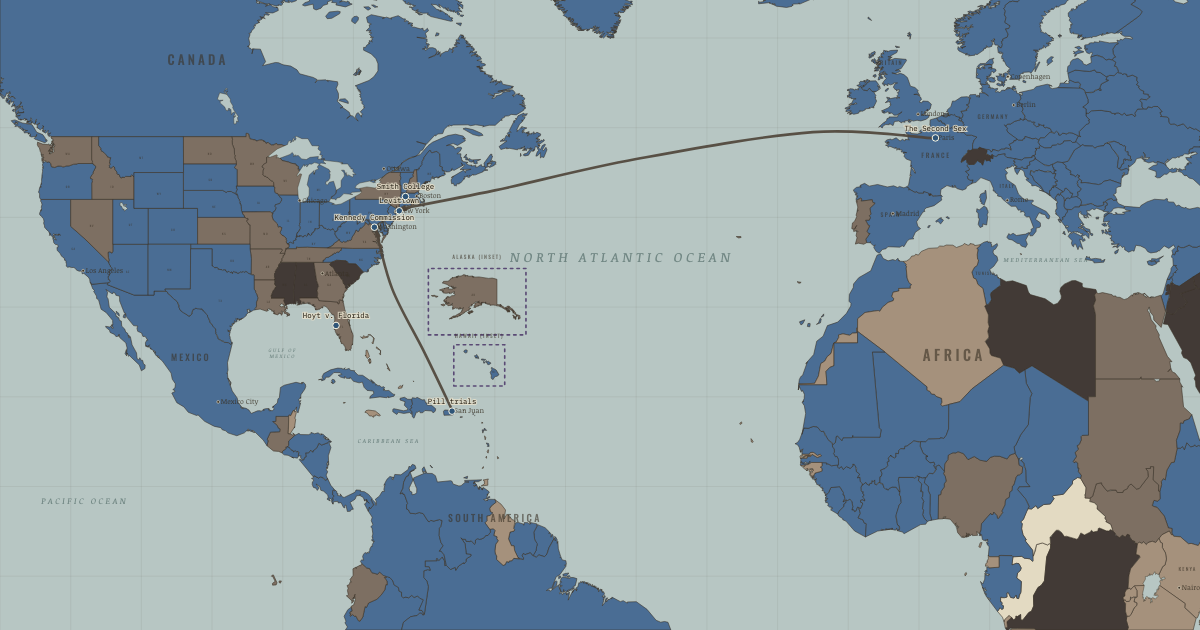
The map above is the world of Women’s rights, November 1961 — Jury service in the US states; the vote elsewhere.
Part of IB History: Second-wave feminism and Tunisia →
BRIEF EXPLANATION — THE ESSENTIAL ARGUMENT
The central question of this whole atlas is why protest movements emerge, how they create change, and whom that change leaves out, and its first case study opens with a puzzle. By 1945 women in the United States, Britain and France could vote, so the “first wave” of feminism, the long campaign for the ballot that ran from the 1840s into the 1920s, appeared to have won. Yet women remained second-class citizens in law. Employers could pay a woman less for the same job, newspapers advertised jobs by sex, and many states kept women off juries. Jury service is the duty to sit in judgement on fellow citizens, the same summons people receive today. The map shows who was allowed to perform it in 1961: three Southern states, in charcoal, barred women completely, and eighteen more, in grey-tan, exempted women simply for being women. The vote had made women voters without making them full citizens.
The “second wave” of feminism, the movement for equality beyond the vote, emerged because private discontent was finally given a name and a measurement. After the war millions of families moved to new suburbs such as Levittown, and a powerful culture told educated women that fulfilment lay in housework and motherhood, even as more married women took paid jobs at lower pay. Simone de Beauvoir’s The Second Sex (1949) argued that “woman” was a role society made, and Betty Friedan’s The Feminine Mystique (1963) called the unhappiness of college-educated housewives “the problem that has no name”. In the same year President Kennedy’s Commission on the Status of Women, a panel of experts much like a government task force today, documented unequal laws state by state, and the Equal Pay Act made unequal pay for equal work illegal. A private complaint had become a public claim, and that conversion is the first step of every movement in this atlas.
The full story
Winning the vote had changed less than its campaigners hoped, because the law still treated a woman first as a wife and mother and only second as an individual citizen. The clearest test was the jury. In 1957 Gwendolyn Hoyt of Tampa, Florida, struck her husband with a baseball bat during a quarrel, and he died. An all-male jury convicted her of murder, because Florida placed women on jury lists only if they registered to serve, and few ever did. In Hoyt v. Florida (1961) the Supreme Court upheld the rule, reasoning that woman was “still regarded as the center of home and family life.” On the map Alabama, Mississippi and South Carolina are charcoal because they excluded women altogether; the grey-tan states exempted women for their sex alone, so that their juries stayed overwhelmingly male. A duty that only volunteers performed turned out to be a right that most women never exercised.
Post-war America told women to find fulfilment at home, yet the economy was quietly pulling them out of it, and this contradiction made discontent possible. Federal mortgage guarantees and the GI Bill, which paid for veterans’ homes and college places, helped build suburbs such as Levittown on Long Island, where 17,447 houses went up between 1947 and 1951, and the suburban homemaker became the national ideal. Meanwhile the share of married women in paid work kept rising, to about a third by 1960, although most worked in low-paid “women’s jobs” and full-time women earned around 60 cents for every dollar men earned. In 1960 the Food and Drug Administration approved the contraceptive pill, which had been tested on women in Puerto Rico in 1956, as the arrow from Puerto Rico to the mainland shows, and within five years millions of American women used it. Women’s lives were changing faster than the ideals and laws that described them.
The second wave of feminism, the movement for equality beyond the vote, began when writers and officials gave this gap a language and a set of numbers. Beauvoir’s philosophy, which the arrow from Paris to New York traces, reached American readers in an English translation in 1953 and taught that inequality was made by society and could therefore be unmade. Friedan, who surveyed her classmates at Smith College, an elite women’s college in Massachusetts, at their fifteenth reunion in 1957, turned their answers into a bestseller that sold more than a million copies within a few years of its publication on 19 February 1963. At the same time the President’s Commission on the Status of Women, a panel Kennedy appointed in 1961 to investigate women’s position, published its report American Women in October 1963. It recorded unequal pay, unequal jury laws and the lack of childcare. The Equal Pay Act of 10 June 1963 was the first federal law against sex discrimination at work. Naming the problem mattered as much as any statute, because a movement needs a shared grievance before it can make a shared demand.
DEEP EXPLANATION — EVIDENCE & INTERPRETATION
How unhappy were the housewives?
Friedan’s portrait of trapped suburban wives shaped how the 1950s are remembered, and historians have since tested it against other evidence. Joanne Meyerowitz examined 489 articles in mass-circulation magazines from 1946 to 1958 and found that they praised women’s public achievements and paid work alongside domestic virtue, so the “feminine mystique” was one strand of the culture and never the whole of it. Daniel Horowitz showed in 1998 that Friedan had spent the 1940s as a left-wing labour journalist writing about working women’s rights, a past she played down in order to present herself as an ordinary housewife who had discovered the problem in her own kitchen. The sharpest criticism came from bell hooks in 1984, who pointed out that the women Friedan described were white, married and middle-class, while Black and working-class women had always worked for wages and rarely experienced paid work as liberation. Unhappiness itself cannot be measured from this distance, because the surveys and letters are self-selected. The fairest conclusion is that Friedan described a real experience accurately for one group of women, and that the book’s power came precisely from that group’s education, money and access to publishers.
The jury box and the meaning of citizenship
Linda Kerber argues that citizenship consists of obligations as well as rights, and that exempting women from duties such as jury service and military service quietly marked them as lesser citizens. Hoyt shows the mechanism at work: in Hillsborough County only a few hundred of the county’s many thousands of eligible women had ever volunteered, so the jury pool was almost entirely male. The challenge to such rules came from lawyers who borrowed the strategy of the civil-rights movement. Pauli Murray, a Black lawyer who coined the phrase “Jane Crow” for sex discrimination that mirrored Jim Crow racial segregation, argued that the Fourteenth Amendment’s guarantee of “equal protection of the laws” covered sex as well as race. With Dorothy Kenyon she won White v. Crook in 1966, which struck down Alabama’s exclusion; South Carolina admitted women jurors in 1967 and Mississippi in 1968, and Taylor v. Louisiana (1975) ended the volunteer-only systems that Hoyt had upheld. Ruth Bader Ginsburg later listed Murray and Kenyon as co-authors on a landmark brief in recognition of this debt. The map of 1961 therefore records a battle that lawsuits opened and that courts and legislatures settled together over the next fourteen years.
A commission that built a movement
Cynthia Harrison has shown that Kennedy created the President’s Commission on the Status of Women in December 1961 partly to manage a quarrel among women’s organisations over the Equal Rights Amendment (ERA), a proposed constitutional guarantee of equal rights regardless of sex. Esther Peterson, head of the Labor Department’s Women’s Bureau and a former trade-union organiser, wanted to deflect the ERA, which she and most labour feminists opposed because they feared it would abolish laws that limited women’s working hours and protected them in factories. The Commission duly recommended challenging discrimination case by case under the Fourteenth Amendment, leaving the Constitution unamended. Yet its most important effect was unplanned. It encouraged governors to create state commissions, which existed in all fifty states by 1967, and these assembled hundreds of informed, well-connected women who compared notes at national conferences. The Equal Pay Act it supported had first been introduced in 1945 and passed only after its standard was narrowed from “comparable” work to “equal” work, which left untouched the many jobs that only women did. A body designed to contain women’s demands ended up giving them an organisation, and in 1966 its third national conference became the birthplace of the National Organization for Women (NOW), the movement’s first national campaigning body.
Key places on the map
On this day
Why it happened
The vote without equality. The first wave had concentrated its energy on the ballot, on the assumption that political power would bring legal equality with it. It did not, because older laws and customs survived the Nineteenth Amendment of 1920, which gave women the vote. Married women in some states still needed a court’s or a husband’s permission to run a business or manage their own property, jury rules kept women out of the jury box, and pay scales openly set lower rates for women. The gap between formal citizenship and daily treatment was the raw material of the second wave.
A contradiction inside the suburban ideal. Post-war culture celebrated the full-time homemaker at the very moment when the economy needed women’s labour, because the service sector, offices and shops were expanding. By 1960 about a third of married women held paid jobs, usually in low-paid, sex-segregated work, while magazines, advertising and television still presented domesticity as women’s natural destiny. Women experienced both pressures at once, and the strain between them made the inequalities of work and law feel personal.
Education without outlets. More women than ever were attending college, yet graduates were widely expected to marry, leave work and devote themselves to their families. Friedan’s Smith College classmates had studied economics, literature and science and were now running households in the suburbs. Educated women had both the skills and the expectations to notice discrimination, and the social confidence to write, organise and lobby against it, which is why the movement’s first leaders came disproportionately from this group.
Ideas that crossed the Atlantic. Simone de Beauvoir’s argument that women were made “the Other”, defined only in relation to men, gave the coming movement a theory of why inequality persisted after the vote. Her book was condemned by the Vatican, read in an abridged English translation from 1953, and absorbed by a generation of American and British readers. It allowed feminists to treat inequality as a social construction, something produced by institutions and upbringing, and therefore as something that politics could change.
THE TURNING POINT
The Feminine Mystique, 19 February 1963. Friedan’s book is the hinge of this chapter because it turned thousands of private disappointments into a public argument with a name. It began as a questionnaire for her Smith College reunion in 1957, grew through five years of interviews, and sold more than a million copies within a few years. Thousands of readers wrote to Friedan to say that they had believed they were alone. The Commission and the Equal Pay Act were already under way, so the book’s contribution was a shared diagnosis for women who would never attend a conference. A grievance that cannot be named cannot be organised, and this was the moment it acquired a name.
What it changed
A language for consciousness-raising. Friedan’s idea that individual unhappiness had social causes became the starting point of the small “consciousness-raising” groups of the late 1960s, in which women compared their experiences and concluded that personal problems had political roots. The phrase “the problem that has no name” passed into the language and made it possible to discuss housework, marriage and ambition as public questions.
A network ready to act. The Commission’s state offshoots brought together hundreds of experienced women in law, unions, universities and government. In June 1966 they met in Washington and found that they could not even pass a resolution urging enforcement of Title VII of the Civil Rights Act of 1964, the new law against sex discrimination at work. A group of them founded the National Organization for Women on the spot. The infrastructure of a movement existed before the movement had an organisation of its own.
Equal pay in law, unequal pay in fact. The Equal Pay Act outlawed paying a woman less than a man for the same job, but it did nothing about jobs that were segregated by sex, and in 1963 most were. Women’s earnings stayed at about 60 per cent of men’s for the next fifteen years. The gap between the law and the paypacket made Title VII of the Civil Rights Act of 1964, which banned sex discrimination in hiring and promotion, the next battleground, and pushed activists toward strikes and lawsuits.
A movement defined by one group of women. Because the first texts of the second wave spoke for educated, married, middle-class women, the movement’s early agenda reflected their concerns: careers, professional schools and escape from the home. Women who had always worked, and women whose main problems were racism, poverty or forced sterilisation, found that the movement did not describe them. That gap would become the movement’s deepest internal argument, because a feminism built on one group’s grievances could not speak for women whose problems were different.
DISCUSSION QUESTION — Was The Feminine Mystique a cause of second-wave feminism, or a symptom of changes that were already under way?
The case for symptom is strong. Married women were already entering paid work in large numbers, the Pill was already on sale, Kennedy’s Commission was already collecting evidence of discrimination, and the Equal Pay Act passed four months after the book appeared, so the structural pressures that produced the movement predate it. Historians such as Meyerowitz and Horowitz also show that Friedan described only one group of women and was drawing on a decade of earlier writing about women and work. Yet the case for cause is real, because movements need more than grievances: they need a shared interpretation that tells people their problem is common and political. The flood of letters to Friedan suggests that the book supplied this to readers who would never have joined a commission. The most persuasive answer is that the book was a catalyst, a trigger acting on conditions already present. The transferable lesson is that structural change makes protest possible, but it usually takes an act of naming, by a writer, a martyr or an event, to turn possibility into mobilisation.
An interesting fact
The man who translated The Second Sex into English in 1953, Howard Parshley, was a professor of zoology at Smith College, the same college whose graduates Betty Friedan surveyed in 1957. Parshley was hired by the publisher Knopf, whose editors reportedly expected a scientific study of sex, and he cut somewhere between a tenth and a sixth of the text and rendered several of Beauvoir’s philosophical terms in ways scholars later criticised. English readers had to wait until 2009 for a complete translation, by Constance Borde and Sheila Malovany-Chevallier, so the book that launched a generation of feminism in English was read for more than fifty years in an abridged form.
Related
THE FREE PRINTABLE STUDY GUIDE
Join the Dispatch — a short welcome series, then a letter when a new atlas opens — and the printable study guide for Protest and Change is yours now, free.
NO TRACKING · YOUR ADDRESS IS USED FOR THE DISPATCH AND NOTHING ELSE · UNSUBSCRIBE ANYTIME