Stalin’s Soviet Union · CHAPTER 2 ·
Collectivisation in the USSR
Chapter 2 of The Soviet Union under Stalin, 1924–1953: “The Great Turn: Collectivisation”
In the Great Turn of 1929 Stalin abandoned the NEP’s market compromise and forced peasants into collective farms, to give the state cheap grain for the towns, exports and war. Kulaks were sorted into categories for camps, execution or deportation, and peasants resisted on a large scale in 1929–30.
WW2 is free — every chapter. Try chapters 1–2 of any 2 other atlases (3 with a free account). Opening a new atlas uses one of them. Membership opens all 21 — Join.
Free printable Stalin’s Soviet Union study guide, sent by email ↓
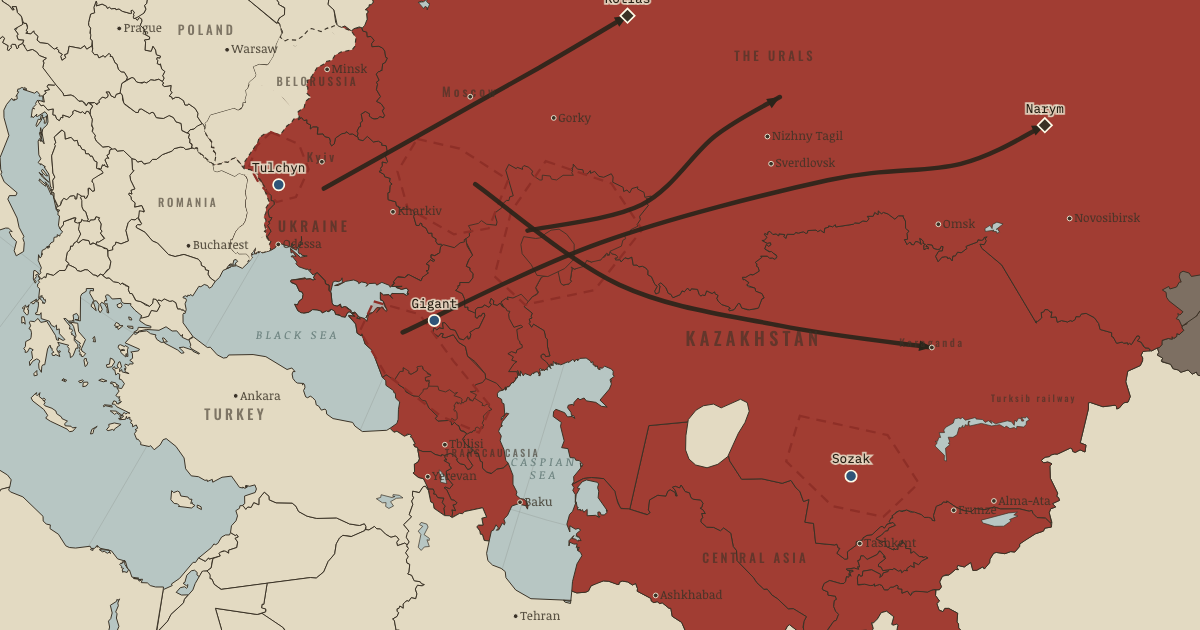
The map above is the world of The Soviet Union, March 1930 — Collectivisation — the countryside in revolt.
Part of IB History: The Soviet Union under Stalin →
BRIEF EXPLANATION — THE ESSENTIAL ARGUMENT
The decision that made Stalin a dictator in fact as well as in title was the “Great Turn” of 1929, when he abandoned the market compromise with the peasants and forced them into collective farms. Four Soviet citizens in five lived in villages, mostly on small family farms. A kolkhoz, or collective farm, merged those farms into one unit that pooled land, animals and tools and delivered a fixed quota of grain to the state. Its members were paid only from what remained, much as a sharecropper keeps only what is left after the landlord has taken his cut. Stalin wanted collective farms because they would hand the state cheap grain to feed the towns, sell abroad for machinery and stockpile for war, and because they would bring the independent peasant under the party’s control.
The peasants resisted, and the map shows the scale of it. In the winter of 1929–30 officials pushed the share of collectivised households from under a tenth to over half in a few months, while “dekulakisation” stripped the better-off peasants, called kulaks (“fists”) and roughly the village’s small business owners, of their land and property. The dark arrows trace the deportation of some 1.8 million of them in 1930–31 to the northern forests, the Urals, western Siberia and Kazakhstan. In 1930 the political police recorded more than 13,000 riots and revolts, shown as dashed outlines, which drew in perhaps 2.5 million people. Because the revolts threatened the spring sowing, Stalin retreated for a few months in March 1930 and then resumed. By 1937 almost every household had been collectivised, and the state had won control of the harvest at the price of the countryside’s trust and much of its livestock.
The full story
Stalin turned against the New Economic Policy (NEP), Lenin’s 1921 compromise that let peasants sell their grain on a free market, because it left the state dependent on peasants who could choose whether to sell. The grain crisis of 1927–28 convinced him that the market could not feed rapid industrialisation, and his speech of 27 December 1929 announced the “liquidation of the kulaks as a class”, meaning the better-off peasants whom the party saw as rural capitalists. The Politburo, the party’s small ruling committee that worked like a cabinet, set the method. Its resolution of 30 January 1930 divided kulaks into three categories: “counter-revolutionary activists” for the camps or execution, wealthier families for deportation to remote regions, and the rest for resettlement on poor land nearby. Local officials, given quotas and little time, branded anyone who resisted as a kulak, including poor peasants who spoke up. The category was political as much as economic, which meant that it could be stretched to fit whoever stood in the way.
Collectivisation was carried out as a campaign, and its speed made it violent. About 27,000 urban workers, the “Twenty-Five Thousanders”, were sent to run the new farms, much as a company sends trusted managers to take over a firm it has bought. They worked alongside party brigades and troops of the OGPU, the political police and a forerunner of the KGB. Peasants answered in two ways: they slaughtered animals that would otherwise have been taken, so the number of horses and cattle roughly halved by 1933, and they revolted. On the map the dashed outlines mark the main regions of unrest in 1930, from right-bank Ukraine and the Kuban to the Volga, the Black Earth region and southern Kazakhstan. Women often led the protests, called babi bunty (“women’s riots”), because the authorities were slower to shoot them. Revolts in Ukraine’s border districts around Tulchyn alarmed Moscow most, and on 2 March 1930 Stalin’s article “Dizzy with Success” blamed local officials for “excesses”. Millions of peasants left the farms within weeks, showing how little of the collectivisation had been voluntary.
The retreat was a tactic, and the state found slower but surer weapons. From the autumn of 1930 it used taxes, delivery quotas and the threat of deportation to push peasants back in, and the share of collectivised households rose to about three-fifths by 1932 and over nine-tenths by 1937. The deportation arrows on the map show where the “kulaks” went: to “special settlements”, guarded exile villages that families had to build for themselves, in the forests around Kotlas, the Urals, Narym in Siberia and the Karaganda steppe, where many died in the first winters. Some showcase farms such as Gigant on the Salsk steppe received tractors, while most villages depended on the new machine-tractor stations, state depots that rented out tractors much as a hire company does, together with political supervisors. The state now took far more grain than before, even as harvests fell. The policy succeeded as a means of control and failed as a means of feeding people, and that gap led directly to the famines of 1932–33.
DEEP EXPLANATION — EVIDENCE & INTERPRETATION
Counting the peasant revolt
Collectivisation provoked the largest rural revolt in Europe since the Russian civil war, and the political police’s own counts, opened only after 1991, show its scale. Lynne Viola’s Peasant Rebels under Stalin (1996) uses OGPU figures of about 13,750 mass disturbances in 1930 involving roughly 2.5 million participants, with March the peak month, at more than 6,500 incidents, and Ukraine the most rebellious republic. Officials called the revolts “kulak terror” and blamed them on hidden enemies, a label that justified further deportations. These numbers are a floor, since they count only incidents that officials reported. Historians read this evidence in two ways. Viola and Andrea Graziosi describe a “peasant war” fought with petitions, riots, arson and murders of activists, while Sheila Fitzpatrick’s Stalin’s Peasants (1994) stresses the quieter strategies that followed defeat, such as working slowly on collective fields and putting effort into private plots. Both views agree on the outcome: open revolt failed by 1931, and resistance moved into everyday life, where it never entirely stopped.
Did collectivisation pay for industry?
Collectivisation probably financed far less of industrialisation than Soviet textbooks claimed, as economic historians who tested the claim with numbers have found. In the 1960s the Soviet economist A. A. Barsov calculated that, once the state’s spending on machinery and the collapse of livestock were counted, agriculture supplied little or no net surplus to industry in 1928–32; James Millar drew the same conclusion in the West. More recently Robert C. Allen’s Farm to Factory (2003) argued that the Soviet Union could have grown as fast or faster by keeping a market in grain. His reason is that the main source of industrial labour was the flight of peasants to the towns, which a market would also have produced. Other historians, including R. W. Davies, accept the economic costs but stress that control of grain let the state feed the cities and the army regardless of the harvest. The debate suggests that collectivisation’s real return was political security for the regime, paid for by the countryside.
The kolkhoz bargain
A working compromise between the state and the villages, reached after 1933, shaped rural life until the end of the Soviet Union. The Model Statute of the collective farm, revised in 1935, let each household keep a private plot of up to half a hectare and some animals, usually a cow, a few pigs and poultry. Members earned “labour days”, units of credit paid at the end of the year in grain and a little cash, but only after the state’s quota had been delivered, so pay was small and unpredictable. Private plots, though a tiny share of farmland, produced a large share of the country’s potatoes, vegetables, milk and meat, much of it sold at kolkhoz markets where prices were free. The internal passport system of December 1932 excluded collective farmers, which tied them to their farms much as serfdom had tied their grandparents to estates, and peasants called the kolkhoz the “second serfdom”. The bargain gave peasants survival and the state control, which is why it lasted.
Key places on the map
On this day
Why it happened
The grain crisis convinced Stalin the market had failed. State grain purchases fell sharply in the winter of 1927–28 because fixed prices were low and goods to buy were scarce, so peasants held back grain or fed it to livestock. Stalin read this as a kulak “grain strike” and concluded that the state could never industrialise while peasants decided when to sell. The emergency seizures of 1928–29 worked in the short run but reduced sowing, which made a permanent system of compulsory delivery look necessary.
Industrialisation needed grain, labour and foreign currency. The First Five-Year Plan, approved in 1929 and then raised, required food for millions of new urban workers and grain exports to pay for foreign machines. Collective farms promised to deliver both cheaply and on schedule, because the state would fix each farm’s quota before the harvest. They would also release labour, since larger farms using tractors needed fewer hands, and the surplus peasants could be sent to build Magnitogorsk and the other new cities.
Bolshevik ideology distrusted the peasant smallholder. Marxists saw private farming as the soil in which capitalism regrew, and Lenin had warned that small-scale production generated capitalism “daily, hourly”. For many party members, collective farming was the socialist future of the village and NEP only a pause, a retreat that Lenin himself had called temporary. The war scare of 1927 added urgency, because a country at war could not depend on peasants who might hoard grain or side with an invader.
Victory over the Right removed every brake. The defeat of the Right silenced the last voices for caution. By 1929 Bukharin, Rykov and Tomsky, who had warned that coercion would wreck the alliance of workers and peasants, had been defeated and silenced. No one in the Politburo could argue for slower change without being accused of “Right deviation”, so targets were raised again and again in a competition to show loyalty. The pace of 1929–30 reflected that political climate as much as any economic plan.
THE TURNING POINT
Tulchyn and “Dizzy with Success”, March 1930. The revolts of February and March 1930, worst in the Ukrainian border districts around Tulchyn, are the hinge of collectivisation because they forced the only retreat Stalin made. His article of 2 March blamed local zealots, and peasants left the collective farms in their millions. Yet the retreat taught the regime a lesson that outlasted it: open force provoked revolt, while taxes, quotas and selective deportation worked more surely. When collectivisation resumed in the autumn, it used those quieter weapons, and by 1932 the state could take the harvest without a single decisive battle.
What it changed
The famines of 1930–33. Compulsory delivery quotas fixed in Moscow took grain regardless of how much had been harvested, and the slaughter of livestock removed the peasants’ reserve. When harvests fell in 1931 and 1932 and the quotas stayed high, villages in Ukraine, the Kuban, the Volga and above all Kazakhstan were left without food. A policy designed to secure grain had removed the margin that kept villages alive.
The special settlements and the Gulag. The 1.8 million deported “kulaks” became the first great forced-labour population of the Stalin era, settled in camps of barracks and dugouts under OGPU control. Their labour cut timber in the north and dug mines in the Urals, which taught the police that deportees and prisoners could be used to open up remote regions. The special settlements became the prototype for the Gulag.
A rural economy that never recovered. Livestock numbers did not return to their 1928 level until the 1950s, and grain yields stayed low for decades. Collective farmers, paid little and late, worked hardest on their own plots, so the kolkhoz system produced a permanent gap between the state’s fields and the peasants’ gardens. The weakness of Soviet agriculture would trouble every leader from Stalin to Gorbachev.
Peasants into workers. Millions of villagers fled collectivisation by moving to the towns and building sites, swelling the industrial workforce faster than the planners had expected. Between 1926 and 1939 the urban population more than doubled. The internal passports introduced in December 1932 tried to control the flow, which made the right to live in a city a privilege the state could grant or withhold.
DISCUSSION QUESTION — Was collectivisation above all an economic policy or a political one?
The best answer is that Stalin treated the economic problem as a political one, and the evidence weighs towards control as the decisive motive. The economic case was real: the grain crisis of 1927–28 threatened the food supply of the towns and the export earnings that paid for foreign machinery. Yet economists from Barsov to Allen find that collectivisation probably delivered little net surplus to industry, because it destroyed livestock and lowered yields, and a market-based alternative might have grown as fast. The political gains, by contrast, were immediate and lasting. The state now controlled the harvest regardless of what peasants wanted, the independent farmer who could withhold grain disappeared, and the countryside was policed by party officials, machine-tractor stations and the threat of deportation. Ideology linked the two motives, since Bolsheviks believed private farming bred capitalism. The transferable insight is that authoritarian regimes often choose the policy that maximises control over the one that maximises output, and then present the result as economic necessity.
An interesting fact
The men sent to run the new collective farms were often townspeople who had never farmed. In late 1929 the party called for 25,000 experienced industrial workers to volunteer for the countryside; about 70,000 applied, and roughly 27,000 were sent, most of them from the factories of Leningrad, Moscow and Ukraine. Lynne Viola, who studied them in The Best Sons of the Fatherland (1987), found that many were genuine enthusiasts who believed they were bringing modern methods to backward villages, and that peasants frequently treated them as occupiers. Several hundred were attacked, and some were killed, during the revolts of 1930.
Related
THE FREE PRINTABLE STUDY GUIDE
Join the Dispatch — a short welcome series, then a letter when a new atlas opens — and the printable study guide for The Soviet Union under Stalin is yours now, free.
NO TRACKING · YOUR ADDRESS IS USED FOR THE DISPATCH AND NOTHING ELSE · UNSUBSCRIBE ANYTIME