Stalin’s Soviet Union · 1930
Was collectivisation an economic or a political policy?
The seminar question: “Was collectivisation above all an economic policy or a political one?”
In the Great Turn of 1929 Stalin abandoned the NEP’s market compromise and forced peasants into collective farms, to give the state cheap grain for the towns, exports and war. Kulaks were sorted into categories for camps, execution or deportation, and peasants resisted on a large scale in 1929–30.
WW2 is free — every chapter. Try chapters 1–2 of any 2 other atlases (3 with a free account). Opening a new atlas uses one of them. Membership opens all 21 — Join.
Free printable Stalin’s Soviet Union study guide, sent by email ↓
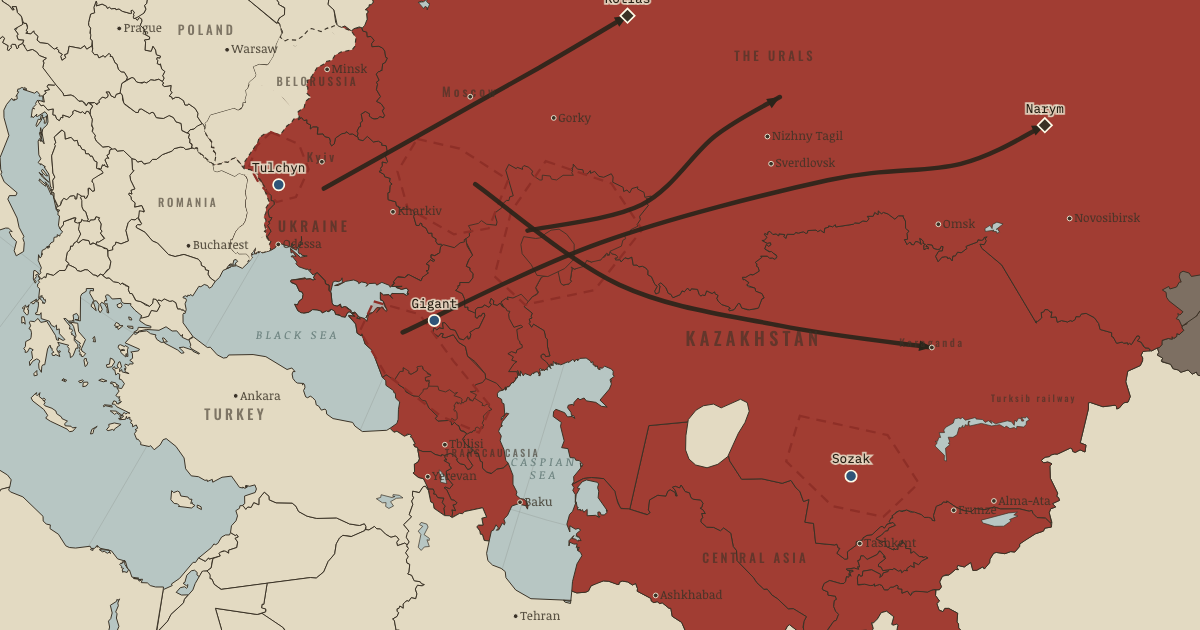
Stalin turned against the New Economic Policy (NEP), Lenin’s 1921 compromise that let peasants sell their grain on a free market, because it left the state dependent on peasants who could choose whether to sell. The grain crisis of 1927–28 convinced him that the market could not feed rapid industrialisation, and his speech of 27 December 1929 announced the “liquidation of the kulaks as a class”, meaning the better-off peasants whom the party saw as rural capitalists. The Politburo, the party’s small ruling committee that worked like a cabinet, set the method. Its resolution of 30 January 1930 divided kulaks into three categories: “counter-revolutionary activists” for the camps or execution, wealthier families for deportation to remote regions, and the rest for resettlement on poor land nearby. Local officials, given quotas and little time, branded anyone who resisted as a kulak, including poor peasants who spoke up. The category was political as much as economic, which meant that it could be stretched to fit whoever stood in the way.
The short answer
- The grain crisis convinced Stalin the market had failed. State grain purchases fell sharply in the winter of 1927–28 because fixed prices were low and goods to buy were scarce, so peasants held back grain or fed it to livestock. Stalin read this as a kulak “grain strike” and concluded that the state could never industrialise while peasants decided when to sell. The emergency seizures of 1928–29 worked in the short run but reduced sowing, which made a permanent system of compulsory delivery look necessary.
- Industrialisation needed grain, labour and foreign currency. The First Five-Year Plan, approved in 1929 and then raised, required food for millions of new urban workers and grain exports to pay for foreign machines. Collective farms promised to deliver both cheaply and on schedule, because the state would fix each farm’s quota before the harvest. They would also release labour, since larger farms using tractors needed fewer hands, and the surplus peasants could be sent to build Magnitogorsk and the other new cities.
- Bolshevik ideology distrusted the peasant smallholder. Marxists saw private farming as the soil in which capitalism regrew, and Lenin had warned that small-scale production generated capitalism “daily, hourly”. For many party members, collective farming was the socialist future of the village and NEP only a pause, a retreat that Lenin himself had called temporary. The war scare of 1927 added urgency, because a country at war could not depend on peasants who might hoard grain or side with an invader.
- Victory over the Right removed every brake. The defeat of the Right silenced the last voices for caution. By 1929 Bukharin, Rykov and Tomsky, who had warned that coercion would wreck the alliance of workers and peasants, had been defeated and silenced. No one in the Politburo could argue for slower change without being accused of “Right deviation”, so targets were raised again and again in a competition to show loyalty. The pace of 1929–30 reflected that political climate as much as any economic plan.
THE TURNING POINT
Tulchyn and “Dizzy with Success”, March 1930. The revolts of February and March 1930, worst in the Ukrainian border districts around Tulchyn, are the hinge of collectivisation because they forced the only retreat Stalin made. His article of 2 March blamed local zealots, and peasants left the collective farms in their millions. Yet the retreat taught the regime a lesson that outlasted it: open force provoked revolt, while taxes, quotas and selective deportation worked more surely. When collectivisation resumed in the autumn, it used those quieter weapons, and by 1932 the state could take the harvest without a single decisive battle.
What it changed
The famines of 1930–33. Compulsory delivery quotas fixed in Moscow took grain regardless of how much had been harvested, and the slaughter of livestock removed the peasants’ reserve. When harvests fell in 1931 and 1932 and the quotas stayed high, villages in Ukraine, the Kuban, the Volga and above all Kazakhstan were left without food. A policy designed to secure grain had removed the margin that kept villages alive.
The special settlements and the Gulag. The 1.8 million deported “kulaks” became the first great forced-labour population of the Stalin era, settled in camps of barracks and dugouts under OGPU control. Their labour cut timber in the north and dug mines in the Urals, which taught the police that deportees and prisoners could be used to open up remote regions. The special settlements became the prototype for the Gulag.
A rural economy that never recovered. Livestock numbers did not return to their 1928 level until the 1950s, and grain yields stayed low for decades. Collective farmers, paid little and late, worked hardest on their own plots, so the kolkhoz system produced a permanent gap between the state’s fields and the peasants’ gardens. The weakness of Soviet agriculture would trouble every leader from Stalin to Gorbachev.
Peasants into workers. Millions of villagers fled collectivisation by moving to the towns and building sites, swelling the industrial workforce faster than the planners had expected. Between 1926 and 1939 the urban population more than doubled. The internal passports introduced in December 1932 tried to control the flow, which made the right to live in a city a privilege the state could grant or withhold.
The full answer, argued
The best answer is that Stalin treated the economic problem as a political one, and the evidence weighs towards control as the decisive motive. The economic case was real: the grain crisis of 1927–28 threatened the food supply of the towns and the export earnings that paid for foreign machinery. Yet economists from Barsov to Allen find that collectivisation probably delivered little net surplus to industry, because it destroyed livestock and lowered yields, and a market-based alternative might have grown as fast. The political gains, by contrast, were immediate and lasting. The state now controlled the harvest regardless of what peasants wanted, the independent farmer who could withhold grain disappeared, and the countryside was policed by party officials, machine-tractor stations and the threat of deportation. Ideology linked the two motives, since Bolsheviks believed private farming bred capitalism. The transferable insight is that authoritarian regimes often choose the policy that maximises control over the one that maximises output, and then present the result as economic necessity.
An interesting fact
The men sent to run the new collective farms were often townspeople who had never farmed. In late 1929 the party called for 25,000 experienced industrial workers to volunteer for the countryside; about 70,000 applied, and roughly 27,000 were sent, most of them from the factories of Leningrad, Moscow and Ukraine. Lynne Viola, who studied them in The Best Sons of the Fatherland (1987), found that many were genuine enthusiasts who believed they were bringing modern methods to backward villages, and that peasants frequently treated them as occupiers. Several hundred were attacked, and some were killed, during the revolts of 1930.
This is the study layer of Collectivisation in the USSR, chapter 2 of The Soviet Union under Stalin, 1924–1953; the full index of the atlas is here.
Related questions
THE FREE PRINTABLE STUDY GUIDE
Join the Dispatch — a short welcome series, then a letter when a new atlas opens — and the printable study guide for The Soviet Union under Stalin is yours now, free.
NO TRACKING · YOUR ADDRESS IS USED FOR THE DISPATCH AND NOTHING ELSE · UNSUBSCRIBE ANYTIME