Stalin’s Soviet Union · CHAPTER 5 ·
Gulag forced-labour camps
Chapter 5 of The Soviet Union under Stalin, 1924–1953: “The Gulag”
From 1930 the Gulag, run by the political police, held prisoners in forced-labour camps, colonies and special settlements across the USSR. About 18 million people passed through the camps and colonies between 1930 and 1953, many sent to remote regions such as Kolyma to work the resources the plans needed.
Chapter 5 is part of membership. WW2 is free — every chapter. Try chapters 1–2 of any 2 other atlases (3 with a free account). Opening a new atlas uses one of them. Membership opens all 21 — Join.
Free printable Stalin’s Soviet Union study guide, sent by email ↓
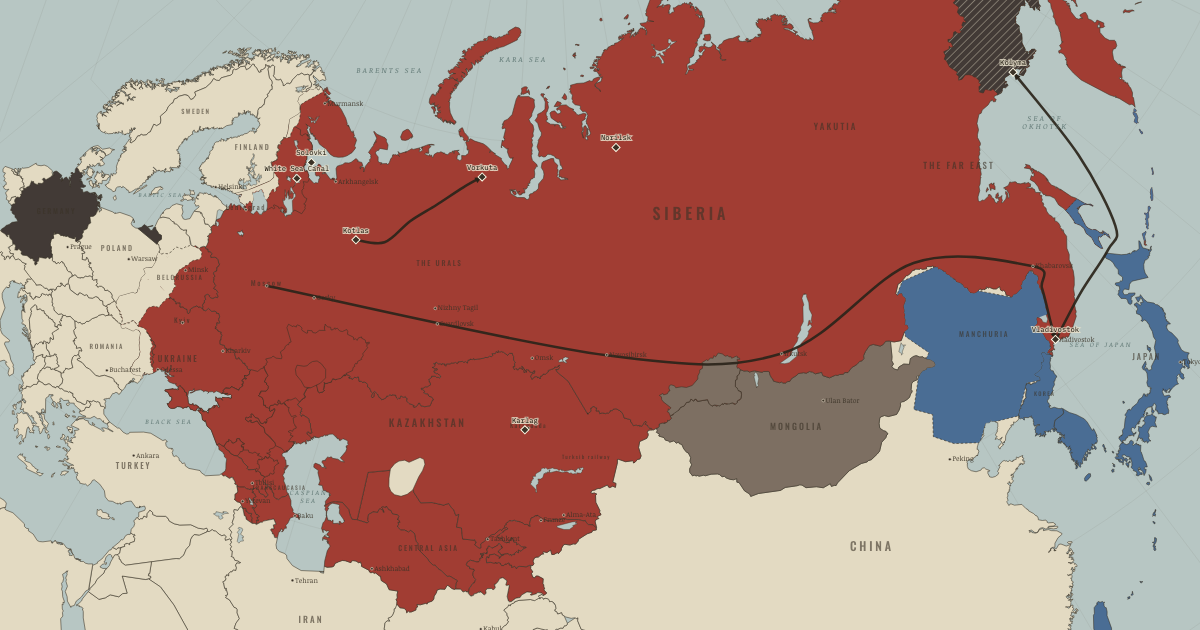
The map above is the world of The Soviet Union, August 1935 — The Second Five-Year Plan: steel, coal and camps.
Part of IB History: The Soviet Union under Stalin →
BRIEF EXPLANATION — THE ESSENTIAL ARGUMENT
The Gulag was the institution that let the regime punish, frighten and use its people at the same time, and the diamond markers on the map trace its reach across the whole Union. The word is an acronym for the Main Administration of Camps, the department of the political police, the forerunner of the KGB, that ran forced-labour camps from 1930. Camps held prisoners sentenced to three years or more, colonies held shorter sentences, and “special settlements” held deported families who were not formally convicted. Together they worked like a vast state employer whose workforce could not quit, could be moved anywhere and could be worked to death. Between 1930 and 1953 about 18 million people passed through the camps and colonies, and millions more lived in special settlements, so the Gulag touched far more lives than its population on any one day suggests.
The camps were placed where free workers would not go, and that is the pattern the map reveals. The first great camp grew on the Solovetsky islands in the White Sea, and prisoners dug the White Sea Canal in 1931–33. From there the system spread to the coal of Vorkuta, the nickel of Norilsk, the farms of Karlag in Kazakhstan and the gold fields of Kolyma. The dark hatching over Kolyma marks the territory ruled by the police trust Dalstroi, which ran the region like a vast company town. The arrows follow the convoys: by rail across Siberia to Vladivostok, by ship to Magadan, and north from Kotlas to the Arctic mines. At its peak in the early 1950s the Gulag held about 2.5 million people. Recorded deaths in camps and colonies reached about 1.5 to 1.8 million, and more died soon after release, so the camps were both an economy and a machine of slow killing.
The full story
The Gulag, the network of forced-labour camps run by the political police, grew from a decision to make prisoners pay for their own punishment and open up the empire’s empty regions. On 27 June 1929 the Politburo, the party’s small ruling committee that worked like a cabinet, decided to transfer all prisoners serving three years or more to camps run by the OGPU, the political police and a forerunner of the KGB. The government decree that followed in July ordered new camps in remote areas “for the purpose of colonising these regions and exploiting their natural resources”. The model was Solovki, where prisoners were fed according to the work they did, so the weak received less food and grew weaker. The deported “kulaks”, the better-off peasants branded rural capitalists during collectivisation, gave the police in 1930–31 a second labour force in the special settlements, guarded villages of exile. Once punishment had been made into an economic resource, the police had a reason to want more prisoners, which helps explain why arrests and labour plans were later linked.
The camps’ geography followed the resources the plans needed, and the map shows how far that pulled prisoners from home. Dalstroi, a police-run company founded in November 1931, ruled the Kolyma basin as a territory of its own, much like the owner of a giant company town. It shipped prisoners from Vladivostok to the port of Magadan to mine gold in permafrost, and the poet Osip Mandelstam died in the Vladivostok transit camp in December 1938. In the Arctic, prisoners opened the coalfield of Vorkuta and the nickel mines of Norilsk, building railways and cities that still stand. In Kazakhstan, Karlag farmed the steppe. Prisoners included political offenders sentenced under Article 58 for “counter-revolutionary” crimes, but most were ordinary people convicted of petty theft, absence from work or leaving a job, so the Gulag touched almost every family.
Life in the camps was organised to extract labour and to break solidarity, and the records allow its cost to be measured. Rations depended on meeting work norms, the daily output each prisoner had to reach. Prisoners worked twelve hours or more in extreme cold, and criminal convicts were often allowed to dominate political prisoners. Mortality soared in the famine years of 1933 and in the war, when about a quarter of camp prisoners died in 1942 alone. Camp officials also released many prisoners who were close to death, which lowered the recorded figures, so historians treat the archive’s total of about 1.5 to 1.8 million deaths as a minimum. The Gulag kept growing until Stalin’s death, peaking at about 2.5 million prisoners in camps and colonies in the early 1950s. Only his death allowed the camps on the map to be emptied, because no one beneath him had dared to propose it.
DEEP EXPLANATION — EVIDENCE & INTERPRETATION
What the archives count
The Gulag’s population at any one time peaked near 2.5 million, below Cold War estimates of more than ten million, while some 18 million people passed through it, as the NKVD’s own statistics, opened after 1991, show. The archives record roughly 500,000 prisoners in camps and colonies in 1934, about 1.9 million in 1938–41 and close to 2.5 million at the peak in 1950–53, with about 2.7 million more people in special settlements. Anne Applebaum, in Gulag: A History (2003), calculates that some 18 million people passed through the camps and colonies between 1930 and 1953 and about 6 million more were deported to exile. The archival death toll is about 1.5 to 1.8 million in camps and colonies. Historians debate how far to trust it. Golfo Alexopoulos, in Illness and Inhumanity in Stalin’s Gulag (2017), shows that the camps routinely released the dying, so many deaths occurred outside the statistics; Michael Ellman and others accept that the records are a floor and argue about how much to add. The figures are therefore minimums, and the debate is about how far above them the truth lies.
An economy or an instrument of terror?
The Gulag served economic plans, political repression and a brutal idea of re-education at once, which is why historians have argued about its purpose since Aleksandr Solzhenitsyn’s The Gulag Archipelago (1973) described it as a system for destroying people. Archival historians such as Oleg Khlevniuk have stressed its economic role: the NKVD was one of the country’s largest builders, produced most of its gold and much of its timber, and planned arrests and transfers partly according to labour needs. Yet the same records show that forced labour was expensive and unproductive, because guards, transport, sickness and death cost more than the work returned, and Gulag officials repeatedly complained of it. Steven Barnes, in Death and Redemption (2011), offers a third view, arguing that the camps were meant to sort prisoners into those who could be “reforged” through labour and those to be discarded, which explains why releases and deaths rose together. The strongest reading combines these, because each purpose excused the others, and the combination made the camps deadlier than any one purpose would have.
The camps in testimony
Much of what readers know about the Gulag comes from survivors whose accounts were published abroad or decades later, and their testimony both confirms and fills out the archives. Varlam Shalamov spent most of the years from 1937 to 1951 in Kolyma and wrote Kolyma Tales, spare stories of men reduced to the struggle for bread. Evgenia Ginzburg, a party member arrested in 1937, described her journey to Kolyma and her eighteen years of imprisonment and exile in Journey into the Whirlwind. Solzhenitsyn, imprisoned from 1945 to 1953, combined his own experience with letters from hundreds of former prisoners. The organisation Memorial, founded in 1989 and dissolved by Russia’s Supreme Court in 2021, gathered names, documents and testimonies from across the former camp regions. These sources are subjective, written from memory and sometimes from political conviction, so historians test them against camp records; on rations, work norms and mortality, they largely agree. Testimony and archive now check each other, which is why the camps can be described in a detail that neither source could give alone.
Key places on the map
On this day
Why it happened
Punishment was redefined as productive labour. Bolsheviks believed that labour could reform criminals and that a socialist state should not pay to keep idle prisoners. The Solovki camp, opened in 1923 in a former monastery on the White Sea, showed the police how to make prisoners work for their food. The resolution of June 1929 turned this into national policy: long-term prisoners would be sent to remote camps to work, which made punishment and economic planning parts of one system.
The plans needed labour in empty places. The gold, coal, nickel and timber that industrialisation required lay in the Arctic, Siberia and the Far East, where few free workers would live. Prisoners and deportees could be sent there by order, kept there by guards and paid almost nothing. The Gulag therefore grew alongside the Five-Year Plans, and by 1940 its prisoners mined most of the Union’s gold, so its map of camps is largely a map of the resources the plans demanded.
Collectivisation produced a forced-labour population. The deportation of about 1.8 million “kulaks” in 1930–31 created the first mass population of forced labourers outside the prisons. The OGPU had to house, feed and employ them in special settlements, which taught it to manage people in their hundreds of thousands. The experience, and the infrastructure of barracks, transit points and convoys, was then extended to convicted prisoners, so the methods of dekulakisation became the methods of the camps.
New laws turned everyday life into crime. The Law of 7 August 1932 on socialist property, the internal passport rules of 1932 and later the labour laws of 1940 made petty theft, unauthorised travel and lateness into crimes with long sentences. Most Gulag prisoners were convicted under such laws, and only a minority as political enemies, so the legal system fed the camps continuously, in quiet years as well as during the Terror, and the camp population kept rising between campaigns.
THE TURNING POINT
The White Sea Canal, 1931–1933. The White Sea–Baltic Canal is the hinge of the Gulag’s history because it was the first great project built entirely by prisoners and was presented as proof that forced labour worked. Some 227 kilometres were dug in twenty months, mostly by hand; officially about 12,000 prisoners died, and other estimates are higher. Stalin sailed along it in July 1933, and a book by thirty-six writers, edited by Maxim Gorky, celebrated the “reforging” of criminals. The canal was too shallow for most ships, yet the regime took from it the lesson that the police could build anything quickly, and gave the NKVD ever larger projects.
What it changed
A police empire with its own territory. Dalstroi governed the Kolyma region directly from 1931 to 1953, with the NKVD acting as government, employer and jailer at once. The dark hatching on the map marks that territory. Other camp complexes in Vorkuta, Norilsk and Karaganda built whole cities, and the NKVD became one of the Union’s largest economic ministries. Its power over land and people outlasted the Terror and ended only after Stalin died.
A channel that the Terror could fill. Because the camps were organised to absorb and use prisoners, the mass arrests of 1937–38 could send hundreds of thousands to Kolyma, the north and Kazakhstan within months. The Gulag population nearly doubled in those years, and in Kolyma the new arrivals were driven to meet gold plans through the Arctic winter of 1938, when deaths there rose steeply. The existing system of convoys, transit camps and work sites made the Terror’s scale possible, and the Terror in turn gave the camps their largest workforce yet.
Forced labour built the wartime and postwar economy. Forced labour stayed part of the economy through the war and after it. In 1941–45 prisoners produced munitions, built railways and mined coal, while about a million were released into the Red Army. After 1945 the Gulag grew to its largest size with new waves of prisoners: returning soldiers, people from annexed lands and those convicted under harsh new theft laws. The camps grew fastest in peacetime, which shows that they served the regime’s routine as well as its emergencies.
A memory that still divides. Survivors returned after 1953 to a society that did not want to hear them, and the camps were acknowledged only partially under Khrushchev. Solzhenitsyn’s One Day in the Life of Ivan Denisovich was published in 1962, then banned again. Memory of the Gulag remains contested in Russia, where the organisation Memorial, which documented it, was dissolved by court order in 2021.
DISCUSSION QUESTION — Was the Gulag primarily an economic institution or an instrument of political terror?
The Gulag was both, and the most persuasive answer explains how each purpose strengthened the other. The economic evidence is strong: the 1929 resolution created the camps to colonise remote regions, the NKVD ran major construction projects and produced most of the country’s gold, and camps were placed where the plans needed resources. Yet political purposes were never absent. The camps held millions convicted under laws designed to discipline the population, the Terror of 1937–38 filled them regardless of economic need, and their living conditions killed people at rates no rational employer would accept. Steven Barnes adds that the regime saw labour as a test of who could be redeemed. Historians such as Khlevniuk show that forced labour was inefficient, which suggests that economic justifications helped the regime explain a system whose deeper purpose was control. A good judgement therefore treats the Gulag as a political institution that was given an economic job, and recognises that this combination is what allowed it to grow so large.
An interesting fact
Some of the engineers who built Soviet aviation and space flight worked as prisoners. The aircraft designer Andrei Tupolev was arrested in 1937 and designed the Tu-2 bomber inside a prison design bureau in Moscow, one of the special camps for scientists that prisoners called sharashki. Sergei Korolev, later chief designer of the rocket that launched Sputnik and Yuri Gagarin, was arrested in 1938, spent months at a Kolyma gold mine in 1939, and was then moved to Tupolev’s bureau. Both were released during the war, and their imprisonment was not publicly acknowledged in the Soviet Union for decades.
Related
THE FREE PRINTABLE STUDY GUIDE
Join the Dispatch — a short welcome series, then a letter when a new atlas opens — and the printable study guide for The Soviet Union under Stalin is yours now, free.
NO TRACKING · YOUR ADDRESS IS USED FOR THE DISPATCH AND NOTHING ELSE · UNSUBSCRIBE ANYTIME