Stalin’s Soviet Union · 1928
Did Stalin win power by skill or his rivals’ errors?
The seminar question: “Did Stalin win the succession mainly through his own skill, or because his rivals made it easy for him?”
When Lenin died in January 1924, Stalin was the rival others feared least, yet as General Secretary he controlled party appointments. Zinoviev and Kamenev shielded him from Lenin’s Testament because they needed him against Trotsky, who was exiled to Alma-Ata in January 1928; by 1929 Stalin led without rivals.
WW2 is free — every chapter. Try chapters 1–2 of any 2 other atlases (3 with a free account). Opening a new atlas uses one of them. Membership opens all 21 — Join.
Free printable Stalin’s Soviet Union study guide, sent by email ↓
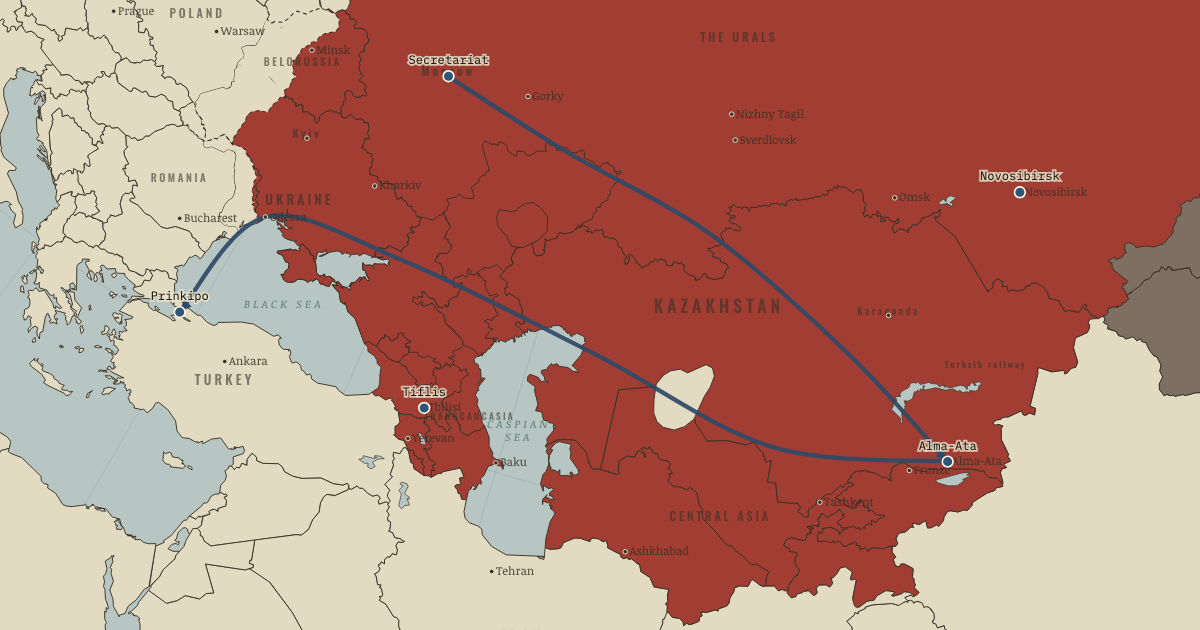
Stalin’s rise depended first on surviving a warning from Lenin himself, and the way the leaders handled it shows how the party already worked. In December 1922 and January 1923, partly paralysed by strokes, Lenin dictated notes later called his Testament. He wrote that Stalin had concentrated “unlimited authority” in his hands, and in a postscript of 4 January 1923 he called him “too rude” and proposed removing him as General Secretary, the head of the party’s administrative office, much like a chief of staff. The quarrel behind the postscript was the Georgian Affair, marked on the map at Tiflis, where Stalin and his ally Sergo Ordzhonikidze had bullied Georgian communists into a federation with Armenia and Azerbaijan. When the notes were read to delegation leaders at the Thirteenth Congress, the party’s national gathering, in May 1924, Zinoviev and Kamenev argued that Stalin should stay, because they needed him against Trotsky. The men best placed to stop Stalin chose to shield him, and the text stayed unpublished in the Soviet Union until 1956.
The short answer
- The party had no rules for succession. Lenin led through personal authority, and the party had no office of leader and no procedure for choosing one. Power sat in committees: the Politburo, which made policy, and the Orgburo and Secretariat, which managed people. When Lenin fell ill in 1922, his colleagues ruled collectively and competed in the dark, so whoever controlled the committees could turn a collective leadership into a personal one before anyone noticed the change.
- The General Secretary controlled appointments. Stalin became General Secretary in April 1922, a post his colleagues saw as administrative. Through it he oversaw the assignment of thousands of officials and the admission of new members, including the Lenin Enrolment of 1924. Provincial secretaries who owed him their posts sent loyal delegates to congresses, which gave Stalin a reliable majority long before he had a reputation. The job looked dull precisely because its power lay in routine.
- His rivals feared Trotsky more than Stalin. Bolsheviks read their revolution through the French one, where the revolution had ended with a general, Napoleon Bonaparte, seizing power. Trotsky, the creator of the Red Army, looked like the obvious Bonaparte, so Zinoviev, Kamenev and Bukharin each allied with Stalin to block him. They mistook a quiet organiser for a safe one, and each discovered too late that the man they had shielded was turning the machine against them in turn.
- NEP’s grain problem made policy a weapon. The question of how fast to industrialise, and who should pay for it, divided the party throughout the 1920s. The Left wanted to squeeze the peasants to fund factories; the Right wanted to keep the market and grow slowly. Because the grain crisis of 1927–28 forced a choice, Stalin could adopt whichever position isolated his current opponent, first defending NEP against the Left and then dismantling it against the Right.
THE TURNING POINT
Alma-Ata, January 1928. The train that carried Trotsky to Alma-Ata on 17 January 1928 marks the moment the succession was settled, because the last leader with an independent following was now 3,000 kilometres from Moscow and outside the party. The same month Stalin left for Siberia and began taking grain by force, adopting the method the defeated Left had urged. The two journeys together explain the turn: once Stalin had no rival on the left, he could take over its programme and use it to destroy the Right, and the struggle for Lenin’s succession became a revolution against the peasants.
What it changed
A leader without rivals launched the Great Turn. With Trotsky gone and Bukharin defeated, Stalin could impose forced collectivisation and breakneck industrialisation without a faction able to stop him. The policies of 1929–33 were his choices, made possible by the victory of 1927–29, and the Politburo that approved them was now filled with his allies, such as Vyacheslav Molotov and Lazar Kaganovich. No one left in the leadership could argue for slower change without being called a “Rightist”, so the succession had settled how fast the country would be changed as well as who would rule it.
Defeated rivals became future defendants. Every leader Stalin beat in the 1920s was later destroyed. Zinoviev and Kamenev were shot in August 1936 after the first Moscow show trial, Bukharin and Rykov in March 1938, and Tomsky shot himself in 1936 before he could be arrested. Trotsky was murdered in Mexico in 1940 by an NKVD agent. The succession struggle supplied the cast of the Great Terror, whose show trials accused the old oppositionists of plotting with foreign powers since the 1920s.
Loyalty replaced debate inside the party. The defeat of open factions ended the party’s tradition of public argument, which the ban on factions in 1921 had already weakened. Opposition now meant expulsion, and later arrest, so officials learned to read the leader’s wishes before he stated them. That habit of anticipating Stalin, like the one Ian Kershaw, writing about Hitler’s Germany, called “working towards the Führer”, made the later cult and the Terror easier to organise.
“Socialism in one country” justified the plans. The slogan that helped Stalin win also defined what came next: if the Soviet Union had to build socialism alone and surrounded by enemies, it had to industrialise at any cost. The Five-Year Plans were presented as the practical form of the idea, with defence as their deepest purpose, and every sacrifice they demanded could be justified by the danger of a war the country might have to fight alone.
The full answer, argued
The evidence supports both, but the decisive factor was the combination of Stalin’s control of appointments with his rivals’ misjudgements. His skill is plain: he grasped earlier than anyone that the Secretariat could produce majorities, he chose allies with care, and his “socialism in one country” spoke to a party tired of waiting for world revolution. Yet his opponents repeatedly helped him. Zinoviev and Kamenev saved him from Lenin’s Testament in 1924, Trotsky refused to fight in the open while he still had support in the army and among students, and Bukharin underestimated Stalin until 1928. Historians weigh these differently: Deutscher and Daniels stress the machine, Kotkin stresses Stalin’s intelligence and conviction, and Fitzpatrick stresses support from below. A reasonable judgement is that skill exploited opportunity, because none of the rivals combined the votes, the timing and the message that Stalin did. The transferable lesson is that in systems without rules for succession, power often passes to whoever controls the routine administration that everyone else ignores.
An interesting fact
Trotsky’s first exile was far from silent. According to his biographers Isaac Deutscher and Pierre Broué, between April and October 1928 Trotsky and his son Lev Sedov sent about 800 political letters and 550 telegrams from Alma-Ata and received around 1,000 letters. Many came from oppositionists in exile across Siberia and Central Asia. The OGPU read much of this correspondence, which helped convince Stalin that a Trotsky inside the Soviet Union, however remote, still led a network. His solution was to deport Trotsky abroad in February 1929, which removed him from the country but left him free to write, and his Bulletin of the Opposition, published abroad from 1929, kept up a running attack on Stalin’s policies for the next decade.
This is the study layer of Stalin’s rise to power, chapter 1 of The Soviet Union under Stalin, 1924–1953; the full index of the atlas is here.
Related questions
THE FREE PRINTABLE STUDY GUIDE
Join the Dispatch — a short welcome series, then a letter when a new atlas opens — and the printable study guide for The Soviet Union under Stalin is yours now, free.
NO TRACKING · YOUR ADDRESS IS USED FOR THE DISPATCH AND NOTHING ELSE · UNSUBSCRIBE ANYTIME