Stalin’s Soviet Union · 1935
How successful were Stalin’s Five-Year Plans?
The seminar question: “To what extent were the Five-Year Plans a success?”
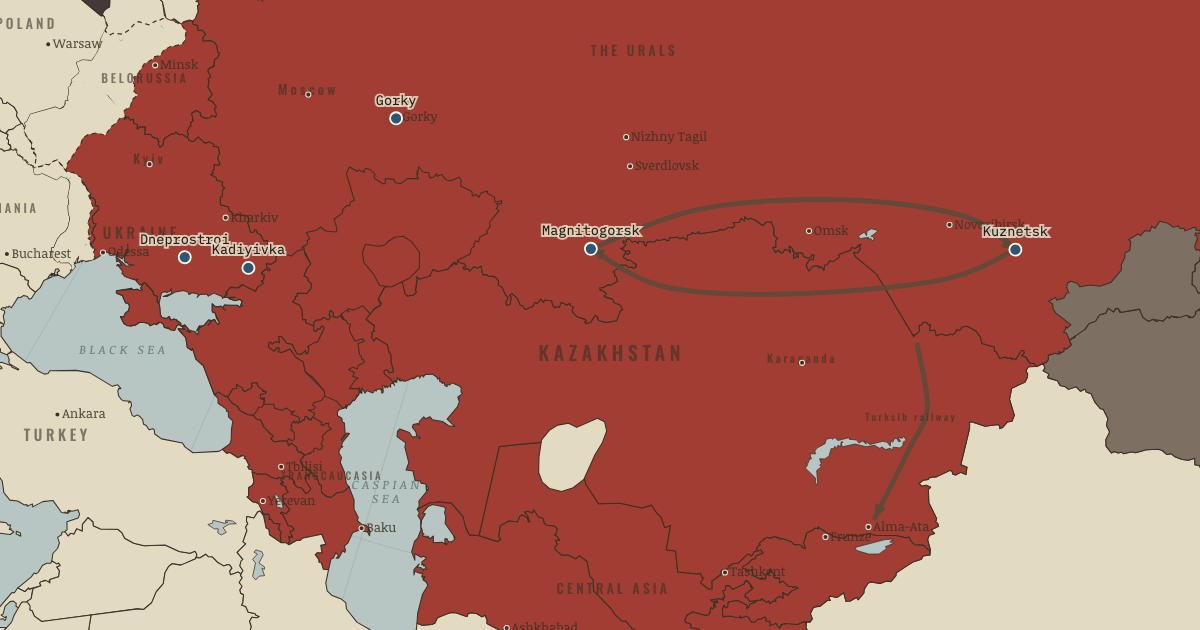
From 1928 Gosplan’s Five-Year Plans set output targets for every industry as political commands and poured resources into steel, coal, machinery and electricity. Stalin argued in 1931 that the USSR had ten years to catch up, and new plants such as Magnitogorsk, which lit its first blast furnace in 1932, moved industry east.
Chapter 4 is part of membership. WW2 is free — every chapter. Try chapters 1–2 of any 2 other atlases (3 with a free account). Opening a new atlas uses one of them. Membership opens all 21 — Join.
Free printable Stalin’s Soviet Union study guide, sent by email ↓
Planning by command, in which the targets of Gosplan, the State Planning Commission, were orders to every factory, meant that speed mattered more than cost, and that choice shaped everything the plans produced. In 1929 the leadership adopted the most ambitious draft of the First Five-Year Plan, the list of output targets for 1928–32, set like a company’s five-year budget but enforced as law, called the “optimal variant”. It then raised the draft further, so that the target for pig iron, the crude iron from which steel is made, of 10 million tonnes for 1932 was pushed to 17 million; actual output that year was about 6 million. Managers who missed targets risked prosecution, especially after the Shakhty trial of 1928 accused mining engineers of “wrecking”, the deliberate sabotage of production, so they hoarded materials, inflated their reports and drove workers harder. The plan was declared fulfilled in four years and three months, in January 1933, because heavy industry had grown fast even when most targets had been missed. Success was defined as growth in the priority sectors, which is why the regime could celebrate while consumers went short.
The short answer
- Fear of war drove the pace. Bolsheviks expected the capitalist powers to attack the first socialist state, and the war scare of 1927 made that fear urgent. Heavy industry meant tanks, aircraft and artillery, so the plans favoured steel and machinery over consumer goods, and defence plants received the scarcest materials first. Stalin’s February 1931 warning that the country had ten years to catch up proved almost exactly right, and he used the deadline to justify every sacrifice the plans demanded.
- Ideology demanded a socialist economy. Marxists believed a socialist society required large-scale industry and an industrial working class, and NEP had left the economy dominated by peasants and small traders. Planning seemed the rational alternative to the market’s booms and slumps, a view many Western observers shared during the Great Depression after 1929, when Western unemployment soared while Soviet factories were hiring. The plans therefore promised a new kind of society as well as more output.
- Collectivisation released grain and labour. Control of the harvest let the state feed the growing towns and export grain to pay for foreign machinery, even during the famine. Grain exports reached about 5 million tonnes in 1931, paying for imported machine tools. It also pushed millions of peasants into industry, either as migrants fleeing the farms or as deported “kulaks” sent to building sites such as Magnitogorsk. The two revolutions of 1929 were designed to work together, and each depended on the other’s violence.
- Political competition inflated the targets. After the defeat of the Right, no one could safely argue that targets were unrealistic. Planners and managers raised them to show loyalty, as when the pig-iron target for 1932 was pushed from 10 to 17 million tonnes, and the slogan “there are no fortresses Bolsheviks cannot storm” made caution sound like cowardice. The result was a planning system in which ambition was rewarded and realism was punished, which built in waste and the falsification of reports.
THE TURNING POINT
Magnitogorsk, February 1932. The first blast furnace at Magnitogorsk, lit in the winter of 1932 on a site that had been empty steppe three years earlier, is the hinge of the plans because it proved that the regime could build a heavy industrial base in the east. With Kuznetsk it formed a second metallurgical centre beyond the reach of any European army. In 1941, when German forces overran the old industrial regions of Ukraine, the Urals and Siberia produced much of the steel for Soviet tanks, so the most expensive decision of the plans also became their most important.
What it changed
The industrial base for victory in 1941–45. The plants built in the Urals and Siberia, and the experience of moving and building whole factories, made the evacuation of 1941 possible and supplied the Red Army through the war. Historians who are harsh on Stalinism still count this as the plans’ decisive result, though they debate whether a less brutal path could have reached the same point. The cost of building in the east was repaid in 1941, when the west was lost.
A society of new workers and new managers. Millions of peasants became urban workers, and a generation of young people from working-class and peasant families was trained as engineers and managers, the so-called vydvizhentsy (“promoted ones”). They owed their rise to the regime and formed the core of its support. Two of them, Leonid Brezhnev and Alexei Kosygin, ran the Soviet Union in the 1960s and 1970s, so the generation the plans promoted governed the country until the 1980s.
Shortage as a way of life. Priority for heavy industry left consumer goods, housing and food permanently scarce. Queues, rationing until 1935, overcrowded communal apartments and a thriving black market became normal, and the best goods went to closed shops for officials. The shortage economy, in which people relied on connections to obtain goods, lasted until the end of the Soviet Union and shaped how ordinary people dealt with the state.
Scapegoats for every failure. Because the plans could not fail officially, failures were blamed on “wreckers”: engineers in the Shakhty trial of 1928 and the Industrial Party trial of 1930, and later managers and officials during the Terror. Accidents, shortages and missed targets became evidence of sabotage, which linked the economy directly to the arrests of 1936–38, when industrial managers were among the most heavily purged groups.
The full answer, argued
The answer depends on which goal is used to measure them. If the goal was heavy industry and military power, the plans largely succeeded: steel, coal and electricity output multiplied, a second industrial base rose in the Urals and Siberia, and during the war the Soviet Union out-produced Germany in tanks and aircraft. Even sceptical recalculations by Bergson and Jasny show unusually fast growth. If the goal was a better life for workers and peasants, the record is far worse. Real wages fell sharply in the early 1930s, famine killed between about 5.5 and 8.7 million people, consumer goods stayed scarce, and much of the new industry depended on forced labour. The plans were also wasteful, with unfinished projects, falsified reports and poor quality. Historians such as Robert Allen argue that the growth came largely from moving peasants into industry, which a less violent policy might also have achieved. A balanced judgement is that the plans succeeded in Stalin’s own terms while failing the promise of socialism to raise living standards, a pattern seen in many states that industrialise by command.
An interesting fact
Some of the best evidence about Magnitogorsk comes from an American. John Scott, who left the University of Wisconsin in 1931, went to the Urals in 1932 to work as a welder and rigger, married a Russian teacher there and stayed until 1938. His memoir Behind the Urals (1942) describes temperatures of minus 40 degrees, workers sleeping in tents and barracks, and constant accidents, alongside genuine enthusiasm among young builders. The historian Stephen Kotkin later used Scott’s account, together with the city’s archives, for Magnetic Mountain (1995), where he argued that Stalinism was a whole civilisation that people learned to live inside, speaking its language as they did so.
This is the study layer of Stalin’s Five-Year Plans, chapter 4 of The Soviet Union under Stalin, 1924–1953; the full index of the atlas is here.
Related questions
THE FREE PRINTABLE STUDY GUIDE
Join the Dispatch — a short welcome series, then a letter when a new atlas opens — and the printable study guide for The Soviet Union under Stalin is yours now, free.
NO TRACKING · YOUR ADDRESS IS USED FOR THE DISPATCH AND NOTHING ELSE · UNSUBSCRIBE ANYTIME