Russian Revolution · JUL 1878
Did Alexander II’s reforms make revolution more likely?
The seminar question: “Did the Great Reforms make revolution in Russia less likely or more likely?”
Defeat in the Crimean War of 1853–56, when Britain and France took Sevastopol, convinced Tsar Alexander II that a serf empire could not keep up with industrial powers. The Emancipation Manifesto of 1861 freed the serfs, but their land went to the village commune and was repaid over 49 years.
WW2 is free — every chapter. Try chapters 1–2 of any 2 other atlases (3 with a free account). Opening a new atlas uses one of them. Membership opens all 21 — Join.
Free printable Russian Revolution study guide, sent by email ↓
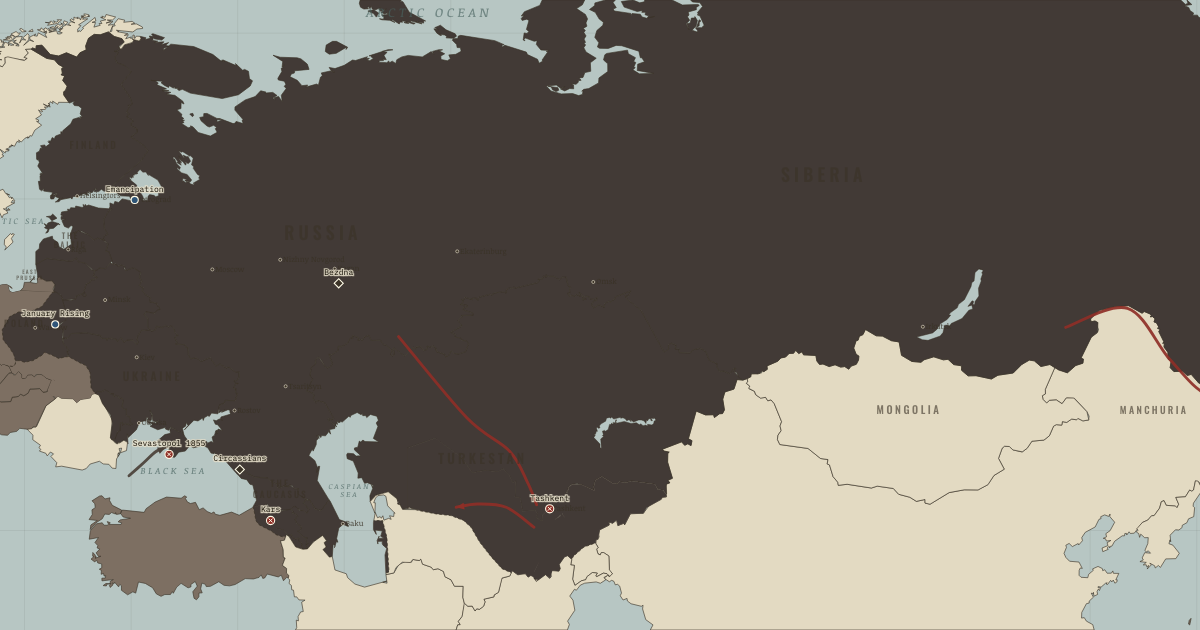
Russia’s emperor, Tsar Alexander II, began his reforms by diagnosing defeat, and the diagnosis pointed to serfdom, under which about half of Russia’s peasants belonged to landlords who could sell, flog or conscript them, as if a landlord owned his tenants too. The arrow across the Black Sea shows the British and French landing in the Crimea in 1854, and the Crimean War cost Russia at least 450,000 soldiers, mostly from disease. Serfdom lay behind the weakness because military service freed a serf for good. The army therefore kept conscripts for up to twenty-five years and had no reserve, the trained former soldiers whom modern armies recall in an emergency. Landowners had also pledged two-thirds of their serfs to state banks as security for loans, as a homeowner borrows against a house, and the banks were short of money by 1857. Freeing the serfs from above was a calculation about survival as much as a moral choice.
The short answer
- Defeat on home soil. The Crimean War was fought on Russian territory, and Russia still lost it. Britain and France supplied their armies by sea faster than Russia could supply its own by cart, because the empire had no railway south of Moscow. Sevastopol fell in September 1855 after an eleven-month siege. The defeat destroyed the prestige Russia had carried since 1812, when its armies drove Napoleon out and pursued him to Paris, and it showed the new Tsar that military power now rested on railways, rifles, money and trained reserves.
- Serfdom as a military and financial brake. Serfdom tied up soldiers and money, the two things most needed by a great power, one of the few states strong enough to shape the affairs of Europe. A serf who finished his long service came home free, so the army could not build a trained reserve without undermining the system that fed it. Landowners had pledged about two-thirds of their serfs as security for loans from state banks, much as a homeowner borrows against a house, and when the banks ran short of cash in 1857 to 1859 the treasury could no longer prop the system up.
- Fear of the village. Russia’s rulers had not forgotten the Pugachev rising of 1773 to 1775, when an army of peasants and Cossacks, the free frontier horsemen of the south, burned estates across the Volga region, and peasant disturbances rose again in the late 1850s as rumours of freedom spread. Alexander’s warning to the Moscow nobles in 1856 that change from above was better than change from below turned that fear into an argument. Emancipation decreed by the throne was meant to arrive before peasants tried to seize it, and on terms the state would set.
- An autocrat and his reformers. Most landowners wanted to delay emancipation or to free the serfs without land, and in a system without a parliament their resistance could only be overcome from the top. Alexander II supplied the will, and officials who had studied the problem for years, led by Nikolai Milyutin, drafted the statutes in the Editing Commissions of 1859 and 1860, the committees under Yakov Rostovtsev that wrote the emancipation laws. The autocracy’s concentrated power, the very thing the reform left untouched, was what made such a sweeping change possible in the first place.
THE TURNING POINT
The Emancipation Manifesto, 19 February / 3 March 1861. The Manifesto is the hinge of the reform era because it changed the legal status of more than a third of the people of European Russia in a single act, and every later reform followed from it. Without masters to judge, police and conscript the freed peasants, the state needed zemstvos, new courts and a new way to raise an army. The terms chosen in 1861 also set the land question, the struggle over who should own Russia’s farmland, for the next fifty years, since the land went to the commune and came with 49 years of debt. Russia then used the Julian calendar, twelve days behind the Western one, so this atlas gives both dates, the Russian one first. The autocracy proved here that it could transform society from above while keeping every political power for itself, and the price of that combination was paid in 1905 and 1917.
What it changed
A free peasantry in debt. The former serfs entered freedom owing redemption payments, the yearly instalments that repaid the state for their land, and arrears, the unpaid instalments, piled up in many provinces until the government cancelled the payments during the revolution of 1905. The commune kept peasants tied to the village and made them answer for each other’s taxes, which slowed the movement of labour to the towns. Land hunger, the conviction that a household had too little land to live on, became the deepest grievance of rural Russia and the question every party of 1917 had to answer.
A public with institutions and no voice. The zemstvos, courts, universities and a freer press created a class of teachers, doctors, lawyers and statisticians, later called the third element because they formed a third force beside elected members and government officials, and an educated public that expected to be consulted. Because no national assembly gave this public a voice, its frustration turned into opposition.
Revolution as a profession. The reform era bred professional revolutionaries, beginning with the students who went to the villages in 1874 to rouse the peasants, found little welcome, and saw more than a thousand of their number arrested. Some of those still at liberty concluded that only terror, the murder of officials to frighten a government into concessions, could break the autocracy, and in 1879 they founded the People’s Will, a secret party that tried again and again to kill the Tsar. The reform era thus produced its own assassins, and in 1881 they killed the Tsar who had freed the serfs.
An empire of many peoples. The conquests of these years added the Amur and Ussuri lands, roughly a million square kilometres, and the cities and oases of Central Asia, with millions of Muslim subjects ruled through military governors and through protectorates, states such as Bukhara and Khiva that kept their own rulers but obeyed Russia, much like a puppet government today. Alaska, too distant to defend after the Crimean War, went the other way, sold to the United States in 1867 for 7.2 million dollars. The Polish rising and the Circassian expulsion showed how the reforming state treated peoples who resisted it. These borderlands, held by force and never consulted, were among the first to rebel or break away when the empire collapsed in 1917.
The full answer, argued
The case that the reforms made revolution less likely is strong in the short run. Emancipation removed the danger of a Pugachev-style rising for a generation, the reformed army won the war of 1877 to 1878, and zemstvo schools and clinics slowly improved village life. The case that they made it more likely rests on what the reforms created and what they withheld. They produced an indebted peasantry with a grievance about land, professionals with institutions and no national voice, and a revolutionary movement that killed the reforming Tsar. The French political thinker Alexis de Tocqueville argued in 1856, the year Alexander first spoke of reform, that the most dangerous moment for a bad government usually comes when it starts to reform, because reform raises hopes faster than it can meet them. Historians still divide on the balance, and much depends on the time frame, since the reforms delayed revolution by decades but shaped the form it took. On this evidence, reform from above buys time only for a regime willing to keep reforming.
An interesting fact
Alexander II announced the end of serfdom in person. Forgiveness Sunday, 5/17 March 1861, was the last Sunday before Lent, when Orthodox Christians ask one another’s pardon. That morning the manifesto was read out in the churches of St Petersburg and Moscow, and Alexander read it himself in the Mikhailovsky Manège, the vast riding hall where the guards paraded. Twenty years later, on Sunday 1/13 March 1881, he watched guard battalions drill in the same building, paid a brief call on his cousin, and was driving home when the bombs of the People’s Will killed him on the Catherine Canal. The hall where he proclaimed his greatest reform was the scene of his last parade.
This is the study layer of Great Reforms of Alexander II, chapter 1 of The Russian Revolution, 1855–1924; the full index of the atlas is here.
Related questions
THE FREE PRINTABLE STUDY GUIDE
Join the Dispatch — a short welcome series, then a letter when a new atlas opens — and the printable study guide for The Russian Revolution is yours now, free.
NO TRACKING · YOUR ADDRESS IS USED FOR THE DISPATCH AND NOTHING ELSE · UNSUBSCRIBE ANYTIME