Meiji Japan and post-Soviet Russia · 1859
How did the unequal treaties weaken Japan most?
The seminar question: “Did the unequal treaties weaken Japan more through their economic terms or through the political crisis they caused?”
On 8 July 1853 Commodore Matthew Perry anchored four US warships at Uraga and asked Japan to open its ports. The shogunate signed the Treaty of Kanagawa in 1854, opening Shimoda and Hakodate, and in 1858 Townsend Harris won a commercial treaty whose terms and politics shook the shogunate.
WW2 is free — every chapter. Try chapters 1–2 of any 2 other atlases (3 with a free account). Opening a new atlas uses one of them. Membership opens all 21 — Join.
Free printable Meiji Japan and post-Soviet Russia study guide, sent by email ↓
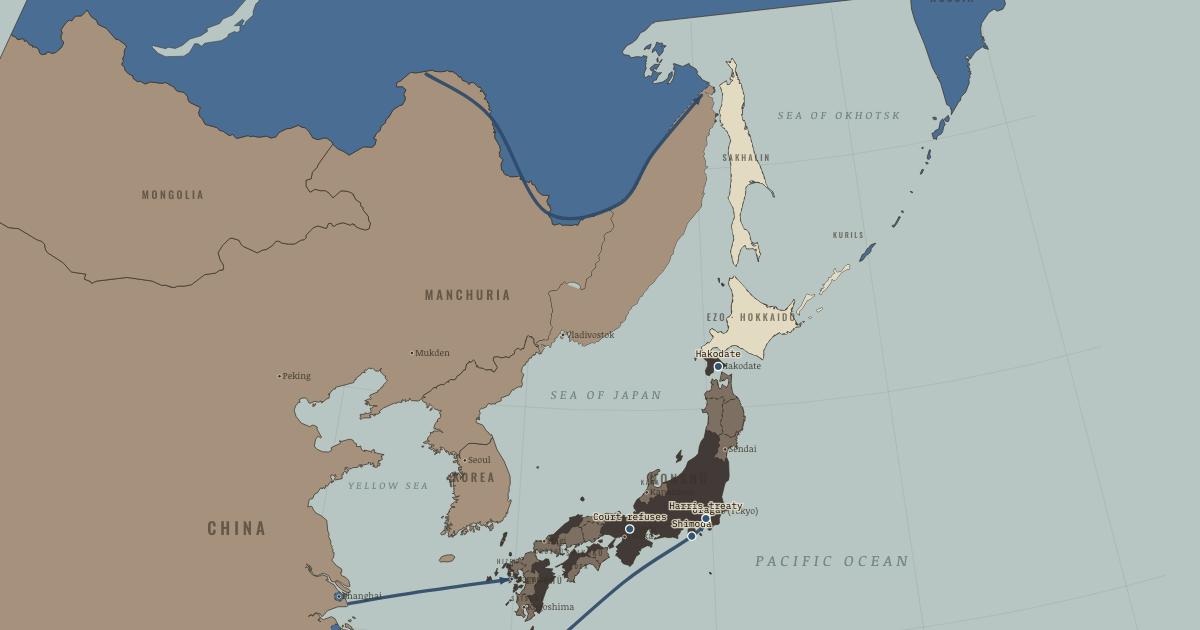
Perry’s squadron forced the shogunate, the shogun’s military government in Edo, today’s Tokyo, into decisions that exposed how its power worked, although its guns never fired in anger. The United States wanted coal for steamships crossing the Pacific to China, safety for American whalers in Japanese waters, and trade, and Perry refused to go to Nagasaki, where foreigners were supposed to be received. A month later a Russian squadron under Admiral Putyatin reached Nagasaki, the arrow from the west, so the shogunate faced two powers at once. The senior councillor Abe Masahiro then did something no shogunal government had done: he sent the American letter to the daimyo, the 260-odd lords who ran their own domains much as governors run semi-independent states, and to the emperor’s court in Kyoto, and asked for their opinions. Most lords advised refusal or delay, and none could offer a fleet, so in 1854 the shogunate signed at Kanagawa, opening Shimoda and Hakodate for supplies. By asking for advice, the shogunate admitted that it could no longer decide foreign policy alone.
The short answer
- Steam and the Pacific brought America to Japan. The United States had gained California in 1848 and wanted a steamship route to China, which needed coaling stations on the way. American whaling fleets worked the waters off Japan, and sailors wrecked there were sometimes imprisoned. These interests made Japan a stop on a commercial highway for the first time. Perry’s mission was a product of the steam age: his two steamers could ignore the winds that had kept sailing ships at the mercy of Japan’s coast for centuries.
- A government without a navy could only delay. The divided state described in chapter 1 had no fleet, no national army and no means to pay for either quickly. Abe’s officials built batteries on artificial islands in Edo Bay after 1853, but they knew that Chinese forts had been destroyed by ships like Perry’s. Refusal meant war and war meant defeat, so the only open question was how much to concede and how to explain it. The shogunate’s weakness turned diplomacy into a choice between humiliations.
- Consultation widened the circle of decision-makers. By asking the daimyo and the court for advice in 1853, Abe hoped to share responsibility for an unpopular decision. Instead he taught the outer lords and the court that they had a legitimate voice in national policy, which they had been denied since 1600. Once the court was asked, its refusal in 1858 carried weight. A consultation meant to strengthen the government created the alternative authority that would replace it.
- A succession quarrel turned diplomacy into a feud. The question of who would succeed the heirless shogun Iesada split the elite in 1857–58. Reforming lords, including Satsuma’s Shimazu Nariakira and Mito’s Tokugawa Nariaki, backed Hitotsubashi Yoshinobu; the conservative officials around Ii Naosuke backed a twelve-year-old from the Kii branch. Because the same men disagreed about the treaty, foreign policy and the succession became one fight, and Ii’s victory on both turned his rivals into enemies of the shogunate itself.
THE TURNING POINT
The Harris treaty signed, 29 July 1858. Signing the Harris treaty without the emperor’s approval is the hinge because it converted a diplomatic retreat into a crisis of legitimacy. Until then the shogunate could claim to rule on the emperor’s behalf; now it had openly defied him. Ii then deepened the break with the Ansei Purge, in which great lords were confined and young activists such as the Chōshū teacher Yoshida Shōin were executed. On 24 March 1860 samurai, most of them from Mito, killed Ii outside the Sakurada Gate of Edo Castle, and the shogunate never again recovered the authority he had spent.
What it changed
Terror entered politics. Ii’s assassination opened a decade in which young samurai calling themselves “men of high purpose” (shishi) murdered officials and foreigners in the emperor’s name. Political violence became a way to force decisions on governments that could not keep order. The movement drew many of its members from Chōshū, Tosa and Satsuma, the domains that would lead the next stage.
Kyoto became a second capital. After 1858 lords and activists flocked to Kyoto, and the court, powerless for two and a half centuries, became a centre of decision. The shogunate itself tried to repair its standing by marrying the emperor’s sister to the young shogun in 1862. Every policy now needed two approvals, and the emperor’s approval carried the moral weight.
Open ports remade prices and livelihoods. Yokohama grew from a fishing village into Japan’s main trading port, and raw silk became the country’s largest export. Silk-raising districts prospered while urban workers and samurai lost to inflation. The trade also gave Japanese merchants and officials their first close look at Western commerce, knowledge that the Meiji state would later use to build industry.
Russia’s advance redrew the north. By the Treaty of Aigun in 1858 and the Treaty of Peking in 1860, Russia took from China the lands north of the Amur and east of the Ussuri, and founded Vladivostok, whose name means “ruler of the East”. In 1861 a Russian warship occupied part of Tsushima for six months. Fear of Russia would shape Japanese strategy for half a century, through Korea to the war of 1904.
The full answer, argued
The economic case is substantial: fixed tariffs denied the government customs revenue and protection for new industries until 1911, the gold drain and export boom drove inflation, and extraterritoriality placed foreigners beyond Japanese law. Yet the economic losses were manageable compared with China’s, and trade also brought new wealth to silk districts and merchants. The political consequences were larger and faster. Signing without the emperor’s approval made the shogunate look disloyal, the purge that followed made enemies of the most capable lords, and within ten years the shogunate was gone. Historians such as W. G. Beasley therefore see the treaties above all as a political catalyst, whose economic harm was real yet manageable. The economic terms framed Meiji Japan’s long campaign for equality, while the political crisis decided who would wage it. The lesson that transfers is that a government’s concessions to outside pressure can do their greatest damage to the belief that it has the right to rule.
An interesting fact
Among Perry’s gifts in 1854 was a working miniature steam railway, with an engine, a carriage and a circle of track laid out near Yokohama. The carriage was built for children, so the Japanese officials who tried it rode clinging to its roof, robes flying, at about twenty miles an hour, a scene recorded in Perry’s official narrative. The Americans also strung a telegraph line about a mile long. The Japanese side answered with silks, lacquer and a display by sumo wrestlers who carried heavy rice bales with ease, a reminder that both delegations were staging power for the other.
This is the study layer of Black Ships and the opening of Japan, chapter 2 of Remaking the State: Meiji Japan 1600–1912 and Post-Soviet Russia 1964–2000; the full index of the atlas is here.
Related questions
THE FREE PRINTABLE STUDY GUIDE
Join the Dispatch — a short welcome series, then a letter when a new atlas opens — and the printable study guide for Remaking the State is yours now, free.
NO TRACKING · YOUR ADDRESS IS USED FOR THE DISPATCH AND NOTHING ELSE · UNSUBSCRIBE ANYTIME