Meiji Japan and post-Soviet Russia · 1877
Why did Meiji centralisation cost so little blood?
The seminar question: “Why did Japan’s centralising revolution of 1871–77 cost so much less blood than most revolutions that remove an entire ruling class?”
The Charter Oath of April 1868 promised assemblies, but Japan’s new leaders put central power first: the lords surrendered their land registers in 1869, and on 29 August 1871 the domains were replaced by prefectures under governors from Tokyo. The state gained one army, one tax and one school system.
Chapter 4 is part of membership. WW2 is free — every chapter. Try chapters 1–2 of any 2 other atlases (3 with a free account). Opening a new atlas uses one of them. Membership opens all 21 — Join.
Free printable Meiji Japan and post-Soviet Russia study guide, sent by email ↓
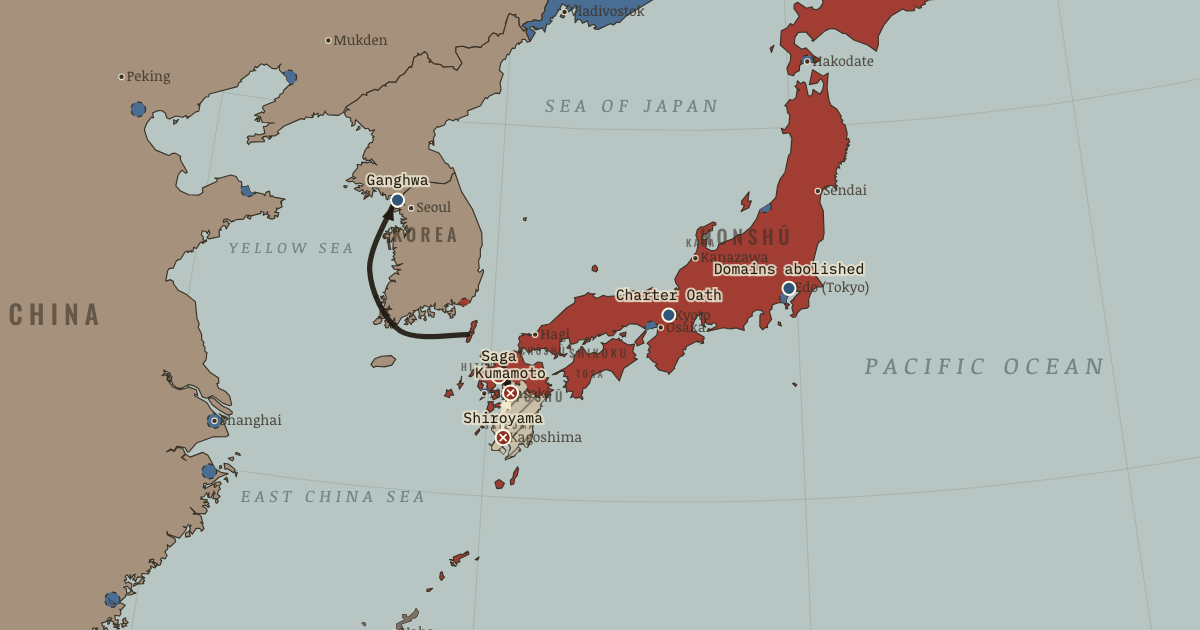
The new government promised participation in principle and built central authority in practice. The Charter Oath, a five-article statement of aims sworn by the fifteen-year-old emperor in April 1868, worked like a manifesto written by former samurai, the hereditary warrior class. It pledged that assemblies would be convened and “all matters decided by public discussion”, that the “base customs of the past” would be broken and that knowledge would be sought throughout the world. Its vague promise of assemblies reassured the lords, while its last articles licensed sweeping change. In 1869 the lords, led by Satsuma, Chōshū, Tosa and Hizen, handed their land and population registers to the emperor. The daimyo, the hereditary lords of the domains, stayed on as appointed governors of their old lands with a tenth of the domain’s revenue as household income, much as a nationalised company might keep its former owners on salary. These steps looked like a formality and established the principle that every acre and every person in Japan belonged to the state.
The short answer
- The domains kept the new state weak. After 1868 the new government still depended on the domains for soldiers and revenue, ruling directly only the confiscated shogunal lands. Its leaders, many of whom had travelled abroad or read Western works, could see that the nation-states threatening Japan raised national taxes and national armies. As long as more than 260 lords kept their own samurai and rice taxes, the government could not build either. The logic of the restoration pointed to abolition from the start.
- The unequal treaties made centralisation urgent. The treaties of 1858 could be revised from 1872, and Japan’s leaders believed that the Western powers would only accept Japan as an equal once it had modern laws, courts and armed forces. That required a single government that could legislate for the whole country. Foreign pressure thus provided both a motive for centralisation and a patriotic argument that even reluctant lords found hard to oppose.
- Many domains were bankrupt. Decades of borrowing, the costs of alternate attendance and the military expenses of the 1860s had left many domains deeply in debt to Osaka merchants and issuing paper money of doubtful value. When the government offered to assume these obligations and guarantee the lords an income, abolition became a rescue as much as a confiscation. The fiscal weakness of the old order made its peaceful dissolution possible.
- The state needed a fixed money income. Under the domains, taxes were collected in rice at rates that varied from place to place and year to year, so no central government could budget. The new leaders needed predictable cash to pay for an army, schools, railways and the samurai stipends they had inherited, which consumed roughly a third of government spending in the early 1870s. A national land tax in money, set on assessed value, was the answer, and it could only be imposed once the domains were gone.
THE TURNING POINT
The domains abolished, 29 August 1871. This is the hinge of Japan’s whole transition, because it changed how the country was governed, which the restoration of 1868 had not yet done. In one afternoon the decree ended a system of semi-independent lordships nearly three centuries old and made possible everything that followed: a national army, a national tax, national schools and a national market. On the map it is the moment the grey-tan patchwork of 1869 becomes a single colour, and in the history of the transition it is the moment a change of rulers became a change of state.
What it changed
One army, one tax, one school system. With the domains gone, the government issued the Education Ordinance of 1872, which aimed at compulsory primary schooling for boys and girls, followed by conscription and the land tax in 1873. These measures built a direct link between the state and every household for the first time. They also created a large, literate and obedient conscript population that the Meiji state would mobilise for industry and war.
Opposition moved from swords to petitions. The defeat of 1877 ended armed resistance by the samurai. Former samurai such as Itagaki Taisuke of Tosa had already petitioned in 1874 for an elected assembly, and after Saigō’s death the Freedom and People’s Rights movement grew into a national campaign of newspapers, speeches and political societies. The government’s critics now demanded a share of power through a constitution.
Japan began to push outward. In the same years the government sent an expedition to southern Taiwan in 1874, fixed its northern border with Russia in 1875 by exchanging its claim to Sakhalin for all the Kurils, and in 1876 forced Korea to open its ports. The red dot at Busan on the map is Japan’s first settlement imposed on a neighbour. Japan was already treating Korea as the West had treated Japan.
The full answer, argued
The leaders bought out the most powerful losers: the lords received debt relief, titles and incomes, and the samurai kept their stipends long enough for the change to settle. They used the emperor’s authority to make resistance look disloyal, they acted quickly and in unity, and a credible army stood behind each step. Many domains were also bankrupt, so abolition relieved more than it robbed. Yet the revolution was far from costless. Thousands died in the samurai revolts and perhaps 12,000 or more in the Satsuma Rebellion alone, and peasants paid in riots, conscription and taxes that historians such as Stephen Vlastos have documented. A strong answer weighs these costs against the speed and scale of the change, and it notes that the costs fell on those who could not bargain. The transferable lesson is that transitions go most smoothly when the powerful are compensated, and that the price is usually shifted onto those without that bargaining power.
An interesting fact
No confirmed photograph of Saigō Takamori exists, so his famous image was drawn after his death from his relatives’ features. He was pardoned in 1889, twelve years after dying as a rebel, and in 1898 a bronze statue was unveiled in Tokyo’s Ueno Park showing him in a plain cotton kimono, walking his dog. At the unveiling his widow, Itoko, is reported to have protested that her husband had never looked like that in public. The rebel of 1877 had become a national hero, honoured by the state he had fought.
This is the study layer of Early Meiji reforms (1868–77), chapter 4 of Remaking the State: Meiji Japan 1600–1912 and Post-Soviet Russia 1964–2000; the full index of the atlas is here.
Related questions
THE FREE PRINTABLE STUDY GUIDE
Join the Dispatch — a short welcome series, then a letter when a new atlas opens — and the printable study guide for Remaking the State is yours now, free.
NO TRACKING · YOUR ADDRESS IS USED FOR THE DISPATCH AND NOTHING ELSE · UNSUBSCRIBE ANYTIME