Meiji Japan and post-Soviet Russia · 1868
Was the Meiji Restoration made by ideas, guns or mistakes?
The seminar question: “Was the Meiji Restoration made by ideas, by guns, or by the shogunate’s own mistakes?”
Within ten years of the 1858 treaties the shogunate fell, as opponents rallied under “revere the emperor, expel the barbarians”. After Western fleets bombarded Kagoshima and Shimonoseki in 1863–64, Satsuma and Chōshū turned to modern arms, and the decisive battle came at Toba–Fushimi in January 1868.
Chapter 3 is part of membership. WW2 is free — every chapter. Try chapters 1–2 of any 2 other atlases (3 with a free account). Opening a new atlas uses one of them. Membership opens all 21 — Join.
Free printable Meiji Japan and post-Soviet Russia study guide, sent by email ↓
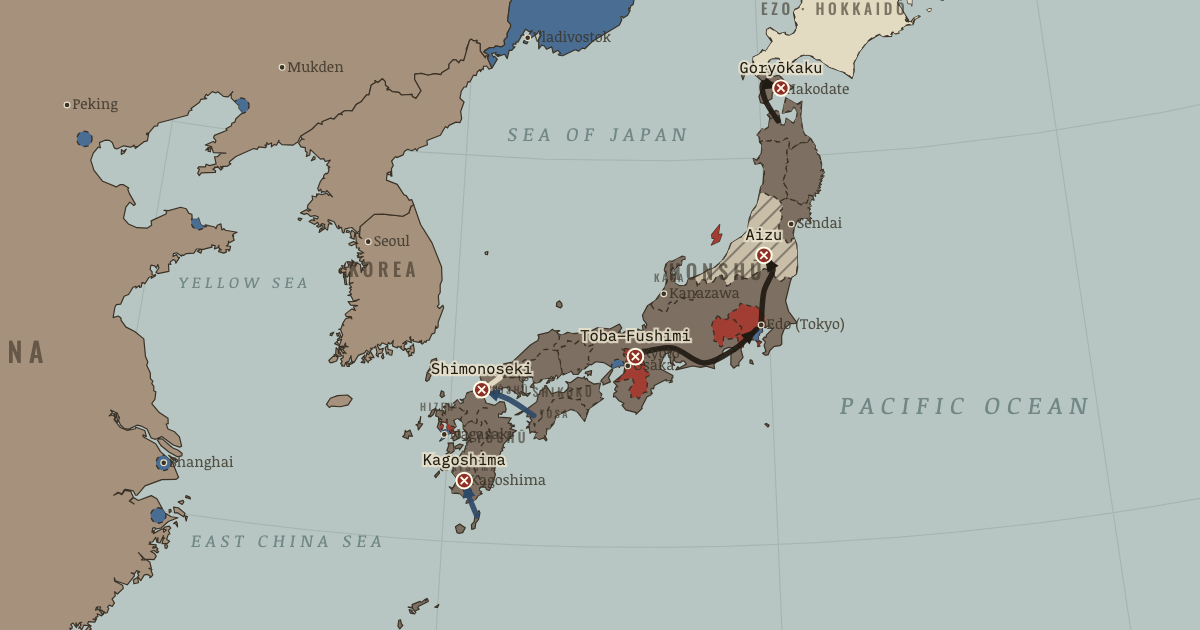
Terror and the emperor’s name gave the opposition its power after 1860. The young activists known as shishi, “men of high purpose”, were mostly samurai, members of the hereditary warrior class, from Chōshū, Tosa and Satsuma, outer domains whose lords ran them almost like independent states, and much like the student radicals of later revolutions they assassinated officials they called traitors and foreigners they called barbarians. Because whoever controlled the powerless court could issue orders in the emperor’s name, Chōshū’s leaders took over the court’s politics in Kyoto and pushed the emperor to order the expulsion of foreigners by 25 June 1863. Chōshū obeyed by firing on ships in the strait at Shimonoseki, while Satsuma faced Britain over the killing of a British merchant at Namamugi. The Western powers punished them swiftly. A British squadron burned much of Kagoshima in August 1863, and in September 1864 an allied Western fleet silenced Chōshū’s batteries in two days. Expulsion had been tested against the most powerful navies in the world, and the domains most committed to it were the first to learn that it could not work.
The short answer
- The emperor gave the opposition a higher loyalty. Once the court had refused the 1858 treaty, the shogun could be cast as disobedient to the emperor, and loyalty to the throne became a reason to defy him. The Mito school’s ideas about national unity around the emperor, written to strengthen the shogunate, became the activists’ creed. Because the emperor had no army of his own, whoever controlled the court could speak in his name, and this made Kyoto the prize of the 1860s.
- Defeat turned the expellers into modernisers. Satsuma and Chōshū were the domains most committed to expelling foreigners, and in 1863–64 they were the ones Western navies punished. The bombardments of Kagoshima and Shimonoseki showed their leaders that coastal guns and samurai swords could not stop steam warships. They kept the goal of a strong, independent Japan and changed the method, buying ships and rifles and sending students secretly to Britain. Defeat made them the most realistic actors in Japanese politics.
- Chōshū recruited beyond the samurai. The Kiheitai and similar units, founded in 1863, enlisted farmers, merchants and townsmen alongside samurai and trained them in Western drill. This gave Chōshū an army larger and more motivated than its samurai alone could provide, and it allowed the reformers to win the domain’s own civil war in 1865. In 1866 these soldiers defeated a far larger shogunal army. A domain that broke the rule of birth in its army found it could beat a government that still respected that rule.
- The shogunate’s late reforms alarmed its rivals. The shogunate’s own late reforms hastened its fall, because they convinced Satsuma and Chōshū that time was running against them. Under Yoshinobu it began modernising quickly, with French officers training its troops and plans for a stronger central administration, so a reformed shogunate might soon be too strong to overthrow. Yoshinobu’s return of power in November 1867 was meant to keep him at the head of a new council of lords, and his rivals’ coup of January 1868 was designed to stop exactly that.
THE TURNING POINT
Toba–Fushimi, 27–30 January 1868. The coup of 3 January was a palace manoeuvre that could have been reversed; the battle south of Kyoto made it permanent. When the court gave Satsuma and Chōshū the imperial brocade banner, the shogun’s troops became rebels against the throne, and several domains changed sides during the fighting. Yoshinobu fled to Edo by sea and then refused to fight on. Within weeks most of the country’s lords had declared for the court, which is why the map’s red and grey-tan spread so quickly while the hatch stays confined to the north.
What it changed
Edo surrendered and was renamed Tokyo. The negotiated handover of Edo Castle in May 1868 saved a city of about a million from a siege. In September the city was renamed Tokyo, “eastern capital”, and the young emperor moved there the following year. The new government thus took over the shogunate’s capital, its administrators and its archives intact, which made it far easier to govern the country from the old centre.
The victors ruled through domain cliques. Leadership of the new government came overwhelmingly from Satsuma and Chōshū, with Tosa and Hizen as junior partners. Men such as Ōkubo, Kido, Saigō, Itō and Yamagata would dominate politics for decades, a pattern critics called “clique government”. This small, tested group gave the new state a coherent leadership, and it also bred resentment among everyone outside it.
The domains survived the war that ended the shogunate. The restoration removed the shogun and left more than 260 domains in place, including those of the victors. The new government ruled directly only the confiscated shogunal lands, the red patches on the map, and it had to bargain with the lords for soldiers and revenue. Its leaders soon concluded that Japan could not become a strong state while the domains existed, which set up the second, more radical revolution of 1871.
The full answer, argued
Ideas mattered because they supplied legitimacy: the cult of the emperor allowed a few domains to present a seizure of power as loyalty, and it made other lords reluctant to fight the imperial banner. Guns and organisation decided the battles of 1866 and 1868, where Chōshū’s mixed-class infantry and Satsuma’s modern equipment beat larger forces. The shogunate’s mistakes opened the door, from Ii’s treaty without imperial approval to the failed expedition of 1866. Historians weight these differently: Marxists stressed social forces, Beasley the ambitions of lower samurai, Totman the shogunate’s own reforms and errors. A strong answer argues that ideas made the challenge legitimate, the shogunate’s weakness made it possible, and military organisation made it succeed, and that without any one of the three the outcome would have been different. The transferable insight is that old regimes usually fall when a rival can claim a higher legitimacy and also field a force willing to act on the claim.
An interesting fact
The last shogunal holdouts in Hakodate set up what they called the Republic of Ezo, and in January 1869 its officers voted to choose their leaders, electing the naval commander Enomoto Takeaki as president. The vote is often described as the first election held in Japan. Among Enomoto’s advisers was a French artillery officer, Jules Brunet, who had resigned from the French military mission to stay with his Japanese students. After the surrender Enomoto was imprisoned, pardoned in 1872, and went on to serve the Meiji government as envoy to Russia and as a cabinet minister.
This is the study layer of Meiji Restoration and Boshin War, chapter 3 of Remaking the State: Meiji Japan 1600–1912 and Post-Soviet Russia 1964–2000; the full index of the atlas is here.
Related questions
THE FREE PRINTABLE STUDY GUIDE
Join the Dispatch — a short welcome series, then a letter when a new atlas opens — and the printable study guide for Remaking the State is yours now, free.
NO TRACKING · YOUR ADDRESS IS USED FOR THE DISPATCH AND NOTHING ELSE · UNSUBSCRIBE ANYTIME