Meiji Japan and post-Soviet Russia · 1889
Did the Meiji constitution advance or prevent democracy?
The seminar question: “Was the Meiji constitution a step towards democracy or a device to prevent it?”
Between 1877 and 1894 Japan’s leaders built a modern state in sequence, economy and army first and a constitution after. The Iwakura Mission studied the West, state factories such as the Tomioka silk mill were sold to the zaibatsu, and the constitution was promulgated on 11 February 1889.
Chapter 5 is part of membership. WW2 is free — every chapter. Try chapters 1–2 of any 2 other atlases (3 with a free account). Opening a new atlas uses one of them. Membership opens all 21 — Join.
Free printable Meiji Japan and post-Soviet Russia study guide, sent by email ↓
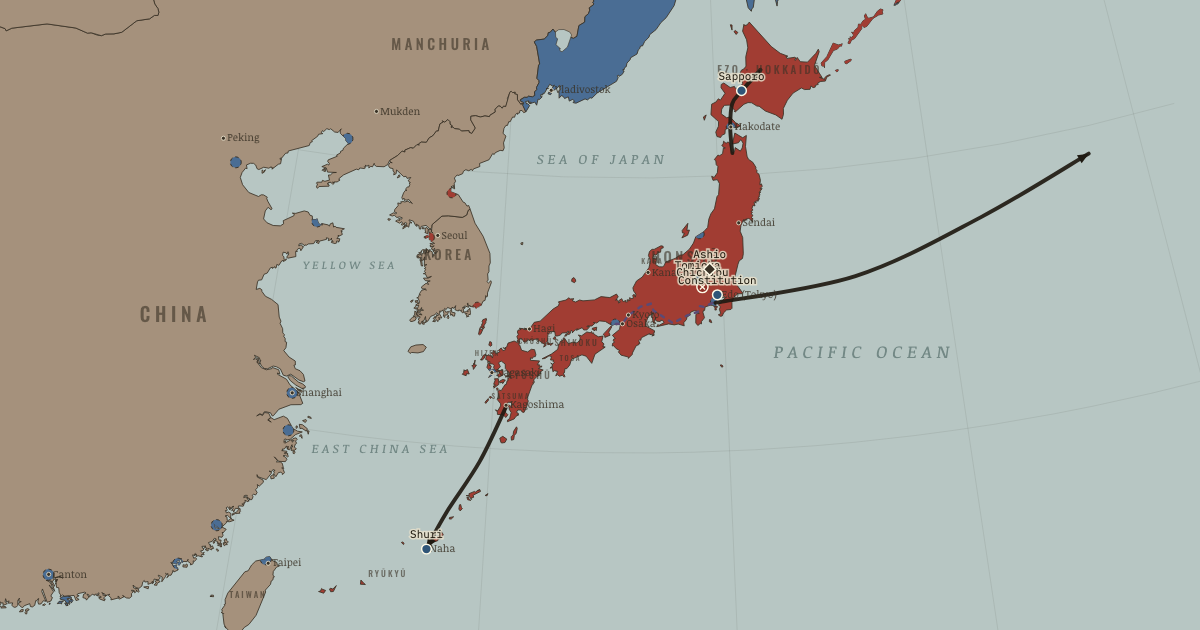
Japan’s builders were a small, stable group who learned systematically from abroad, and that combination explains much of their success. The Iwakura Mission of 1871–73 took about half the government’s leaders, including Ōkubo Toshimichi, Kido Takayoshi and the young Itō Hirobumi, on a tour of America and Europe. It failed to revise the treaties and returned convinced that Japan needed factories, schools and laws before it could demand equality. The government employed foreign experts, sent students abroad and copied selectively: a navy on British lines, an army on French and later German lines, and schools on American and French models. After Ōkubo was assassinated in 1878, power passed to a circle later called the genrō, the elder statesmen, an unelected inner council something like a permanent board of senior partners, among them Itō, Yamagata Aritomo and Matsukata. They took turns as prime minister for thirty years, which gave the state a continuity of purpose that few governments in transition enjoy.
The short answer
- The Iwakura Mission taught that strength must come first. The mission set out in 1871 to begin revising the unequal treaties and was told politely that Japan’s laws and institutions were not yet acceptable to the Western powers. Its members saw factories in Manchester, railways in America and Bismarck’s Germany, and they returned believing that a strong economy and army had to come before equality. That conviction set the order of the reforms that followed.
- Inflation forced financial discipline. The government paid for the Satsuma Rebellion largely by printing paper money, and by 1880 prices were rising fast and the currency was losing credibility. Matsukata Masayoshi, finance minister from 1881, chose deflation: higher taxes, lower spending, a central bank and convertible notes. The policy stabilised the yen and the budget, and it pushed many farmers into debt and tenancy, which is why Chichibu’s silk farmers rose in 1884.
- A popular movement demanded a voice. Former samurai, rich farmers and urban journalists built the Freedom and People’s Rights movement after 1874, holding meetings and drafting dozens of private constitutions. By 1880 petitions for an assembly were arriving in Tokyo from every region. The movement could not take power, yet it made a constitution unavoidable, and the oligarchs chose to write one themselves before their critics could write it for them.
- Treaty revision required a legal order the West would accept. Western governments refused to give up extraterritoriality until Japan had codes of law and courts that met their standards. A written constitution, a cabinet, a criminal code and a civil code were therefore instruments of foreign policy as well as domestic ones. Each institution the oligarchs built also served as evidence in Japan’s case for equality.
THE TURNING POINT
The constitution, 11 February 1889. The promulgation is the hinge because it fixed the rules of Japanese politics for more than half a century, until 1947. It made Japan the first Asian state with a lasting written constitution and an elected parliament, which helped persuade Britain to give up extraterritoriality in 1894. It also wrote into law the ambiguities that would matter later: a sovereign emperor who did not govern, ministers responsible to him alone, and armed forces answerable to no civilian. The ceremony itself, held in the new palace in Western dress, showed the state’s intention to look modern while remaining in control.
What it changed
Treaty revision became possible. In July 1894 Britain signed a treaty agreeing to end extraterritoriality from 1899, and the other powers followed. The new constitution, cabinet system and legal codes had given the West the institutional evidence it demanded. Full control of tariffs followed in 1911, completing the escape from the unequal treaties that had begun with Perry’s ships.
Parties won a foothold in the state. From the first Diet in 1890 the elected lower house fought the cabinet over the budget, and the oligarchs found they could not govern without some cooperation from the parties. The franchise widened in 1900 and again in 1919, and in 1925 all adult men gained the vote. The limited parliament of 1890 became the seed of the party governments of the 1920s.
A state ideology entered every classroom. The Rescript on Education of 1890 was read aloud in schools on national holidays, and pupils bowed before the emperor’s portrait. In 1891 the Christian teacher Uchimura Kanzō was forced from his post after hesitating to bow deeply enough before the Rescript. The ideology of loyalty to the emperor, taught to a literate conscript nation, would be mobilised in the wars that followed.
The full answer, argued
The case that it prevented democracy is strong: it was granted from above without any assembly’s approval, it made the emperor sovereign and ministers answerable to him, it gave the vote to about 1% of the population, and its clause on supreme command let the army escape civilian control in the 1930s. Yet the case that it advanced democracy is also real. The control that the Diet, Japan’s new parliament, held over new budgets gave elected politicians leverage, the oligarchs had to bargain with parties within a decade, and the electorate grew until all men could vote in 1925. Historians such as Carol Gluck show that the same document supported both an ideology of obedience and a lively public politics. A good answer argues that the constitution was designed to contain participation and that, once participation had legal channels, it grew beyond its designers’ intentions. The lesson that transfers is that institutions created to limit change can become the means by which later generations demand more of it.
An interesting fact
The youngest member of the Iwakura Mission was a six-year-old girl, Tsuda Umeko, one of five girls sent to be educated in the United States at government expense; her father, Tsuda Sen, a former shogunate interpreter turned agricultural reformer, had volunteered her. She lived with an American family in Washington, returned to Japan in 1882 barely able to speak Japanese, and later studied biology at Bryn Mawr College. In 1900 she founded a school for women that became Tsuda University, and in 2024 her portrait appeared on Japan’s new 5,000-yen banknote.
This is the study layer of Meiji Constitution and modernisation, chapter 5 of Remaking the State: Meiji Japan 1600–1912 and Post-Soviet Russia 1964–2000; the full index of the atlas is here.
Related questions
THE FREE PRINTABLE STUDY GUIDE
Join the Dispatch — a short welcome series, then a letter when a new atlas opens — and the printable study guide for Remaking the State is yours now, free.
NO TRACKING · YOUR ADDRESS IS USED FOR THE DISPATCH AND NOTHING ELSE · UNSUBSCRIBE ANYTIME