Meiji Japan and post-Soviet Russia · 1842
Was the Tokugawa order already collapsing before 1853?
The seminar question: “Was the Tokugawa order already collapsing before 1853, or did the outside world break a system that still worked?”
After Sekigahara in 1600 the Tokugawa shogunate gave Japan some 250 years without civil war, ruling a quarter of the country directly and binding about 260 daimyo through alternate attendance. Peace brought growth and a national market, while the Treaty of Nanking of 1842, imposed on China by Britain, showed the danger outside.
WW2 is free — every chapter. Try chapters 1–2 of any 2 other atlases (3 with a free account). Opening a new atlas uses one of them. Membership opens all 21 — Join.
Free printable Meiji Japan and post-Soviet Russia study guide, sent by email ↓
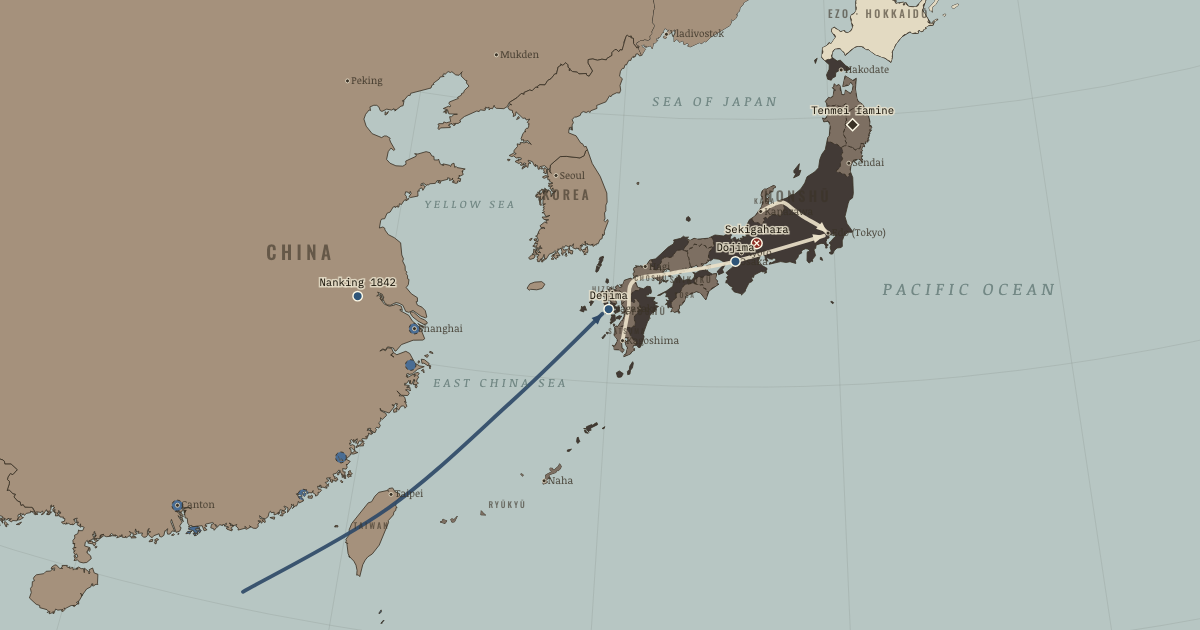
The Tokugawa order was designed to make another civil war impossible, and the map shows how it did so. After his victory at Sekigahara in 1600, Tokugawa Ieyasu became shogun in 1603, a hereditary general ruling behind a powerless emperor, much like a strongman behind a figurehead king, and he redistributed the land. His own house and the fudai lords, families who had served the Tokugawa before 1600 like a ruler’s trusted inner circle, took the strategic centre around Edo, Kyoto and Osaka, all in charcoal. The lords who had fought him or joined him late, the tozama or “outer” lords such as the Shimazu of Satsuma and the Mōri of Chōshū, kept large domains on the edges, in grey-tan, but were shut out of national office. Alternate attendance, the rule from 1635 that each lord live every other year in Edo, the shogun’s capital and today’s Tokyo, then tied the lords to the centre, because the processions and a permanent mansion swallowed much of each domain’s income. The result was 250 years without civil war, bought by watching the lords and leaving the government of most Japanese to them.
The short answer
- Sekigahara settled who ruled and left the losers in place. Ieyasu won in 1600 but could not destroy every enemy, so he cut their lands and left them armed on the edges of the country. The Mōri of Chōshū lost most of their eight provinces and kept two; the Shimazu of Satsuma kept their whole domain far to the south-west. These outer lords nursed their grievances for 250 years, and their remoteness gave them room to build armies and treasuries the shogunate could not inspect. The settlement that made peace in 1600 also placed the future rebels exactly where they would be hardest to control.
- Alternate attendance bought loyalty by draining the lords. From 1635 every daimyo spent alternate years in Edo with a large retinue and kept his wife and heir there permanently. The processions and mansions consumed a large share of domain revenue, so few lords could afford to rebel. The same rule built highways, inns and a national market, and it made Edo one of the largest cities in the world. The system worked as a political brake, yet it pushed the domains into debt to the merchants and left them with little money for defence when the need arrived.
- A divided state had no national army or tax. The shogun taxed only his own lands, and each daimyo kept his own samurai and his own rice tax. That arrangement suited a country whose main danger was internal war. Against a foreign navy it was close to useless, because no one could raise money from the whole country or command all its soldiers. When the reformer Mizuno Tadakuni tried to bring the land around Edo and Osaka under direct shogunal control in 1843, the lords and bannermen affected forced him out within months. The shogunate could not even reorganise its own heartland.
- Controlled contact gave knowledge without power. Dejima, the Dutch news reports and the scholars of Dutch learning kept Japan’s elite unusually well informed about Western science and Western wars. By the 1840s officials knew how Britain had beaten China and what steam warships could do. Knowledge alone could not build a navy, however, because the money and the soldiers belonged to the domains. The result was a ruling class that understood its danger earlier than most of Asia and still lacked the machinery to act on what it understood.
THE TURNING POINT
The Treaty of Nanking, 29 August 1842. China’s defeat is the hinge of this chapter because it turned an abstract danger into a concrete precedent. Japan’s rulers had read about Western power for decades; now they watched the region’s greatest state lose a war, pay 21 million silver dollars, hand over Hong Kong and open five ports to British merchants, who a year later won the right to be tried under their own law. Already alarmed by reports of British victories, the shogunate cancelled its 1825 order to fire on foreign ships in the same weeks, which was a sensible step and also an admission that it could not fight. The blue dots that appear on China’s coast are a preview of what Japan’s own map would look like within twenty years.
What it changed
Caution replaced preparation. After 1842 the shogunate chose to avoid provocation, offering fuel and water to foreign ships, and it rejected a Dutch royal letter of 1844 urging it to open the country on its own terms. Coastal batteries were built in places, but no navy and no national tax followed. When Perry arrived in 1853, the government faced him with the same divided machinery it had in 1842.
An emperor-centred nationalism was already taking shape. Scholars of the Mito school, above all Aizawa Seishisai, argued that Japan needed spiritual unity around the emperor to resist the West, and they coined the slogan of “revering the emperor and expelling the barbarians”. The idea was meant to strengthen the shogunate, yet it placed loyalty to the emperor above loyalty to the shogun. Within twenty years it would be turned against the house it was written to defend.
The rim domains reformed their finances first. While the shogunate’s reforms stalled, the two great outer domains repaired their treasuries in the 1830s and 1840s. Satsuma’s Zusho Hirosato cleared enormous debts partly through a sugar monopoly worked by islanders in Amami and partly through the trade it ran through Ryukyu, and Chōshū’s Murata Seifū rebuilt its finances and trade. Twenty years later these were the domains that could afford Western ships and rifles, which is why the revolution came from the edge of the map.
The full answer, argued
The case for internal collapse rests on real evidence: domains and samurai sank into debt, peasant protests grew more frequent after 1750, famines killed hundreds of thousands, and Ōshio’s rising showed discontent inside the ruling class itself. Marxist historians in Japan long argued that feudalism was decaying from within. The case for resilience is also strong, because no lord challenged the shogun for 250 years, the economy grew, and the order survived every famine and protest it faced. Most historians, including Marius Jansen and Conrad Totman, now treat the internal strains as the cause of vulnerability and the foreign threat as the trigger. The strains decided how badly the system would handle a shock, and the shock decided when it would have to. The same question returns in this atlas’s second half, where historians argue whether the Soviet system was dying in 1985 or was killed by the attempt to reform it. The transferable lesson is that old orders rarely fall from internal weakness alone, yet internal weakness determines how hard they fall when pressure arrives from outside.
An interesting fact
One of the best European descriptions of Tokugawa Japan came from a German doctor working for the Dutch, Engelbert Kaempfer, who travelled with the Dutch mission to Edo in 1691 and 1692. At the shogun Tsunayoshi’s court he and his Dutch colleagues were ordered to walk, dance, jump, sing, play the drunkard and speak broken Japanese while the shogun and his ladies watched from behind a lattice; Kaempfer added a German love song to his dance. His posthumous History of Japan (1727) remained Europe’s fullest account of the country for more than a century, and it showed readers a ruler who could make foreign envoys perform for him at will.
This is the study layer of Tokugawa shogunate and sakoku, chapter 1 of Remaking the State: Meiji Japan 1600–1912 and Post-Soviet Russia 1964–2000; the full index of the atlas is here.
Related questions
THE FREE PRINTABLE STUDY GUIDE
Join the Dispatch — a short welcome series, then a letter when a new atlas opens — and the printable study guide for Remaking the State is yours now, free.
NO TRACKING · YOUR ADDRESS IS USED FOR THE DISPATCH AND NOTHING ELSE · UNSUBSCRIBE ANYTIME