Stalin’s Soviet Union · 1956
Was Stalinism made by one man or by the Soviet system?
The seminar question: “Was Stalinism the creation of one man, or of the Soviet system and society?”
After Stalin died in March 1953, his successors amnestied about 1.2 million prisoners, declared the Doctors’ Plot invented and began to dismantle the camps, while prisoners struck at Norilsk, Vorkuta and Kengir. In February 1956 Khrushchev’s Secret Speech denounced Stalin’s cult of personality.
Chapter 12 is part of membership. WW2 is free — every chapter. Try chapters 1–2 of any 2 other atlases (3 with a free account). Opening a new atlas uses one of them. Membership opens all 21 — Join.
Free printable Stalin’s Soviet Union study guide, sent by email ↓
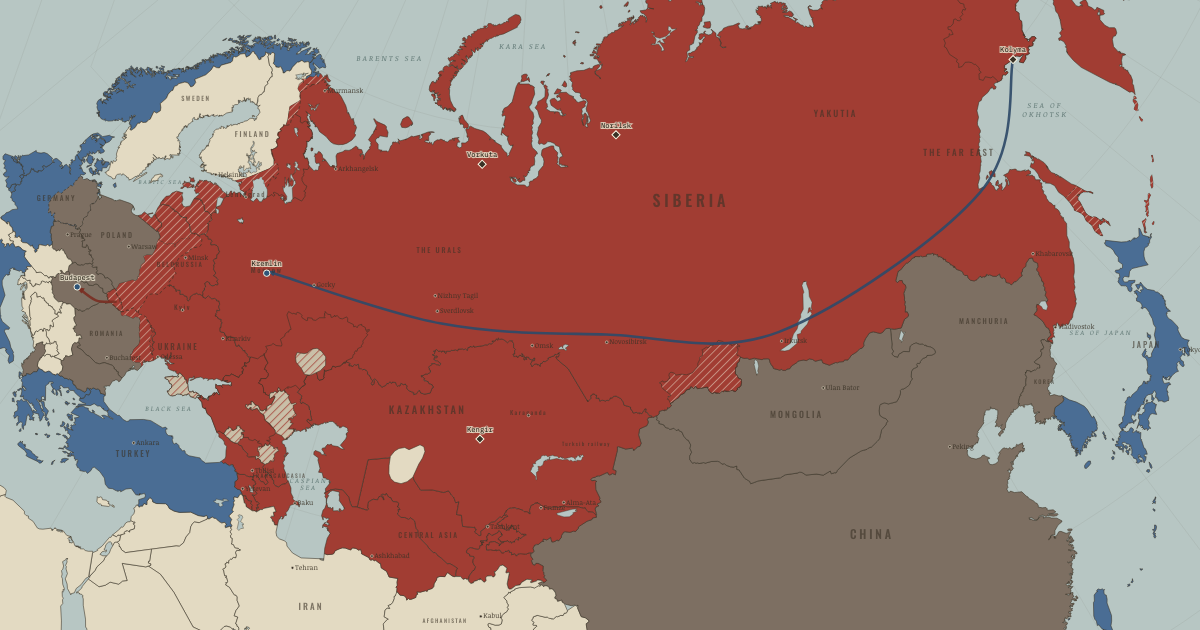
Stalin’s death exposed how his colleagues had experienced his rule. On 1 March 1953 he suffered a stroke at his dacha, or country house, at Kuntsevo outside Moscow and lay for hours before doctors were called, because his guards feared to disturb him; he died on 5 March. His successors, Georgy Malenkov, Beria, Khrushchev, Molotov and Nikolai Bulganin, at once formed a collective leadership, rule by a committee of supposed equals, and moved quickly. The amnesty of 27 March freed about 1.2 million prisoners, mostly those with short sentences, and on 4 April the Doctors’ Plot, the charge that Kremlin doctors had murdered Soviet leaders, was declared a fabrication. In June the others arrested Beria, fearing that his control of the police made him a new Stalin, and he was shot in December. The speed of these changes shows that Stalin’s heirs had wanted reform for years and had not dared to propose it.
The short answer
- The system depended on one man. Stalin had concentrated power so completely that his death removed the force holding the system’s extremes in place. His colleagues had approved and carried out his policies, but they had also feared him and privately doubted many of them. Once he was gone, no one had the authority or the wish to continue mass terror, and a collective leadership replaced personal rule within days, because none of his heirs could claim his authority.
- The Gulag had become too large and too costly. The camp system had grown so large that it cost more than it produced: by 1953 the camps held about 2.5 million prisoners and the special settlements about 2.7 million more. Gulag officials and economic ministers knew that forced labour was unproductive and expensive to guard, and Beria himself proposed cutting it. Releasing prisoners and ending giant projects such as the Arctic railway from Salekhard to Igarka saved money as well as easing fear.
- Prisoners and borderlands had stopped being afraid. Many of the political prisoners of the 1950s were former soldiers and partisans who had fought and were used to organising. Concentrated in special camps, they formed networks across national lines and refused to work when the amnesty passed them by. Their strikes forced the authorities to choose between massacres and reforms; Kengir was crushed by tanks in June 1954, but elsewhere the leadership mostly chose reforms, which showed that the camps could no longer be run by fear alone.
- Stalin’s heirs needed a new legitimacy. Khrushchev and his colleagues had to explain why the system they ran had killed so many loyal communists. Blaming Stalin personally, and dating the crimes from 1934, allowed them to condemn the Terror while keeping the party, collectivisation and the planned economy. The Secret Speech also helped Khrushchev against rivals such as Molotov and Malenkov, who were more closely tied to the worst years, so condemning Stalin served Khrushchev’s own climb as well as the party’s need for a new start.
THE TURNING POINT
The Secret Speech, 25 February 1956. Khrushchev’s speech is the hinge of the epilogue because it turned Stalin from infallible leader into official criminal within the communist world, and because its limits defined everything that followed. By naming the torture of loyal communists and the deportation of nations, it made rehabilitation and the return of prisoners official policy. By leaving out collectivisation and the famines and blaming one man, it protected the system and its leaders. Its effects outran its intentions, reaching Polish and Hungarian streets within months, and Soviet tanks then marked the boundary that the party would not let de-Stalinisation cross.
What it changed
The return of the prisoners. Hundreds of thousands of political prisoners were released between 1954 and 1960, and many were formally rehabilitated, often after death. Their return, which the historian Stephen F. Cohen called “the victims return”, brought survivors face to face with the colleagues and neighbours who had denounced them. Literature such as Solzhenitsyn’s One Day in the Life of Ivan Denisovich (1962) briefly allowed the camps to be described in print.
Restored homelands, for some. The homelands were restored only in part. In 1957 the Chechen-Ingush, Kalmyk, Karachay and Balkar autonomies were restored and their peoples allowed to return. The Volga Germans were cleared of collective guilt in 1964 but never regained their republic, and the Crimean Tatars, whose homeland the 1956 map still hatches, could return only in 1989, which shows how long the state took to admit it had wronged whole nations.
Revolt and repression in the bloc. The speech encouraged reformers in Eastern Europe. In Poland, protests in June 1956 led to the return of Władysław Gomułka without Soviet invasion, but in Hungary a revolution in October was crushed by Soviet forces on 4 November, with about 2,500 Hungarians and 700 Soviet soldiers killed. The crisis showed that de-Stalinisation in the bloc could change leaders but could never be allowed to take a country out of the Soviet alliance.
An unfinished reckoning. Stalin’s body was removed from the Mausoleum in 1961, and cities named after him were renamed, Stalingrad becoming Volgograd. Yet the reckoning stopped short of the system itself, and under Brezhnev criticism was muted again. Only in the late 1980s did the full history of the famines, the Terror and the camps become public, and debate over Stalin’s legacy continues in the states that emerged in 1991.
The full answer, argued
The archives make it impossible to remove Stalin from the centre. He launched collectivisation, approved the famine measures, ordered the Terror and its quotas, signed execution lists and decided the deportations of nations, and his death ended mass terror within weeks. Yet one man could not run a state of 170 million people. The party Lenin built, with its ban on factions and its secret police, gave Stalin his tools, and Marxist-Leninist ideology gave him a language in which class enemies and saboteurs had to be destroyed. Millions of officials, police, activists and neighbours carried out policies, sometimes from conviction, sometimes from fear or ambition. Social historians show that society also shaped Stalinism, through resistance that forced retreats and support that sustained the regime. A strong answer gives Stalin decisive responsibility for the regime’s choices while explaining the structures and people that turned those choices into reality. The transferable insight is that dictatorships are personal in their decisions and collective in their execution, which is why their crimes outlive the dictator in the institutions and memories they leave.
An interesting fact
Stalin did not stay long beside Lenin. After his death his embalmed body was placed in the Mausoleum on Red Square, renamed the Lenin–Stalin Mausoleum. In October 1961, at the Twenty-Second Party Congress, an elderly Bolshevik named Dora Lazurkina, who had spent years in the camps, told the delegates that Lenin had appeared to her in a dream and said he did not like lying next to Stalin. The congress voted to remove the body, and on the night of 31 October it was taken out and buried beside the Kremlin wall under a layer of concrete, while the name on the Mausoleum reverted to Lenin alone.
This is the study layer of Death of Stalin and de-Stalinisation, chapter 12 of The Soviet Union under Stalin, 1924–1953; the full index of the atlas is here.
Related questions
THE FREE PRINTABLE STUDY GUIDE
Join the Dispatch — a short welcome series, then a letter when a new atlas opens — and the printable study guide for The Soviet Union under Stalin is yours now, free.
NO TRACKING · YOUR ADDRESS IS USED FOR THE DISPATCH AND NOTHING ELSE · UNSUBSCRIBE ANYTIME