Norse and Aztecs · CHAPTER 3 ·
Settlement of Iceland
Chapter 3 of Climate and Innovation: The Norse and the Aztecs, c. 790–1521: “Iceland: A Society on a Volcanic Island”
Norse settlers reached Iceland from the 870s, and within about sixty years the landnám had claimed every usable valley; many came from Ireland and Scotland, often enslaved. The Althing assembly met at Þingvellir from 930, while woodcutting and grazing stripped birch woodland that once covered a quarter to two-fifths of the land.
Chapter 3 is part of membership. WW2 is free — every chapter. Try chapters 1–2 of any 2 other atlases (3 with a free account). Opening a new atlas uses one of them. Membership opens all 21 — Join.
Free printable Norse and Aztecs study guide, sent by email ↓
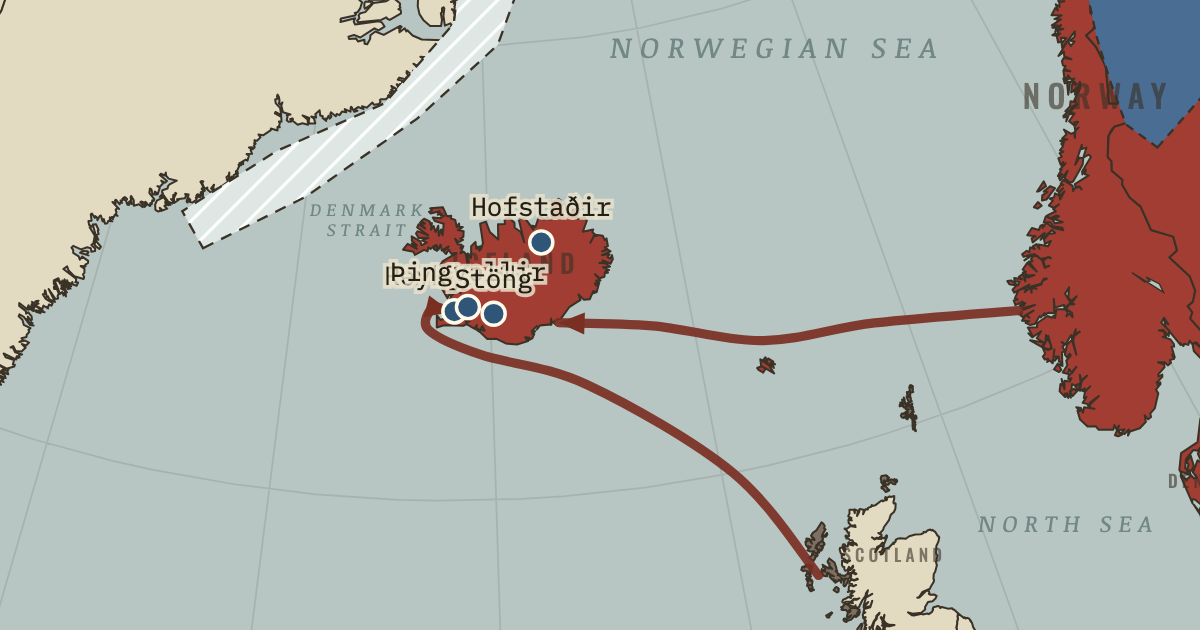
The map above is the world of The Norse North Atlantic, 930 — The Althing; Normandy granted; York English again.
Part of IB History: The Norse and the Aztecs →
BRIEF EXPLANATION — THE ESSENTIAL ARGUMENT
Iceland shows both sides of Norse innovation at once, because its settlers invented a remarkably durable way of governing themselves while farming the land in a way the land could not sustain. When Norse settlers began arriving in the 870s, the island was empty of people and covered, according to the twelfth-century scholar Ari Þorgilsson, with woodland “between fell and fore-shore”. Within about sixty years a period Icelanders call the landnám, the land-taking, a rush to claim farms much like a modern gold rush, had claimed every usable valley. The settlers brought sheep, cattle and barley from Norway, and they brought people from the Gaelic lands of Ireland and Scotland too, many of them enslaved, whose descendants make up a large share of Iceland’s ancestry. On the map, Iceland turns red by 930, and the two arrows show the routes from Norway and from the Gaelic west. Within two generations an empty island had become a crowded farming society.
The island’s great institutional innovation was the Althing, an open-air assembly founded in 930 at Þingvellir, where chieftains and farmers met each June to make law and settle disputes. Iceland had no king, no army and no tax collectors, so the Althing worked much like a modern national parliament combined with a supreme court, holding the country together through agreed procedure. Its strength showed in 999 or 1000, when it adopted Christianity by agreeing to accept one respected man’s ruling, as parties to a modern dispute accept an arbitrator, and so avoided civil war. The farming system proved less wise, because grazing animals stopped the birch woods from growing back and the thin volcanic soils began to blow away. Iceland therefore survived through its law while it lost its forests, and that contrast between a sound institution and a fragile land runs through the whole Norse story.
The full story
The settlement of Iceland was a planned migration of farmers, and its scale is now measurable from several directions. Landnámabók, the Book of Settlements, names nearly 400 leading settlers and about 1,400 places, and population geneticists estimate that some 8,000–16,000 people arrived in all. Ancient genomes, DNA read from the skeletons of the first settlers much as a modern ancestry test reads a living person’s, studied by Sunna Ebenesersdóttir’s team in 2018, show that the settlers were on average only about 57 percent Norse in ancestry, with most of the rest Gaelic, and earlier studies found that more than 60 percent of female lineages came from Ireland and Scotland. Many of these women and men came as slaves taken in raids, which means that the Gaelic west supplied much of the labour that built the new farms. The colony was therefore a Norse society with a mixed people at its foundation.
The settlers farmed as they had at home, and the island made them pay for it. Livestock lived on hay cut in summer and stored for winters that could last seven months, so every farm needed meadows, and barley grew only in the milder south and west. Birch woodland covered perhaps a quarter to two-fifths of the land when the settlers arrived, but cutting for fuel and building, and above all grazing by sheep that ate the seedlings, left less than 1 percent by the twentieth century. Without roots to hold it, the light volcanic soil was stripped by wind and water, and about 20,000 square kilometres of soil cover have probably eroded since settlement. Volcanoes added sudden shocks, as the volcano Hekla did around 1104 when its pumice buried the valley of Þjórsárdalur, so the Icelanders lived with a land that could change suddenly and that degraded slowly.
The Althing, Iceland’s national assembly, was the answer to a different problem, which was how to keep peace among armed farmers who acknowledged no king. Each June the chieftains, called goðar, who were part local lords and part elected representatives, much like the bosses of modern political parties, met at Þingvellir with their followers for about two weeks. There were 36 chieftaincies at first and 39 after a reform around 965, which also created four regional courts, one for each quarter of the island, and around 1005 a Fifth Court heard appeals. The lawspeaker, an elected official, recited one third of the law from memory every summer until the law was written down in 1117–18. Iceland therefore had procedure without enforcement, since victorious litigants had to carry out judgments themselves, and the system lasted for more than three centuries before civil war ended it in 1262–64.
DEEP EXPLANATION — EVIDENCE & INTERPRETATION
Dating the land-taking
Three independent kinds of evidence date the settlement of Iceland, and their agreement is one of the triumphs of North Atlantic research. The written tradition comes from Ari Þorgilsson’s Íslendingabók, composed in the 1120s, and from Landnámabók, which survives in thirteenth-century versions and gives the first settler, Ingólfr Arnarson, the year 874. A layer of volcanic ash known as the Landnám tephra lies just beneath the earliest turf walls across much of the island, and its fragments appear in the Greenland ice cores, which date it to 871 plus or minus two years on Karl Grönvold’s 1995 reckoning or 877 on the revised timescale used by Magdalena Schmid in 2017. Pollen cores show birch pollen falling and grass and cereal pollen rising just above that layer. A few archaeologists argue for earlier visits, citing turf structures that may predate the ash, but the three records together place the main land-taking in the decades after the 870s. Written tradition, volcanic ash and pollen were produced in completely different ways, which is exactly why their agreement is persuasive.
What the genomes reveal about the settlers
Genetics has rewritten the story that Icelandic tradition told about itself, because the sagas mostly name Norwegian chieftains while the bones and DNA show a far more mixed population. Agnar Helgason’s 2001 study of mitochondrial DNA, which passes from mother to child, estimated that about 62.5 percent of Iceland’s founding female lineages were Gaelic. Sunna Ebenesersdóttir’s 2018 study of 27 ancient genomes put the average Norse ancestry of the first settlers at about 57 percent, with a wide uncertainty of 43–70 percent, against about 70 percent in Icelanders today. The authors suggest that people of Norse ancestry had more surviving children, which fits the written evidence that many Gaels arrived as slaves with fewer chances to marry and raise families. The genomes therefore give a voice to settlers whom the literary sources barely mention, and they show that the Norse expansion was also a forced migration. For an inquiry into innovation, the lesson is that the labour behind a new society often belongs to people its own histories leave out.
Deforestation and erosion: a debate about blame
The loss of Iceland’s woodland and soil is certain, and the debate concerns how far the settlers can be blamed for it. The Icelandic Forest Service estimates that birch covered 25–40 percent of the island at settlement, and studies of soil layers show erosion accelerating after the land-taking. Andrew Dugmore and colleagues stress that the settlers brought a farming system from Norway, where deeper soils and denser forests recovered from grazing, and that they had no way to know how slowly Iceland’s volcanic soils and birch would regrow. Climate added pressure after 1300, when colder summers shortened the growing season and barley cultivation contracted. Ólafur Arnalds has shown that the worst erosion runs across the highland margins, where grazing persisted longest. The fairest reading is that a reasonable system, transplanted without local knowledge, produced damage that nobody intended and that no institution of the time was designed to prevent. The Althing could settle a quarrel over a meadow, but no assembly managed the soil of the whole island.
Key places on the map
Why it happened
An empty island within reach of the ships. Iceland lies about 970 kilometres west of Norway but only about 450 from the Faroe Islands, which Norse settlers had already reached, so the ship technology of Chapter 2 made the crossing practical. Irish hermits may have visited before the Norse, but no settled population existed, so newcomers could claim land without conquest. That emptiness made Iceland the first true Norse colony, a society built from scratch on land that no other people held.
Land hunger and politics in Norway. Later Icelandic writers explained the migration as flight from the tyranny of Harald Fairhair, who united much of Norway in the late ninth century. Historians treat that story with caution, because it flattered the settlers’ descendants, but scarce farmland and the growing power of kings do seem to have pushed ambitious families outward. Iceland offered the chance to be a chieftain answerable to no one, and the earliest settlers claimed vast estates that they later divided among followers and kin.
Captives from the Gaelic west. Norse raiding in Ireland and Scotland produced captives, and the settlers took many of them to Iceland as slaves to clear land, herd animals and weave cloth. The genomes show how large this element was. Without forced labour from the Gaelic world, the rapid clearing of a whole island within about sixty years would have been much slower, so violence abroad was built into the foundations of the new society.
The need for law without a king. Settlers who had left Norway partly to escape royal power still needed a way to settle quarrels over land, livestock and killings, which otherwise led to blood feuds that could destroy families. The answer was to borrow the Norwegian tradition of regional assemblies, called things, and to create one assembly for the whole island. The Althing grew out of this practical need for order among equals, and it was designed so that no single chieftain could dominate it.
THE TURNING POINT
Þingvellir, 930 — and the decision of 999/1000. The founding of the Althing at Þingvellir in 930 is the hinge because it gave a scattered population of farmers a single place and procedure for resolving conflict. Its value was tested around the year 1000, when Christian and pagan factions threatened civil war. Both sides agreed to let the lawspeaker Þorgeir decide, and after a day and a night under his cloak he ruled that all Icelanders should be baptised while some pagan practices might continue in private. A society without a king had found a way to make an enormous decision peacefully.
What it changed
A springboard further west. Iceland became the base for the next voyages. Erik the Red, outlawed from Norway and then from Iceland for killings, sailed west in the early 980s and returned with plans for a new colony. Chapter 4 follows the fleet that left Iceland for Greenland in 985 or 986. Each new colony was founded by people who had lost out in the last one, so the frontier kept moving west.
A durable legal culture. The Althing sat almost every summer until 1798 and was revived in the nineteenth century, and Icelanders call it one of the oldest parliaments in the world. The tradition of law recited and later written in the Grágás law codes gave Iceland a sense of identity that outlasted its independence, which ended when the chieftains accepted the Norwegian crown in 1262–64.
An environment slowly degraded. The loss of woodland meant that Icelanders soon lacked timber for houses and ships and relied on driftwood and imports. Erosion reduced the grazing land just as the climate cooled after 1300. Iceland survived, unlike Norse Greenland, but it became poorer and more dependent on trade with Norway, and that slow pressure on a farming society frames the colder centuries of Chapter 5.
DISCUSSION QUESTION — Was the Althing a successful innovation if Iceland still fell into civil war and lost its independence in 1262–64?
Judged over three centuries, the Althing succeeded remarkably well. It resolved disputes among armed chieftains for more than 300 years without a king, an army or taxes, and its peaceful adoption of Christianity in 999 or 1000 shows that it could manage even a decision that divided society. Its weakness was the absence of enforcement, since winners of lawsuits had to carry out judgments with their own followers. As wealth and power concentrated in a few great families in the thirteenth century, those families fought the civil wars of the Sturlung Age and finally accepted the Norwegian king. The Althing’s failure was therefore a failure to adapt to changing inequality, which no medieval assembly anywhere had solved, and the institution itself survived as a symbol and later as a parliament. The transferable insight is that institutions which depend on rough equality among participants become fragile when that equality disappears.
An interesting fact
When the first settlers reached Iceland, the only land mammal living there was the arctic fox, which had probably crossed on sea ice at the end of the last Ice Age. Every sheep, cow, horse, goat, pig, dog and cat on the island arrived in Norse ships, and mice came with them as stowaways. The settlers’ animals therefore met plants that had never been grazed by anything larger than a goose, which helps explain why the birch woods and thin volcanic soils gave way so quickly once the farms were built.
Related
THE FREE PRINTABLE STUDY GUIDE
Join the Dispatch — a short welcome series, then a letter when a new atlas opens — and the printable study guide for Climate and Innovation is yours now, free.
NO TRACKING · YOUR ADDRESS IS USED FOR THE DISPATCH AND NOTHING ELSE · UNSUBSCRIBE ANYTIME