Mao’s China · 1967
Was the Cultural Revolution from below or from above?
The seminar question: “Was the Cultural Revolution a revolution from below or a purge directed from above?”
In 1966 Mao launched the Cultural Revolution against Communist Party leaders he accused of revisionism. Red Guards, reviewed at Beijing rallies of about twelve million in all, attacked the “Four Olds” and beat teachers and officials, and by July 1967, as the Wuhan Incident showed, the army had been drawn in.
Chapter 9 is part of membership. WW2 is free — every chapter. Try chapters 1–2 of any 2 other atlases (3 with a free account). Opening a new atlas uses one of them. Membership opens all 21 — Join.
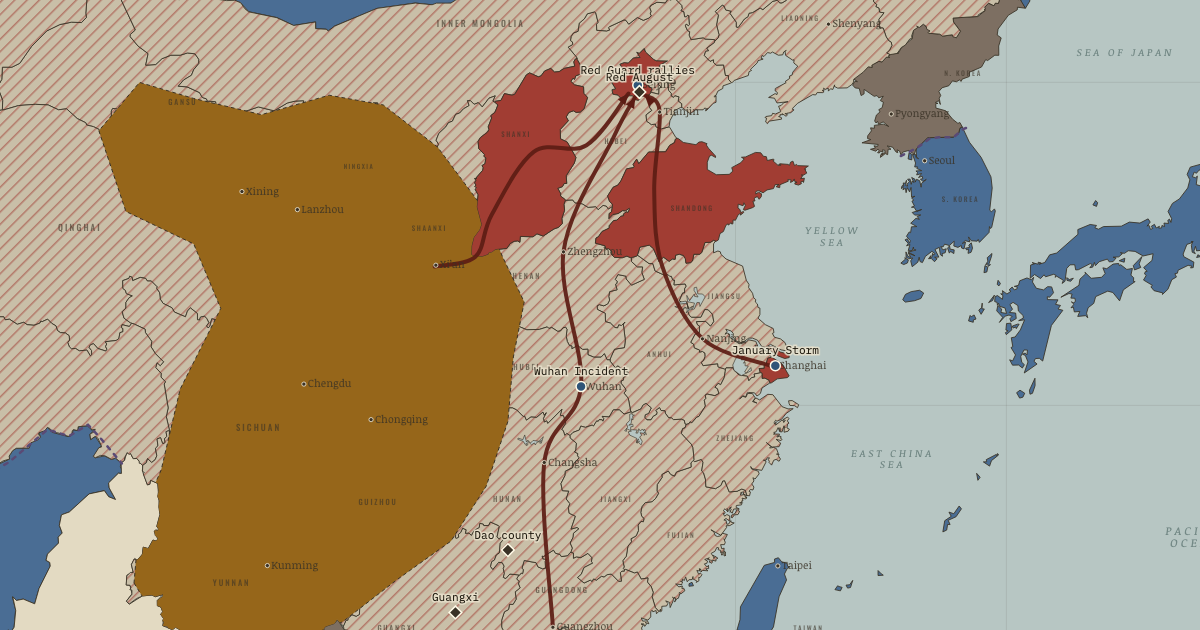
Mao launched the Cultural Revolution, his movement to purge officials he called “revisionists” and to remake Chinese culture, by going around the Communist Party, the single ruling party, which he chaired. In November 1965 a Shanghai critic attacked a play by Beijing’s deputy mayor that Mao read as a veiled defence of his critics, and by May 1966 the capital’s leaders had been purged. A Central Cultural Revolution Group now directed the campaign: a small committee that answered to Mao, bypassed the Party’s normal leadership and included his wife Jiang Qing. On 25 May a lecturer’s poster at Peking University attacked its leaders, and Mao had it broadcast nationally. Liu Shaoqi and Deng Xiaoping sent work teams to contain the students, and Mao condemned them. His own poster of 5 August, “Bombard the Headquarters”, told the country that the enemy sat in the Party’s leadership. At the first great rally on 18 August he wore the armband of the Red Guards, student fighting groups much like a youth militia sworn to him. The highest authority in the land had licensed rebellion against every other authority.
The short answer
- Mao’s fear of a Chinese Khrushchev. After the famine Mao believed that Liu Shaoqi and Deng Xiaoping were running the country without him and leading it towards capitalism, much as he thought Khrushchev had done in the Soviet Union. The Socialist Education Movement had not removed them, because they controlled the Party machine that ran it. Mao concluded that only a movement from outside the Party, mobilising the young and backed by the army, could purge “those in authority taking the capitalist road”.
- A generation raised on the cult. Students in 1966 had grown up with Lei Feng, the Little Red Book and lessons that taught loyalty to Mao above family and teachers. They also faced shrinking chances of university places and city jobs, and in June 1966 the university entrance examinations were suspended altogether. When Mao told them that rebellion was justified, they had both the faith and the frustration to take him at his word. Teachers, who stood for the examinations and the order that had judged them, became the first targets.
- Grievances waiting for a target. Seventeen years of campaigns had left many people with grievances: families stigmatised by class labels, workers on insecure temporary contracts, victims of earlier purges and students resentful of privileged classmates. The Cultural Revolution gave them, briefly, the right to attack those in authority. Rebel factions drew on these grievances, which is one reason the movement spread so fast and proved so hard to control. Each faction’s enemies were often personal and local, so the national campaign broke into thousands of separate feuds.
- An army ordered to take sides. Mao ordered the army in January 1967 to “support the left” in the power seizures, but nobody could agree who the left was. Regional commanders backed the factions that suited them, and rival groups armed themselves from military depots. A campaign that began with posters and meetings therefore became a series of armed conflicts in which machine guns and even artillery were used in some cities. Once soldiers took sides, the only force that could end the fighting was a decision by Mao about which side the army should back.
THE TURNING POINT
Wuhan, 20 July 1967. The Wuhan Incident was the hinge because it showed Mao that his revolution could split the army, the one institution he could not afford to lose. Troops and the mass organisation “Million Heroes” seized two envoys from Beijing while Mao himself was in the city; he had to be flown out to Shanghai. Mao removed the regional commander, but he also drew back. Within weeks the most radical members of the Cultural Revolution Group were arrested, the army became the arbiter of every province, and the drive to form revolutionary committees accelerated. From this point the Cultural Revolution turned from rebellion to the restoration of order by force.
What it changed
The army becomes the government. Military officers dominated the revolutionary committees, and by 1969 nearly half the Central Committee wore uniform. The army ran factories, schools and ministries, and its leader, Lin Biao, was named Mao’s successor. The cost of ending the chaos was a militarised state, in which political work teams of soldiers and workers took over universities and the army’s methods became the model for civilian life.
The young sent away. Once the Red Guards had done their work, Mao dispersed them. From December 1968 millions of urban school leavers were sent “up to the mountains and down to the villages” to learn from the peasants, removing the movement’s shock troops from the cities and easing urban unemployment at the same time. About seventeen million young people were sent down by 1980, and for most of them the rebellion ended in a village.
Liu Shaoqi and Deng Xiaoping destroyed. Liu Shaoqi was expelled from the Party in October 1968 as a “renegade, traitor and scab” and died in custody in Kaifeng in November 1969, denied proper medical care. Deng Xiaoping was sent to work in a tractor plant in Jiangxi, and his son was crippled after a fall while held by Red Guards. Deng’s survival would shape China after Mao.
Schools closed, heritage destroyed. Secondary schools and universities stopped normal teaching in 1966, and the university entrance examination did not return until 1977. Temples, libraries, graves and private collections were destroyed in the attack on the Four Olds. China lost a decade of trained graduates and a large part of its material past. The reformers of the 1980s had to rebuild universities, research institutes and professions almost from the beginning.
The full answer, argued
It was launched from above and became, for a time, a rebellion from below, before ending in repression from above again. Mao chose the targets, licensed the Red Guards, called for power seizures and decided when to end the movement, so the initiative was his throughout. Yet millions joined for their own reasons: students angry at privilege, workers with insecure contracts, families stigmatised by class labels, and officials settling scores, and the research of Perry and Li Xun and of Yiching Wu shows rebels pursuing real grievances. Walder’s work adds a crucial point about the violence, since most deaths were caused by the authorities, militias and army-backed committees in 1968–71, while the rebels’ battles killed fewer. MacFarquhar and Schoenhals emphasise the leader; social historians emphasise the society that responded. A balanced judgement is that Mao opened the door and decided when to close it, while what happened in between depended on millions of local choices. The case shows how authoritarian leaders can mobilise popular anger and how quickly the state reclaims it.
An interesting fact
Mao announced his return to politics in July 1966 with a swim. On 16 July, aged 72, he floated down the Yangtze at Wuhan, and the state news agency reported that he had covered nearly 15 kilometres in 65 minutes, a speed faster than any world record of the time; the current did most of the work. Photographs of the swimming chairman filled the newspapers, and the anniversary of the swim was celebrated with mass swims for years afterwards. The message was political, since two days later Mao was back in Beijing to condemn the work teams.
This is the study layer of Cultural Revolution, chapter 9 of The People’s Republic under Mao, 1949–1976; the full index of the atlas is here.
Related questions
THE FREE PRINTABLE STUDY GUIDE
Join the Dispatch — a short welcome series, then a letter when a new atlas opens — and the printable study guide for The People’s Republic under Mao is yours now, free.
NO TRACKING · YOUR ADDRESS IS USED FOR THE DISPATCH AND NOTHING ELSE · UNSUBSCRIBE ANYTIME