Norse and Aztecs · 1500
Did the Norse or the Aztecs respond better to climate?
The seminar question: “Which society’s response to its environment was more successful, and by what standard should success be judged?”
The Norse met a cold, scattered environment with mobility: ships, seasonal hunting, trade and assemblies. The Mexica met a rich but closed lake basin with concentration: dikes, aqueducts, raised fields and a tribute empire feeding perhaps 200,000 people. Norse Greenland, of perhaps 2,000–2,500 people, had no reserves.
Chapter 12 is part of membership. WW2 is free — every chapter. Try chapters 1–2 of any 2 other atlases (3 with a free account). Opening a new atlas uses one of them. Membership opens all 21 — Join.
Free printable Norse and Aztecs study guide, sent by email ↓
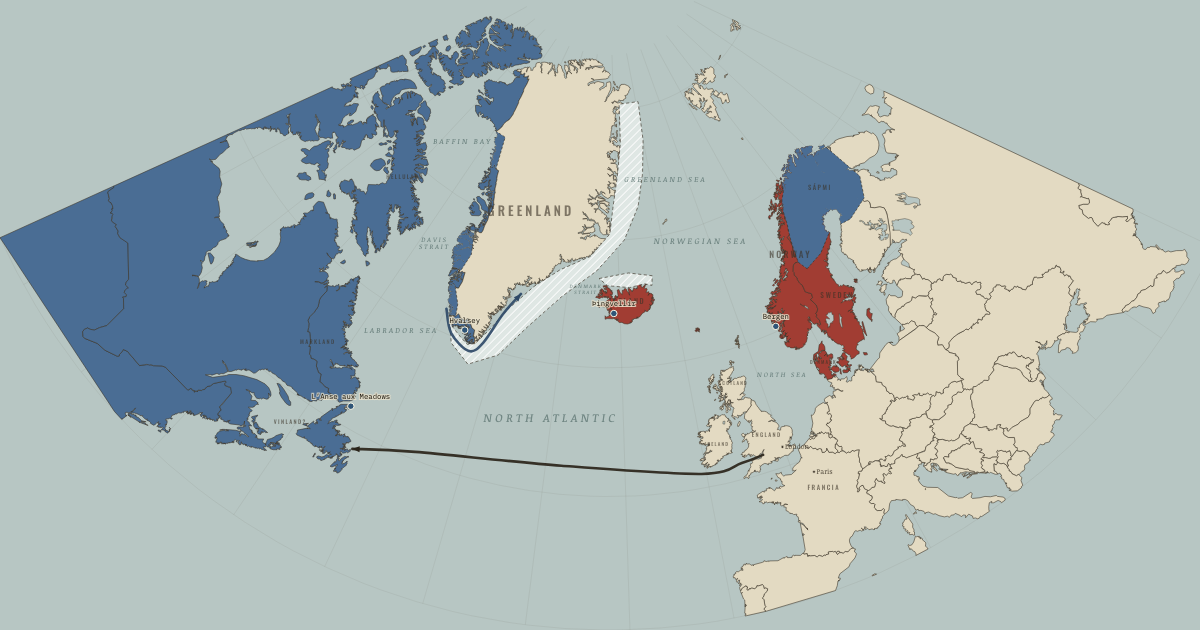
The inquiry question, how societies innovate to live with a demanding climate, shows that climate mattered in both cases, but in different ways. For the Norse, climate set the stage, since the warmth of about 950–1250 made Greenland’s fjords farmable and the cooling and drying after about 1275–1300 narrowed the margin again. For the Mexica, climate brought sudden shocks inside a stable pattern: the floods of 1449 and 1499, the frosts and drought of 1450–54 confirmed by tree rings, and a long drought from 1514 to 1539 that overlapped the conquest. The Norse met slow change with gradual adaptation, eating seals and shifting trade, until leaving made more sense. The Mexica met sudden shocks with engineering, storage and conquest of warmer lands. Each society answered the climate it actually faced.
The short answer
- Different environments demanded different answers. The North Atlantic offered scattered pockets of grass and rich seas separated by dangerous water, which rewarded mobility, ships and trade. The Basin of Mexico offered a concentrated, fertile lake system in a closed valley, which rewarded engineering and the organisation of labour. Each society’s innovations fitted the opportunities its environment offered, which is why their systems look so different despite facing the same underlying problem of a demanding climate.
- Scale shaped resilience. The Norse colony in Greenland held a few thousand people at most, while the Basin of Mexico held more than a million, a difference of several hundred times. Scale decided how much labour could be mobilised, how much food could be stored and how many losses could be absorbed. It explains why the Mexica could build dikes and survive famine and why the Norse colony had so little margin when its pressures combined.
- Single points of failure decided both endings. Norse Greenland depended on one export, walrus ivory, and one link to Europe, the ships from Bergen, so their decline left the colony with no fallback. Tenochtitlan depended on causeways, an aqueduct and canoe supply across one lake, which a besieger could cut. In both cases the end came where the system concentrated its dependence, which is the strongest common lesson of the comparison and the hardest to see while a system is succeeding.
- Other peoples with different systems replaced both. In Greenland the Thule Inuit, with technology built for sea ice, expanded as the Norse withdrew, and in Mexico Spanish colonists, with their own diseases, livestock and engineering, replaced the Mexica state. In both cases a different system took over the same environment, one adapting to it and one attempting to remake it, which shows that an environment sets the price of each way of life and leaves the choice to the people living in it.
THE TURNING POINT
Hvalsey and Tenochtitlan: two kinds of ending. The silent ruin of Hvalsey church and the drained lake beneath Mexico City are the two endpoints of this atlas, and placing them side by side is the hinge of the comparison. Norse Greenland ended in a quiet withdrawal, with a church left standing and farms abandoned in order, because a small society concluded that the costs of staying outweighed the gains. Tenochtitlan ended in a siege, and its lake system was then dismantled by new rulers with other priorities. One system faded through smallness and distance; the other was broken through its concentration and remade by conquerors.
What it changed
Greenland becomes an Inuit land, then a Danish colony. Inuit communities spread along Greenland’s west and south coasts by about 1500. Danish colonisation began in the eighteenth century and shaped the island for two hundred years. Greenland’s colonial status ended in 1953, Home Rule followed in 1979 and Self-Government in 2009. The Norse ruins became a focus of national and scholarly memory, and in 2017 the farming landscape of Kujataa, including Hvalsey, joined the World Heritage list.
The lake becomes a sinking city. Mexico City grew on the bed of the drained lake into one of the world’s largest cities, and it still faces both flooding and subsidence, sinking by up to about 50 centimetres a year where the compressible lake clay is thickest, as groundwater is pumped from beneath it. The Mexica problem of living with water in a closed basin remains the city’s central environmental challenge five centuries later.
A question for the present. The inquiry this atlas has followed, how societies innovate to live with a demanding climate and why some innovations last, has become a question for every society facing climate change. The two cases suggest that lasting adaptation depends on spreading risk across resources, places and people, and on institutions able to change as conditions change, which is a historical argument that students can test against the sources in this atlas.
The full answer, argued
The answer depends on the standard chosen, and stating that standard explicitly is the key to a strong answer. Judged by scale and achievement, the Mexica were far more successful, since their dikes, aqueducts, chinampas and tribute fed a city of perhaps 200,000 and survived famine and flood, while Norse Greenland never exceeded a few thousand people and was abandoned. Judged by longevity, Norse Greenland lasted about 450 years, longer than the Mexica empire’s century of dominance after 1428, and Iceland endures today. Judged by the survival of innovations, both left lasting techniques, the clinker ship, the stockfish trade and the Althing from the Norse, and the chinampas from the Mexica. Neither society was undone by climate alone, since the Norse faced compounding economic pressures and the Mexica a coalition of enemies and an epidemic. The transferable insight is that success in adapting to the environment must be measured over time and against all the shocks a society faces, human as well as natural.
An interesting fact
Europeans rediscovered Greenland while looking for people who were no longer there. In 1721 the Norwegian priest Hans Egede sailed from Bergen to Greenland, hoping to find descendants of the medieval Norse settlers and bring them into the Lutheran church, since nobody in Scandinavia knew whether they had survived. He found only Inuit, learned their language and stayed to work among them. His first mission stood on a small island, and in 1728 the colony moved to the mainland under the governor Claus Paarss as Godthåb, today’s Nuuk, the capital of Greenland. A mission to the vanished Norse became the beginning of Danish rule over the Inuit who had replaced them.
This is the study layer of Norse and Aztecs compared, chapter 12 of Climate and Innovation: The Norse and the Aztecs, c. 790–1521; the full index of the atlas is here.
Related questions
THE FREE PRINTABLE STUDY GUIDE
Join the Dispatch — a short welcome series, then a letter when a new atlas opens — and the printable study guide for Climate and Innovation is yours now, free.
NO TRACKING · YOUR ADDRESS IS USED FOR THE DISPATCH AND NOTHING ELSE · UNSUBSCRIBE ANYTIME