Industrial Revolution · 1913
Why did Germany lead the Second Industrial Revolution?
The seminar question: “Why did Germany, and not Britain, lead the second industrial revolution?”
After 1870 steel, chemicals, electricity and the internal combustion engine created a second industrial revolution led by science, big business and Germany. The basic process of 1878 made Lorraine’s phosphoric ores usable, German steel output passed Britain’s in about 1893, and BASF, Bayer, Siemens and AEG led new industries.
Chapter 8 is part of membership. WW2 is free — every chapter. Try chapters 1–2 of any 2 other atlases (3 with a free account). Opening a new atlas uses one of them. Membership opens all 21 — Join.
Free printable Industrial Revolution study guide, sent by email ↓
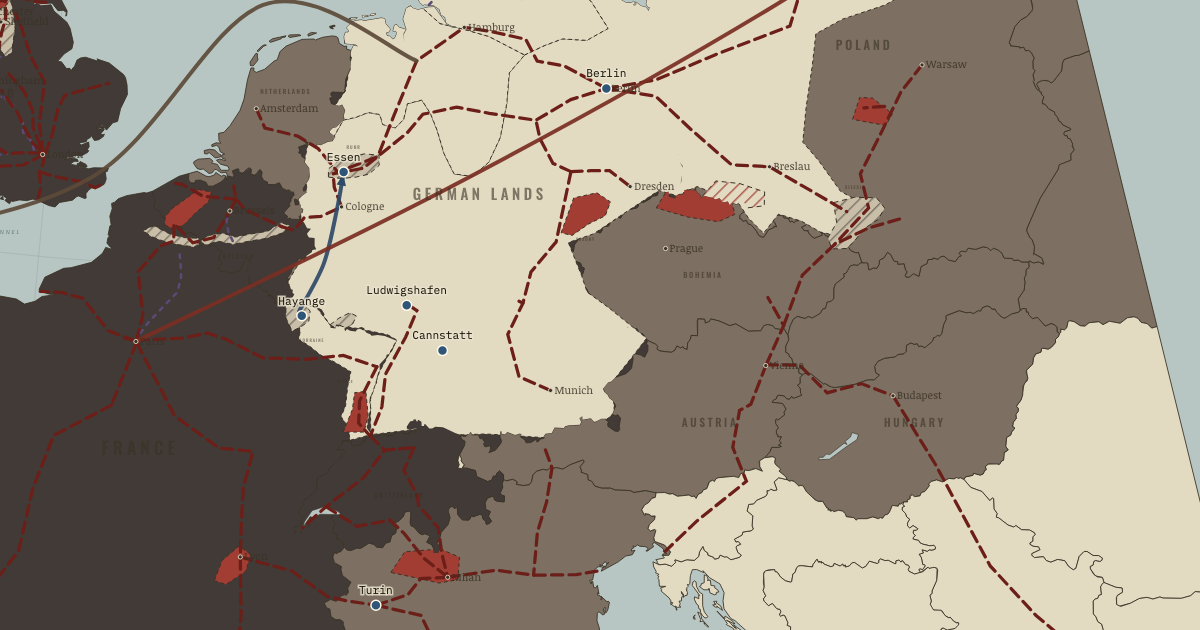
Steel was the material of the second industrial revolution, and its story shows how new processes redrew the industrial map. The English inventor Henry Bessemer’s converter of 1856 blew air through molten iron to make steel cheaply, and the Siemens–Martin open-hearth furnace of the 1860s made it in larger, more controllable batches, yet both failed with iron ore containing phosphorus, which made the steel brittle. In 1878 two cousins solved the problem: Sidney Gilchrist Thomas, a London police-court clerk who studied chemistry in his spare time, and Percy Gilchrist, chemist at the Blaenavon ironworks in Wales, lined the converter with limestone, which absorbed the phosphorus. Their basic process, named for its chemically basic, or alkaline, lining, turned the phosphoric ores of Lorraine, much of it annexed by Germany in 1871, into Europe’s largest ore field, worked by firms such as the de Wendel family’s ironworks at Hayange. The arrow carries Lorraine ore north to the coal of the Ruhr, where the steelmaker Krupp of Essen employed about 70,000 people by 1912, and German steel output passed Britain’s in about 1893. Ore from one region, coal from another and a chemical discovery tested in Wales together made Germany Europe’s steel power.
The short answer
- Science became a source of invention. Science had begun to outrun the workshop: by the 1860s chemistry and physics had produced knowledge, such as the structure of carbon-based molecules and the laws of electromagnetism, that practical tinkering alone could not reach. Firms that employed university-trained researchers, such as BASF, Bayer and Siemens, turned that knowledge into products: synthetic dyes, drugs, the electric generators called dynamos, and electric light. Invention moved from the workshop into the laboratory, and Germany, with more universities and technical colleges than any rival, gained most from the shift.
- Cheap steel replaced iron. The English inventor Henry Bessemer’s converter of 1856, which blew air through molten iron, the open-hearth furnace of the 1860s, which made steel in larger batches, and the basic process of 1878, which could use iron ore rich in phosphorus, cut the price of steel so far that it replaced iron in rails, ships, bridges and machines. Steel rails lasted many times longer than iron ones, and steel ships were lighter and larger. Countries with coal and the right ores, above all Germany and the United States, built the largest steel industries, so geology helped decide which nations would lead heavy industry.
- Unification, tariffs and banks. The German Empire of 1871 combined the market of the Zollverein, the German customs union of 1834, with a single currency, a dense railway network run by the individual states, and the coal and ore of the Ruhr and Lorraine. From 1879 the chancellor Otto von Bismarck’s tariffs protected German industry and agriculture, and the great banks financed mergers and cartels, agreements among firms to fix prices or output. Large, protected, well-financed firms could invest in research and in plants bigger than any in Britain, although critics then and since argue that they also fixed prices at consumers’ expense.
- Followers started with the newest technology. Late industrialisers built their steelworks and power stations with the latest designs, while Britain’s older industries still used machinery and methods from the 1850s. The American economist Thorstein Veblen called this the penalty of taking the lead. Followers also had larger or faster-growing populations, so catching up with Britain, and then passing it in total output, was partly a matter of arithmetic. Being first carried costs as well as advantages.
THE TURNING POINT
The basic process reaches Lorraine, 1878–79. The basic process is the hinge because one chemical change redrew the heavy-industrial map of Europe. It took its name from a chemically basic, or alkaline, furnace lining of burnt dolomite that drew phosphorus, the impurity that made steel brittle, out of molten iron, and was worked out in 1878 by the amateur chemist Sidney Gilchrist Thomas, a London police-court clerk, and his cousin Percy Gilchrist, a works chemist in Wales. Before the process was proved at Middlesbrough in 1879, the phosphoric ores of Lorraine were almost useless for steel; afterwards they became Europe’s largest source of iron ore, and Germany had annexed much of the field in 1871. Ruhr coal and Lorraine ore together built German steel, which passed Britain’s output in about 1893. A laboratory result had made a borderland enormously valuable, which sharpened Franco-German rivalry for decades.
What it changed
An arms race of steel and chemistry. Steel and chemistry made the weapons of the twentieth century: the arms maker Krupp’s guns, steel battleships and explosives made from nitrogen captured from the air. The Haber–Bosch process, which turned that nitrogen into ammonia, freed Germany from imported Chilean nitrate, a nitrogen-rich mineral, and so later let it keep making explosives despite the British blockade of the First World War. Navies and armies now competed through their countries’ factories, so industrial power had become military power.
Commodity frontiers move. Synthetic indigo, a factory-made blue dye, ruined indigo planting in Bengal and Bihar in India, and nitrogen captured from the air would later undermine Chile’s exports of mined nitrate fertiliser, while demand for rubber, copper and oil for the electrical and motor industries drew new regions into the world economy, often by force. Historians call such zones of extraction commodity frontiers, and they ran from the Congo to Persia, today Iran. A discovery in a European laboratory could now make or break an economy on the other side of the world.
America takes the lead. The United States applied the new technologies on a continental scale, with the largest steel industry, the first great electric power systems and mass-produced cars. By 1913 it made about a third of the world’s manufactured goods, more than Germany and Britain combined, and firms such as Carnegie Steel and General Electric matched the German giants in scale. In the new industries, the size of a country’s market had become as important as being first.
The full answer, argued
Three kinds of explanation compete for attention. The first stresses German strengths: universities and technical colleges that trained chemists and engineers by the thousand, banks that financed huge plants, a protected and growing market after 1871, and the coal and ore of the Ruhr and Lorraine. The second stresses British weaknesses, in the tradition of the historians David Landes and Martin Wiener: family firms content with old methods, an education system that prized Latin and Greek, and capital that flowed abroad. The third, argued by the economic historian Deirdre McCloskey and others, doubts that Britain failed at all, since British firms often chose rationally to keep profitable older technologies, and a larger, later starter was bound to catch up. The evidence supports a mixture of all three. In science-based industries such as dyes, Germany’s institutions gave it a real advantage, while in steel and cotton the gap mainly reflected differences in resources, markets and timing. The institutions that win one technological era are seldom the ones best suited to the next.
An interesting fact
The modern electric grid was first shown to the public at a trade fair. In August 1891 visitors to the International Electrotechnical Exhibition in Frankfurt saw a thousand electric lamps and an artificial waterfall powered by electricity generated 175 kilometres away, at a cement works beside the River Neckar at Lauffen. Engineers from the German electrical firm AEG and the Swiss firm Oerlikon, among them Mikhail Dolivo-Dobrovolsky and Charles Brown, sent the power along overhead wires using a new system, three-phase alternating current, in which three linked currents rise and fall in turn, at high voltage. The demonstration settled a fierce argument over how to transmit electricity over long distances, and the same system still carries power in almost every grid on earth.
This is the study layer of Second Industrial Revolution, chapter 8 of The Industrial Revolution, 1750–1914; the full index of the atlas is here.
Related questions
THE FREE PRINTABLE STUDY GUIDE
Join the Dispatch — a short welcome series, then a letter when a new atlas opens — and the printable study guide for The Industrial Revolution is yours now, free.
NO TRACKING · YOUR ADDRESS IS USED FOR THE DISPATCH AND NOTHING ELSE · UNSUBSCRIBE ANYTIME