Decolonization of Africa · APR 1980
Why did settler rule last so long in southern Africa?
The seminar question: “Why did settler rule in southern Africa survive decades longer than colonialism elsewhere — and what combination of pressures finally ended it?”
Rhodesia’s white settlers declared independence unilaterally in 1965 and held out for fifteen years, until the 1979 Lancaster House settlement brought majority rule to Zimbabwe in 1980. In South African-occupied Namibia, the 1987–88 battle of Cuito Cuanavale led to talks linking Cuban withdrawal to Namibian independence.
Chapter 9 is part of membership. WW2 is free — every chapter. Try chapters 1–2 of any 2 other atlases (3 with a free account). Opening a new atlas uses one of them. Membership opens all 21 — Join.
Free printable Decolonization of Africa study guide, sent by email ↓
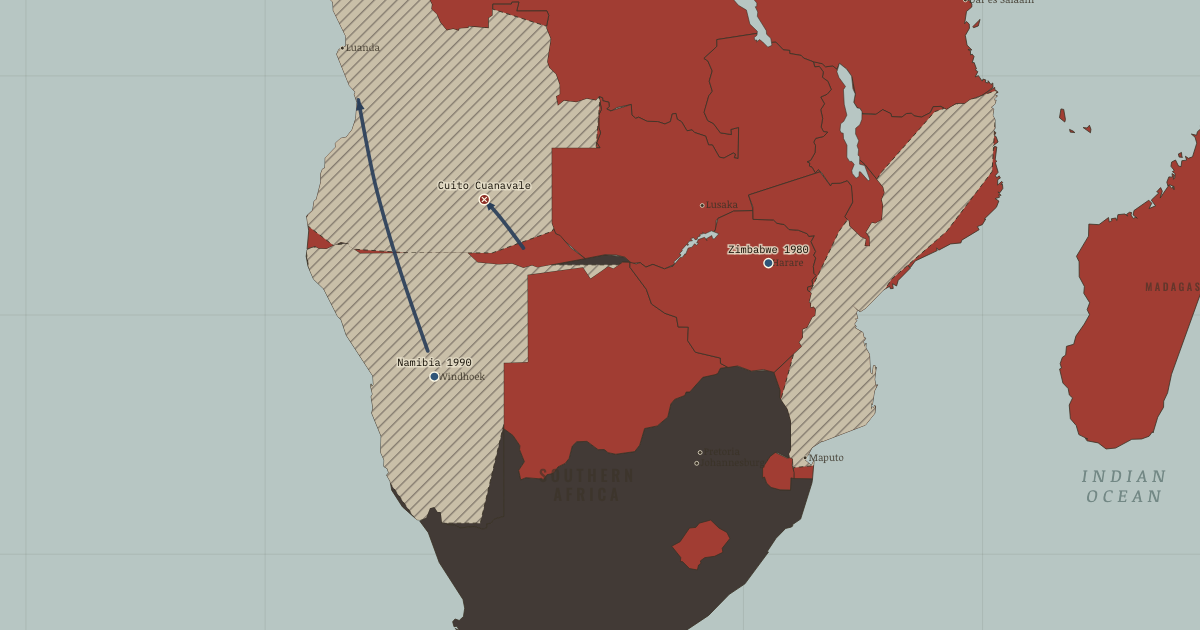
Rhodesia’s settlers could evade sanctions as long as they had friendly neighbours, routing trade through South Africa and through Portuguese Mozambique, which is why economic pressure alone did so little for so long. When Mozambique became independent and hostile in 1975, both the guerrilla war and the isolation grew much harder to contain. The Lancaster House agreement then delivered a ceasefire and one-person-one-vote elections, yet its willing-buyer, willing-seller land clause froze the colonial distribution of land for ten years. It ended the immediate war while postponing the injustice that would detonate in Zimbabwe two decades later.
The short answer
- Settlers with nowhere to go, again. Rhodesia’s quarter-million whites and South Africa’s far larger settler population regarded southern Africa as their only home and controlled its land, mines and government. As in Algeria, this made a negotiated handover almost impossible for decades: majority rule meant, to them, the loss of everything, so they chose defiance, sanctions and war over the compromise that had freed the colonies to the north. The structural logic of settler colonialism. The one this atlas keeps returning to. Reached its extreme here.
- “Kith and kin” and the failure of sanctions. Rhodesia’s 1965 UDI gambled that Britain would not use force against fellow whites (it did not) and that sanctions could be evaded. For fifteen years they were. Through South Africa, through busted embargoes, through Portuguese Mozambique until 1975. Sanctions alone never toppled the regime. What broke it was the guerrilla war plus the loss of its Portuguese buffer, which together made the country ungovernable and its economy unsustainable. A lesson about the limits and the slow cumulative bite of economic pressure.
- Lancaster House: how a settler state is negotiated away. The 1979 settlement is a template worth studying: sustained guerrilla pressure and sanctions brought the white regime to accept majority rule, but the price was constitutional guarantees. Reserved white parliamentary seats for a period, and above all a willing-buyer-willing-seller land clause that froze the colonial land distribution for ten years. It ended the war and enabled a peaceful transfer. It also deferred the explosive land question, which detonated in Zimbabwe two decades later. Negotiated endings trade present peace for deferred problems.
- Cuito Cuanavale: the myth broken. The 1987–88 battle in south-east Angola was the largest in Africa since El Alamein. Its outcome. A bloody stalemate rather than the South African victory Pretoria expected. Is argued by historians as the military hinge of the whole southern endgame: it demonstrated that apartheid’s army was not invincible, strengthened the Cubans’ and Angolans’ negotiating hand, and produced the linkage deal (Cuban withdrawal for Namibian independence) that finally freed Namibia. Whether it was a clear defeat or merely a check, it changed the political arithmetic decisively.
THE TURNING POINT
Cuito Cuanavale, 1987–88 — the hinge. South Africa commits its heaviest armour to crush the Angolan-Cuban forces and is fought to a standstill at a ruined town in the Angolan bush. The myth of white military supremacy. The psychological foundation of the settler redoubt. Does not survive it. Within months the linkage negotiations produce the deal that ends South Africa’s occupation of Namibia. Within two years Namibia is free and Pretoria, its army checked abroad and its economy strangled by sanctions at home, opens the talks that will end apartheid itself. A stalemate in the Angolan mud is the moment the last redoubt begins to fall.
What it changed
Zimbabwe, 1980 — and the deferred reckoning. The former Rhodesia became independent under Mugabe after the Lancaster House settlement. A genuine triumph of the negotiated model, and the birthplace of a land grievance deferred rather than resolved. When the ten-year land clause and the patience behind it expired, the violent seizures of 2000 and the country’s economic collapse followed. The settlement bought a peaceful birth at the cost of an unaddressed injustice. The pattern of negotiated transitions.
Namibia, 1990 — Africa’s last colony. The linkage deal freed Namibia after 75 years of South African rule and 23 years of war. SWAPO’s Sam Nujoma took office in a UN-supervised transition that became a model. On the map, the second-to-last charcoal territory turns red. Only South Africa now remains. And the same forces that freed Namibia, above all the proof that the apartheid state could be checked, are now turned inward.
The noose on Pretoria. By 1990 South Africa stood alone: its buffer states gone, its army bloodied abroad, its economy reeling under sanctions and capital flight, its townships ungovernable at home. The fall of the settler redoubt to its north. Mozambique, Zimbabwe, Namibia. Stripped away every layer of the apartheid state’s defensive glacis and left it facing the reckoning the next two chapters describe.
The full answer, argued
It survived because the settler equation was at its strongest here: large, entrenched white populations who saw the region as their only homeland, controlled its wealth and arms, and would fight rather than concede majority rule. The Algerian dynamic without a metropole to withdraw to. No single pressure was sufficient: sanctions alone were evaded for fifteen years. Guerrilla wars alone could not militarily defeat well-armed states. International isolation alone was tolerable. What ended it was the accumulation and interaction of all of them. Sustained armed struggle that made the countries ungovernable, the collapse of the Portuguese buffer that exposed the redoubt, economic strangulation by sanctions and capital flight, and finally the military check at Cuito Cuanavale that destroyed the myth of white invincibility and shifted the political arithmetic. The transferable lesson is that deeply entrenched minority regimes rarely fall to one clean blow. They fall when military, economic, diplomatic and internal pressures compound over time until the cost of holding on exceeds the cost of letting go. And when the belief in their own invincibility, which is half their strength, is finally broken.
An interesting fact
Bob Marley had released a song called “Zimbabwe” on the 1979 album Survival, and when the real thing arrived he came in person — flying the Wailers and their equipment to Harare at his own expense to play the independence ceremony at Rufaro Stadium on 18 April 1980, the night the new flag first rose. Tear gas, fired at the crowds pressing the stadium gates, drifted over the field and briefly stopped the show; the next day Marley played a second, free concert so the tens of thousands who had been shut out could hear him.
This is the study layer of Rhodesia, Zimbabwe and Namibia, chapter 9 of The Decolonization of Africa, 1945–1994; the full index of the atlas is here.
Related questions
THE FREE PRINTABLE STUDY GUIDE
Join the Dispatch — a short welcome series, then a letter when a new atlas opens — and the printable study guide for The Decolonization of Africa is yours now, free.
NO TRACKING · YOUR ADDRESS IS USED FOR THE DISPATCH AND NOTHING ELSE · UNSUBSCRIBE ANYTIME